




Buy Basic Chromium Sulfate in Pakistan: BCS Price, Wholesale Supply
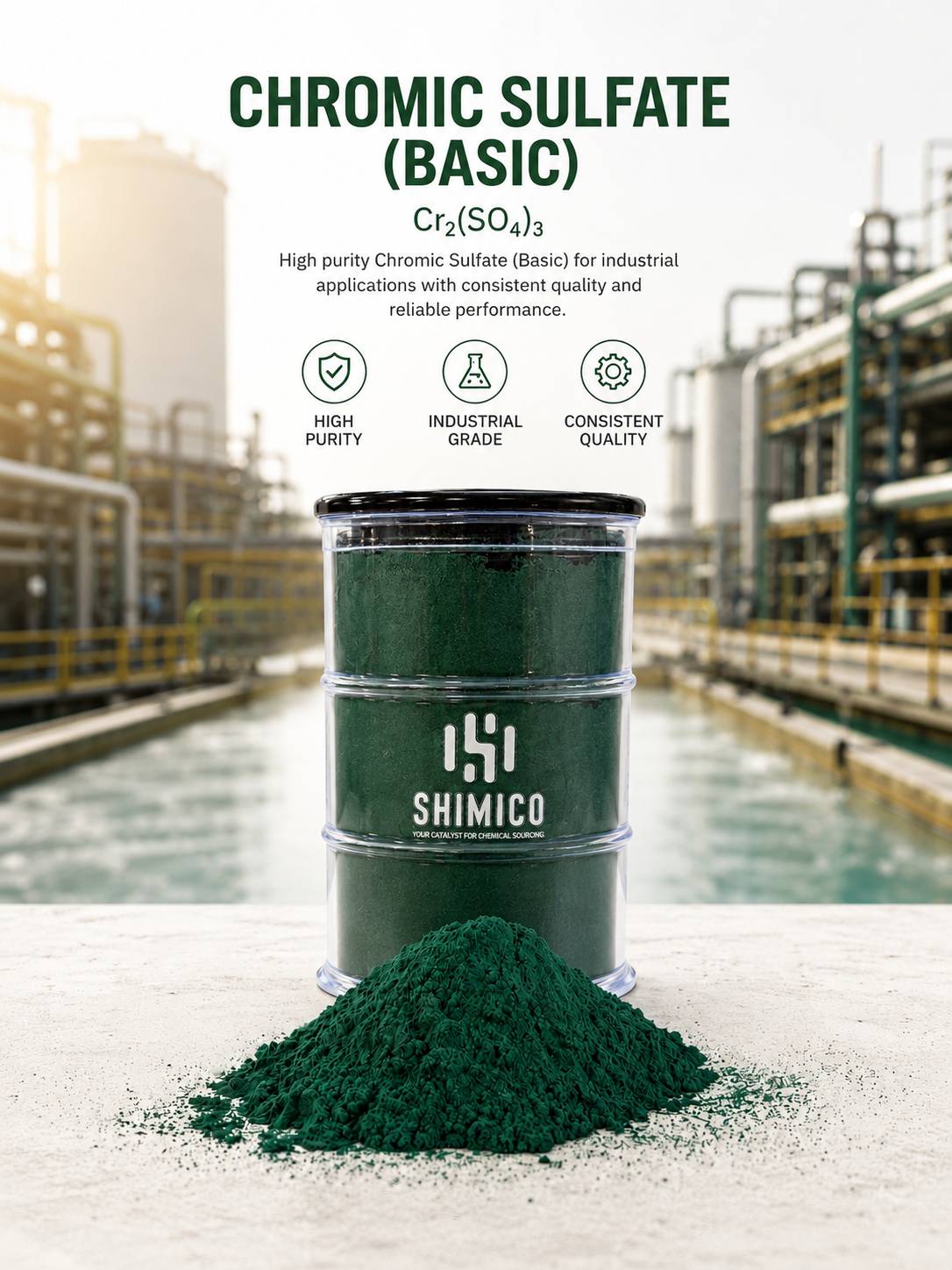
Request current pricing for Basic Chromium Sulfate in Pakistan, also searched as Basic Chromium Sulphate, Basic Chrome Sulphate and BCS. Compare 33% basicity tanning grades, Cr2O3 content, COA results, 25 kg bags, bulk orders, origin, import terms and delivery options for leather factories in Pakistan.
When purchasing chromium sulfate, the green color of the powder is the first thing you notice, yet it is almost the last factor you should rely on when judging quality. Two shipments may look nearly identical and still behave very differently in a tanning line. The real differences appear in chromium oxide content, basicity, dissolution rate, insoluble matter, iron, hexavalent chromium, and batch-to-batch consistency.
This page is written for purchasing managers at leather factories, raw-material procurement teams, trading companies, manufacturers of tanning auxiliaries, and export buyers. Its purpose is not merely to define a chemical.
The aim is to help you understand which specifications should appear in a chromium sulfate purchase inquiry, which documents to request from the seller, how to evaluate a sample, and how to compare several offers against one shared specification.
For buyers in Pakistan, the product is commonly searched under several closely related names: Basic Chromium Sulfate Pakistan, Basic Chromium Sulphate Pakistan, Basic Chrome Sulphate Pakistan, BCS Pakistan, chrome tanning salt Pakistan, and basic chromium sulphate price in Pakistan. The spelling “sulphate” is common in Pakistan and other markets that use British English, while “sulfate” is common in international technical documentation. This page intentionally uses both forms so industrial buyers can find the same product regardless of spelling.
Quick purchasing answer: In your inquiry, state the product type, Cr2O3 content, target basicity, maximum allowable Cr6 and insoluble matter, order quantity, packaging, destination, payment terms, and whether you require a COA, SDS, or sample.
Basic Chromium Sulfate in Pakistan: BCS Demand, Leather Tanneries and Industrial Buyers
Pakistan is a relevant market for Basic Chromium Sulfate because the country has an established leather and leather-goods sector. The Trade Development Authority of Pakistan describes leather and leather goods as a priority export sector, while the Pakistan Tanners Association represents tanning companies across the southern and northern zones. For a BCS supplier, this means the target market is not limited to one city or one tannery cluster.
Industrial demand is concentrated around leather-processing centers such as Karachi and Korangi Industrial Area, Lahore, Kasur, Sialkot, Sheikhupura and other Punjab leather clusters. Buyers in these areas usually evaluate Basic Chromium Sulphate according to Cr2O3 content, basicity, Cr6 control, insoluble matter, packaging, delivery time and landed cost rather than powder color alone.
Pakistan’s Trade Development Authority identifies leather and leather goods as a major export sector, while the Pakistan Tanners Association maintains industry representation in Karachi and Lahore.
Source: Trade Development Authority of Pakistan | Source: Pakistan Tanners Association
Basic Chromium Sulphate Supplier in Pakistan: What Local Buyers Search For
Pakistan-based search intent is strongly commercial. A tannery purchasing manager is more likely to search for Basic Chromium Sulphate supplier in Pakistan, BCS 33% basicity Pakistan, Basic Chrome Sulphate price Pakistan, Basic Chromium Sulfate 25% Cr2O3, or leather tanning chemicals supplier Pakistan than for a purely academic definition of chromium sulfate.
Local chemical traders also use the British spelling “sulphate.” Pakistani supplier pages list Basic Chromium Sulphate and Basic Chrome Sulphate under leather tanning agents, which makes these spelling variants important for search visibility in Pakistan.
Basic Chromium Sulfate Imports to Pakistan and Common Shipment Sizes
Published trade records show Basic Chromium Sulfate shipments entering Pakistan under HSN 32029010 in industrial quantities such as 20,000 kg and 40,000 kg. Records also describe material packed in 25 kg bags and grades around 25% chrome content with 33% basicity. These shipment sizes are consistent with tannery and trading-company procurement rather than small retail demand.
For Pakistan-bound orders, the commercial quotation should state origin, net weight, bag size, palletization, Incoterm, port or inland destination, estimated transit time, COA, SDS, certificate of origin and inspection requirements. If the seller quotes CFR Karachi, FOB origin or another delivery term, compare the landed cost rather than the ex-works price alone.
Pakistan BCS purchasing note:
For leather tanneries in Pakistan, write the inquiry as: Basic Chromium Sulphate / BCS, Cr2O3 target, 33% basicity or required tolerance, maximum Cr6, insoluble matter, 25 kg bags or FIBC, required quantity in metric tons, delivery location in Pakistan, and required trade documents.
What Is Basic Chromium Sulfate, and Which Industries Purchase BCS?
Chromium sulfate, also known as chromium(III) sulfate, is an inorganic compound based on trivalent chromium. In some markets, it is also searched incorrectly as “chromium sulfide,” which is a different substance.
Normal chromium sulfate (non-basic) is mainly used in laboratories and selected chemical processes, whilebasic chromium sulfate (BCS) is the principal high-volume chromium tanning agent used by the leather industry.
When industrial buyers search for “chromium sulfate,” they often mean the 33% basicity grade used in tanneries and leather factories, sometimes sold under traditional trade names such as Chromosal.
Chemical Formula of Chromium(III) Sulfate and Its Difference from Basic Chromium Sulfate
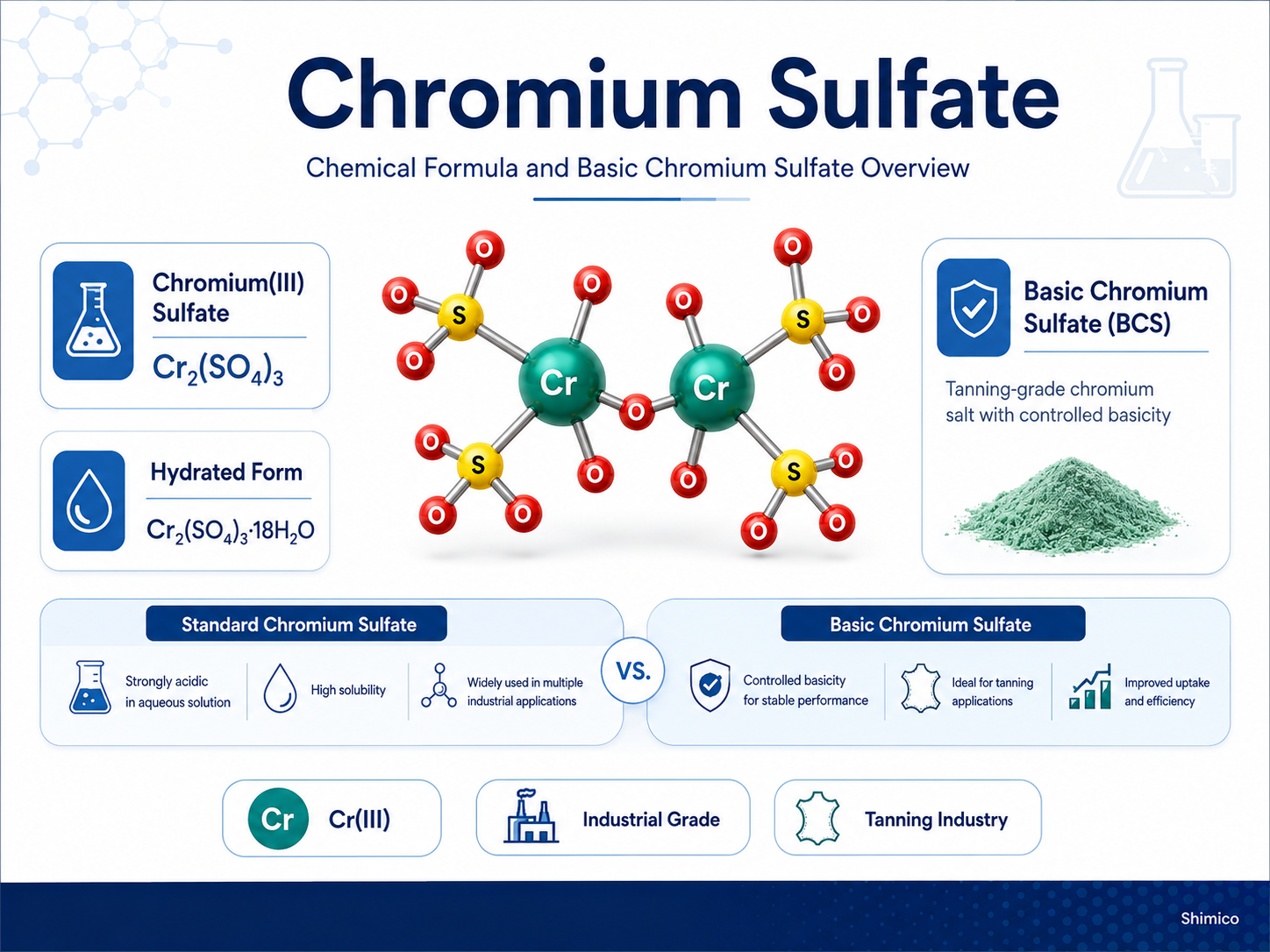
Chromium sulfate, or chromium(III) sulfate, refers to a family of salts containing trivalent chromium and sulfate ions. The anhydrous formula is written as Cr2(SO4)3, but commercial industrial products are often hydrated or supplied as basic chromium sulfate.
Basic chromium sulfate is not a single substance with one completely fixed molecular formula. It is a group of trivalent chromium complexes in which some sulfate ligands are replaced by hydroxyl groups. This structure makes basicity one of the main purchasing specifications.
Commercial Names for Basic Chromium Sulfate: BCS, Basic Chrome Sulphate and Chromium Sulphate
The market uses names such as chromium sulfate, chromium sulphate, chromium(III) sulfate, basic chromium sulfate, basic chromium sulphate, basic chrome sulfate, basic chrome sulphate, chrome tanning salt, Chromosal, and BCS. In Pakistan, “sulphate” and “basic chrome sulphate” are especially common commercial spellings. These names do not always indicate the same grade.
Potassium chromium sulfate, also called chrome alum, is a different compound and must not be confused with tanning-grade BCS in an industrial order. Including the chemical formula, CAS number, grade, and intended use in the inquiry reduces the risk of receiving the wrong material.
How Does Basic Chromium Sulfate Tan Leather?
In raw hide, collagen fibers do not yet have sufficient resistance to heat, water, or microbial activity. After trivalent chromium ions penetrate the hide cross-section, they form coordination bonds with carboxylate groups in collagen chains.
These multipoint bonds stabilize the protein network and raise the shrinkage temperature of the leather. The result is the characteristic blue-green wet-blue intermediate used to manufacture footwear, bags, garments, and upholstery leather.
Tanning quality does not depend only on the amount of powder. Pickle pH, drum temperature, penetration time, float percentage, addition sequence, and the basification program also affect chromium uptake and fixation.
Physical and Chemical Properties of Basic Chromium Sulfate for Industrial Purchasing
Commercial basic chromium sulfate is usually a dark-green or blue-green powder.
Color, Odor, Appearance, and Solubility of Chromium Sulfate
Commercial basic chromium sulfate is usually supplied as a dark-green or blue-green powder. Some grades are available as granules or solutions. Color can vary with the reduction route, auxiliary materials, moisture, and particle-size distribution.
A suitable powder grade should flow freely, contain no hard lumps, and leave little significant residue during dissolution. Most tanning products dissolve faster in warm water, but the TDS instructions for the specific brand should always govern preparation.
pH and Basicity of Basic Chromium Sulfate
Solution pH is not the same as basicity. pH measures hydrogen-ion activity in the test solution, whereas basicity describes the proportion of hydroxyl groups bonded to chromium relative to the theoretical capacity.
A 33% basicity product is one of the standard tanning grades. Grades with 42% or 50% basicity are also supplied for specialized formulations. Buyers should specify the test method and acceptable basicity tolerance in the COA requirements.
Difference Between Trivalent Chromium and Hexavalent Chromium
The chromium in a tanning agent should be predominantly in the trivalent state. Hexavalent chromium is highly relevant to occupational safety and finished-product restrictions.
Cr6 may result from raw-material impurities, poor reduction control, or oxidation under certain conditions. The claim “Cr6-free” is not adequate for an industrial contract unless the test method and detection limit are stated.
Basic Chromium Sulfate COA Analysis: What Should Be Checked Before Purchase?
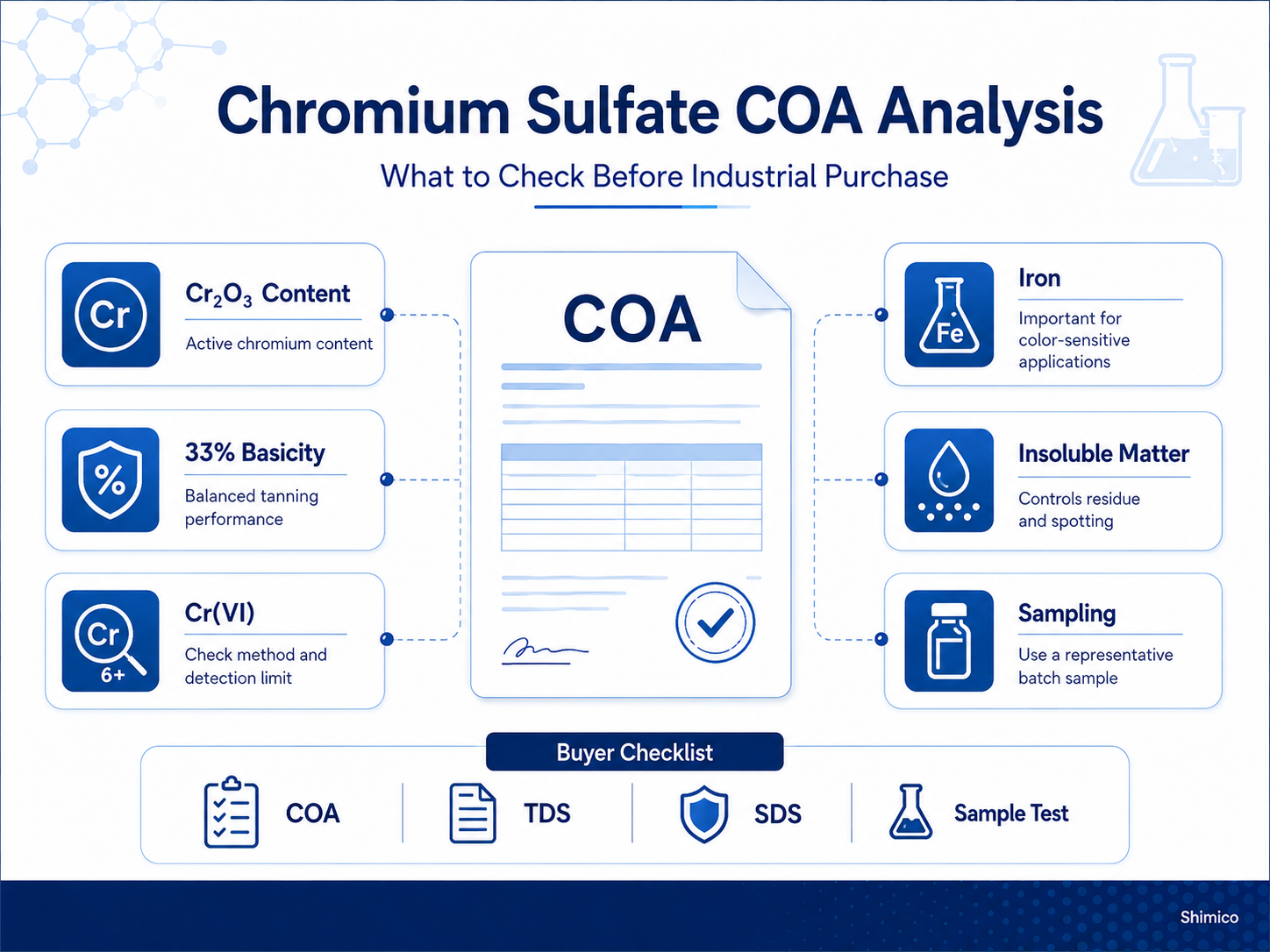
Cr2O3 percentage is the common market basis for expressing active chromium content.
Cr2O3 Percentage in a Chromium Sulfate COA
Cr2O3 percentage is the common market basis for expressing active chromium. Two offers with the same shipment weight and price may contain different quantities of Cr2O3. For comparison, divide the price per metric ton by the kilograms of Cr2O3 contained in that ton. Then include the cost of lower uptake, accompanying salts, and wastewater treatment.
33% Basicity in a Chromium Sulfate COA
A basicity of 33% is widely used in tanning because it provides a practical balance between penetration and reactivity. The correct value still depends on hide type, thickness, pickle conditions, and the basification system.
Consistent basicity across batches may be more important than one additional percentage point of Cr2O3 because changing bath behavior can destabilize shade, grain, fullness, and chromium uptake.
Cr6, Iron, and Insoluble Matter in a Chromium Sulfate COA
Cr6 should be reported using an appropriate method with a known detection limit. Iron matters more in light-colored leather and color-sensitive dyeing. Insoluble matter may come from raw materials, reaction precipitates, or process contamination. A simple solubility test using the factory’s process water often provides more practical information than viewing the dry powder.
Sampling Chromium Sulfate for Incoming Inspection
Do not collect a sample only from the top of one bag. Take increments from several bags located at different points on the pallet or truck, combine them, homogenize the composite, and divide it. Seal one portion for the laboratory, one for the seller, and one as a retained reference sample. For large shipments, the sampling procedure should be written into the contract.
Types of Basic Chromium Sulfate for Purchase, Sale and Industrial Use
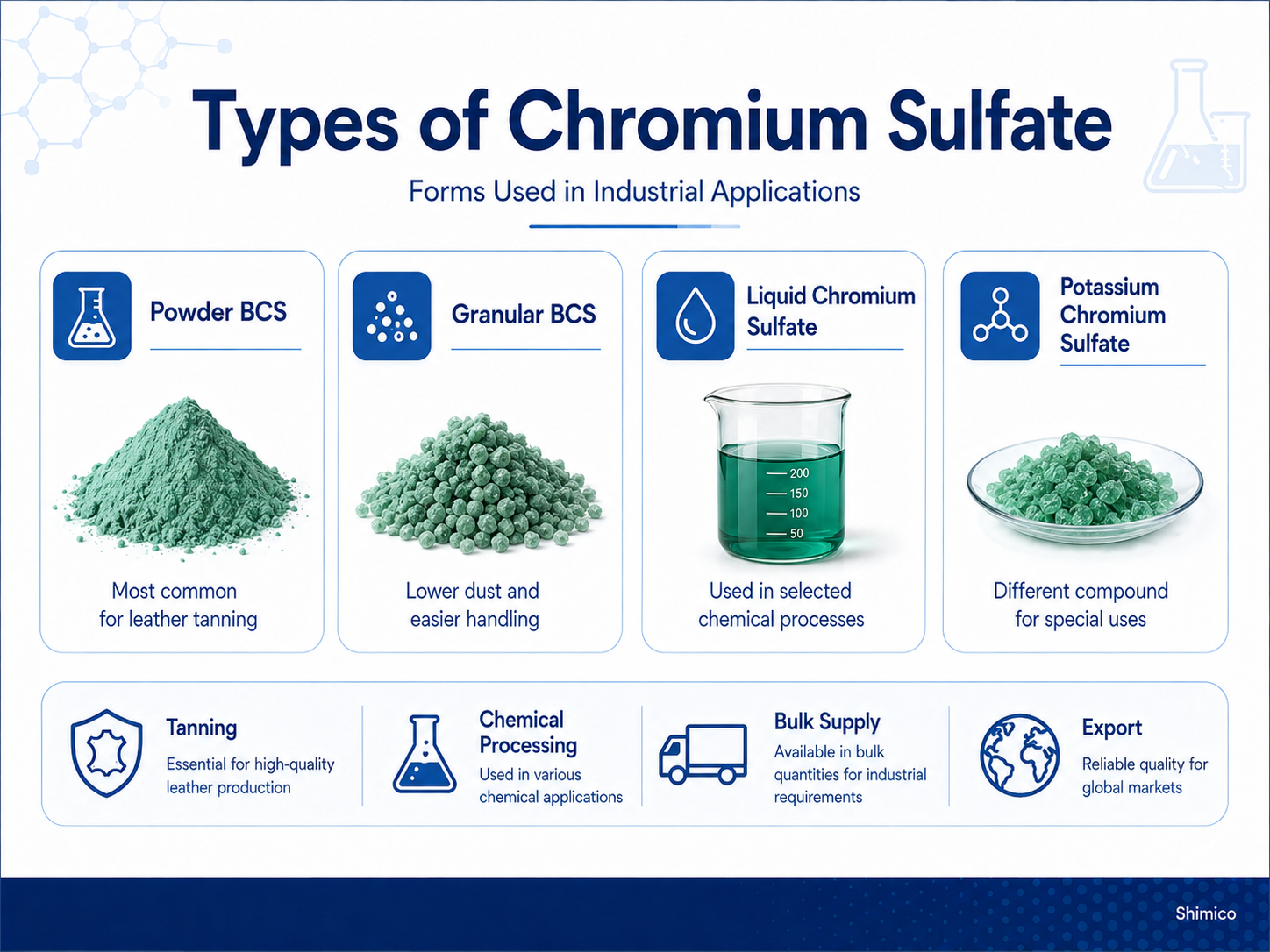
BCS powder is the most common shipment form in the leather industry.
Powdered Basic Chromium Sulfate for Tanning
BCS powder is the most common shipment form in the leather industry. It offers practical storage, high freight density, and weight-based dosing. When purchasing powder, check for caking, dust, dissolution rate, particle-size consistency, and the quality of the bag’s inner liner.
Granular Basic Chromium Sulfate
Granules generate less dust and can improve handling and dosing in some plants. Their dissolution time and behavior in the factory’s water must still be tested. A higher price is justified only when lower losses, reduced dust, and shorter preparation time offset the difference.
Chromium Sulfate Solution for Electroplating and Chemical Production
Chromium sulfate solutions are used in selected metal-finishing, pigment, textile mordant, catalyst, and chromium-chemical processes. In these applications, concentration, density, acidity, accompanying ions, and tank material are important. Tanning-grade product should not be introduced directly into an electroplating bath without checking purity and accompanying ions.
Potassium Chromium Sulfate and Its Difference from BCS
Potassium chromium sulfate dodecahydrate, or chrome alum, has the approximate formula KCr(SO4)2·12H2O and is more commonly used in laboratories, dyeing, and specialized applications. It is not a direct replacement for tanning-grade BCS.
Basic Chromium Sulfate Production and Its Effect on Product Quality
Industrial BCS production commonly begins with a hexavalent chromium source such as sodium dichromate.
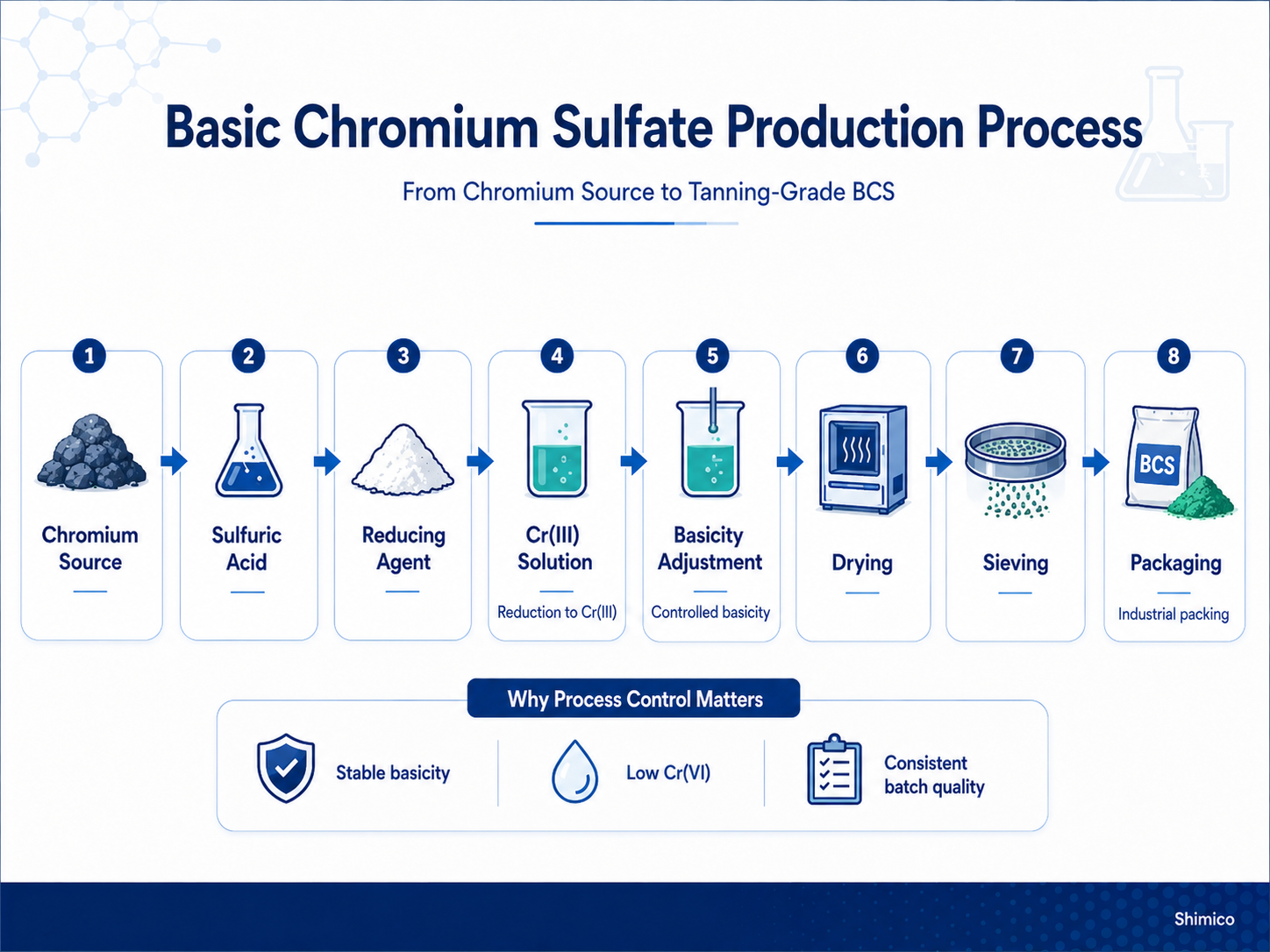
Reaction of Dichromate, Sulfuric Acid, and a Reducing Agent
Industrial BCS production commonly begins with a hexavalent chromium source such as sodium dichromate. In an acidic medium, a reducing agent converts it to trivalent chromium.
Sulfur dioxide, glucose, molasses, and other organic reducing agents have been used in different production routes. The selected reducing agent affects accompanying salts, color, residual organics, and tanning behavior.
Adjusting Chromium Sulfate Basicity with Alkaline Materials
After reduction, basicity is raised through controlled addition of alkaline materials or by adjusting reaction ratios. Sodium carbonate and sodium bicarbonate are established basifying agents. A rapid pH increase raises the risk of large chromium complexes and localized precipitation. Industrial production must control temperature, mixing intensity, feed rate, and residence time.
Drying and Particle-Size Control of Chromium Sulfate
Spray drying can produce powder with suitable particle distribution and solubility. Poor thermal conditions may cause caking, reduced solubility, or uneven moisture. Drying is followed by screening, metal control, and moisture-resistant packaging.
“IS 6301 identifies basic chromium sulfate as a material intended for tanning and recognizes that its basicity may be adjusted to suit process requirements.”English source: IS 6301, Basic Chromium Sulphate for Tanning
💡 Technical Purchasing Note for Tanning-Grade Chromium Sulfate
Do not evaluate the price per kilogram in isolation. Calculate the true cost per kilogram of usable Cr2O3, chromium uptake in the hide, residual chromium in the bath, and consistency across several production batches.
Basic Chromium Sulfate Technical Specifications and Acceptance Criteria
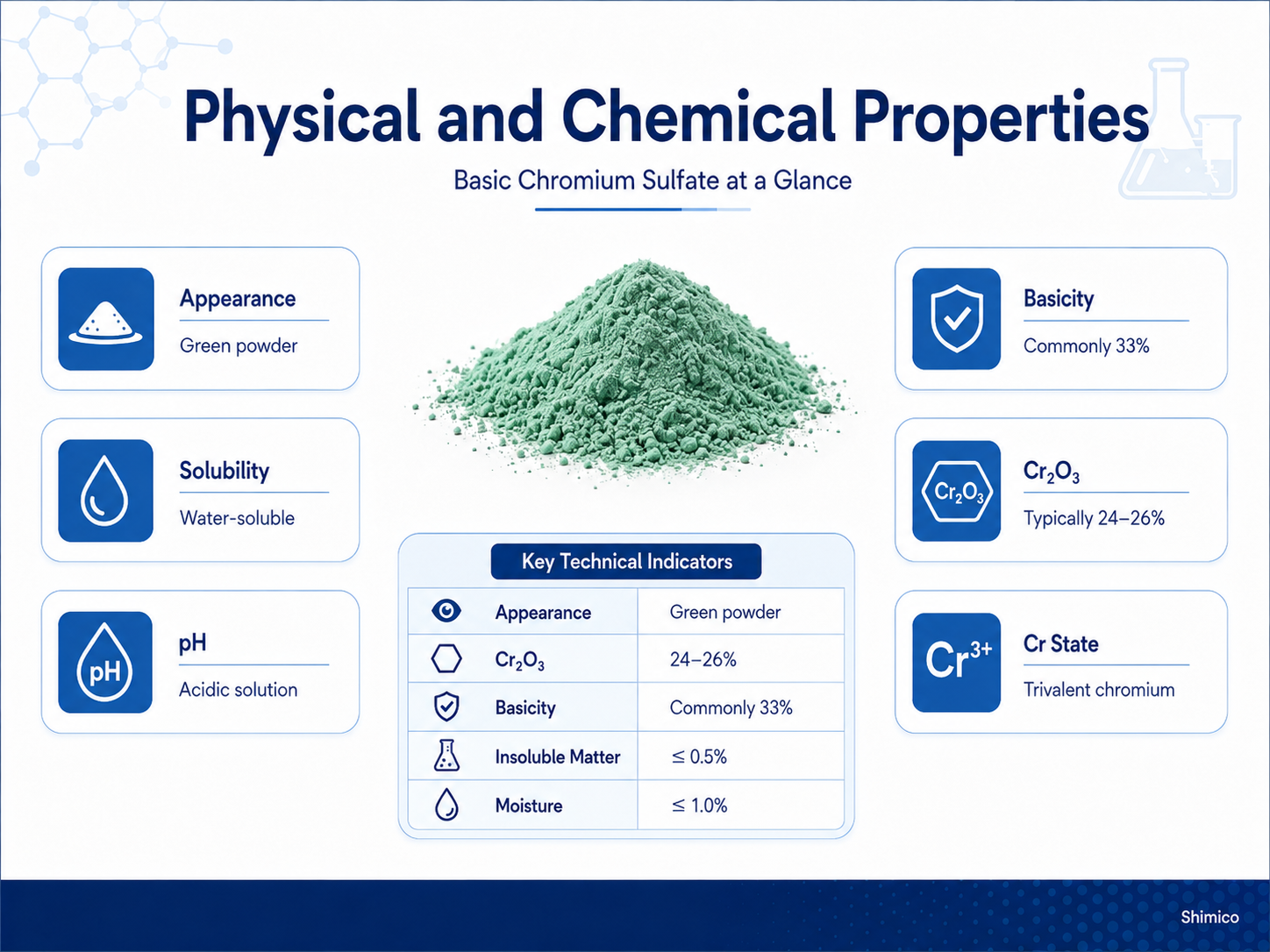
The table below presents example market ranges and does not replace an agreed purchasing specification. One recognized TDS reports approximately 25±1% Cr2O3, 33±1% basicity, no more than 0.1% insoluble matter, and no more than 0.02% iron. These figures are useful starting points, but they must be matched to the production line and an actual sample.
| Parameter | Typical Example Range | Purchasing Relevance | Decision Method |
|---|---|---|---|
| Appearance | Green to dark-green powder | Consistency check | Compare with approved reference sample |
| Cr2O3 | Typically 24% to 26% | Active material content | Independent testing and cost calculation |
| Basicity | Typically 32% to 34% | Balance between penetration and fixation | Select according to the process formulation |
| Insoluble matter | Maximum 0.1% in some TDS documents | Residue and spotting risk | Filtration and gravimetric measurement |
| Iron | Maximum 0.02% in some TDS documents | Effect on color | Instrumental analysis |
| Cr6 | According to the agreed limit and stated method | Safety and conformity | State the detection limit |
| Moisture | Grade-dependent | Effect on active content and caking | Incoming inspection |
| Solubility | Uniform dissolution with low residue | Operational stability | Test with factory process water |
For bulk purchasing contracts, define the target, acceptance limit, and rejection limit for each parameter. Writing only “25% Cr2O3” is not enough. The tolerance, test method, sampling procedure, and treatment of out-of-specification results must also be stated.
“A commercial TDS for basic chromium sulfate reports green powder, 25±1% Cr2O3, 33±1% basicity, maximum 0.1% insoluble matter, and maximum 0.02% iron.”English source: INTER-CHEMIE Technical Data Sheet
Evaluating a Chromium Sulfate Supplier for the Approved Vendor List
Before adding a seller to the approved vendor list, record laboratory sample results, drum-pilot performance, HSE evaluation, document control, delivery history, and the supplier’s ability to respond to complaints. Price should be only one part of the score.
Applications of Basic Chromium Sulfate in Leather and Large-Scale Industries
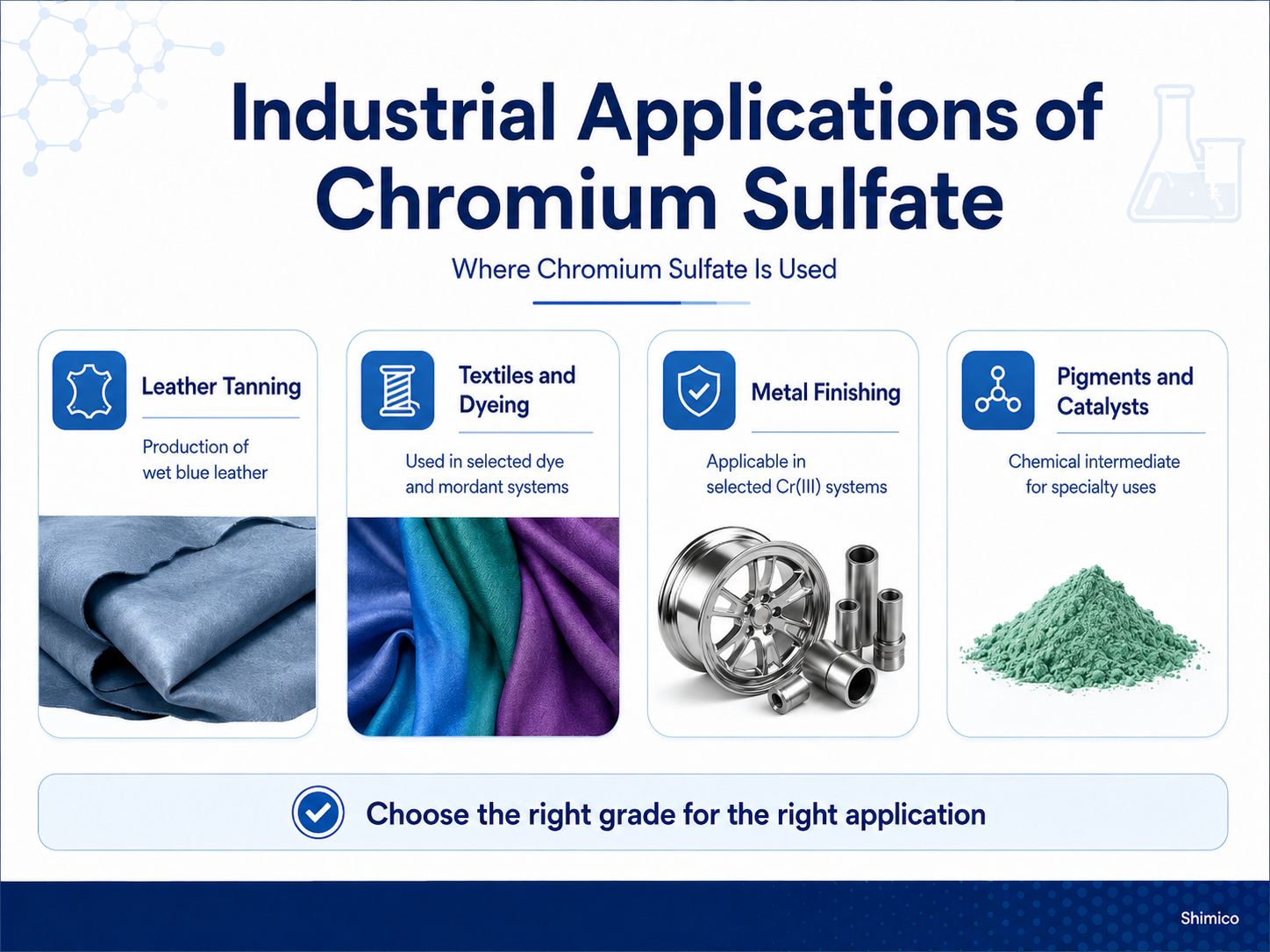
Leather tanning is the dominant use of BCS, but chromium sulfate is also found in chromium-chemical production, dyes and pigments, textiles, catalysts, and selected surface-finishing processes. Each application requires different grades and specifications, and transferring a tanning grade into an electroplating line without technical testing is not a sound decision.
Use of Chromium Sulfate in Tanning and Wet-Blue Production
In chrome tanning, BCS is added to the drum after pickling. Chromium ions must first penetrate the hide cross-section. The pH is then raised gradually to increase fixation on collagen. If basification occurs before full penetration, the surface reacts too early and the center receives less chromium.
Chromium Sulfate Dosage per Metric Ton of Hide
Consumption depends on hide type, pelt weight, product Cr2O3 percentage, the target leather, and bath-recycling rate. Rather than using one fixed number, calculate dosage from active chromium and verified trial results. Supplier data should be confirmed in a pilot using the factory’s actual hides and formulation.
Use of Chromium Sulfate in Dyeing and Textiles
Chromium salts may serve as mordants in selected dyeing systems or as intermediates in chromium-dye production. Environmental restrictions and finished-product requirements make residual chromium control necessary.
Use of Chromium Sulfate in Electroplating and Metal Finishing
Some trivalent chromium plating baths use salts such as chromium sulfate. Purity, chloride, interfering metals, acidity, and organic matter are sensitive parameters in these baths. Tanning-grade BCS may be unsuitable because of sodium sulfate or organic additives.
Use of Chromium Sulfate in Ceramics, Pigments, and Catalysts
Chromium sulfate can be a precursor for selected salts, chromium oxide, catalysts, and pigments. In these industries, ionic ratios, metallic purity, and thermal behavior may matter more than tanning basicity.
Basic Chromium Sulfate Safety and MSDS Guidance for Tanneries and Factories
Trivalent chromium is not the same as hexavalent chromium, but that difference does not make chromium sulfate harmless.
A recent supplier SDS for chromium(III) sulfate hydrate lists skin irritation, possible skin sensitization, serious eye effects, and harmful effects if swallowed or inhaled.
The exact classification must be taken from the SDS for the specific brand and grade.
Required PPE When Handling Chromium Sulfate
During bag emptying and solution preparation, use chemical-resistant gloves, enclosed safety goggles, work clothing, and effective dust control. Where engineering controls are insufficient, respiratory protection should be selected from the risk assessment and product SDS.
What to Do After Chromium Sulfate Contacts Skin or Eyes
Remove contaminated clothing and rinse the skin with plenty of water. For eye contact, continuous rinsing and medical attention are required. The product-specific SDS takes priority over general guidance.
Is Chromium Sulfate Flammable?
Many inorganic chromium sulfate salts are not combustible by themselves, but the packaging, accompanying organic matter, and fire-decomposition products must be considered. Select firefighting methods according to the surrounding materials.
Spill Control and Chromium-Containing Wastewater
Spilled material must not enter surface water or untreated sewers. Collect powder using a low-dust method and contain solutions in compatible vessels. Wash water must also be managed through the site’s treatment system.
Basic Chromium Sulfate Packaging for Pakistan, Wholesale Supply and Export
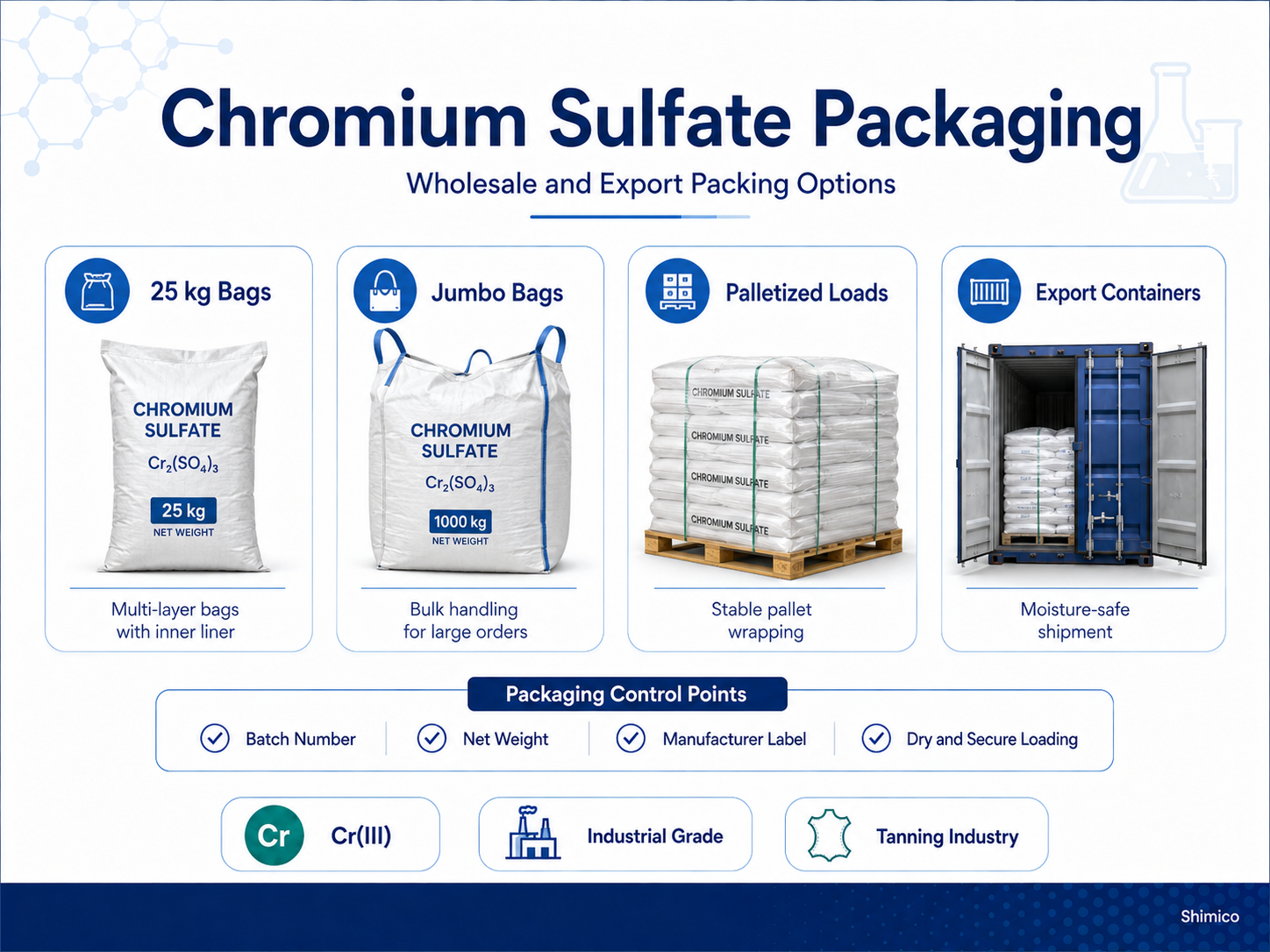
The standard BCS package is often a 25 kg multiwall bag with an inner polyethylene liner. Some manufacturers also supply 1,000 kg bulk bags. Packaging selection depends on the plant unloading system, route humidity, storage conditions, dust restrictions, and loading method.
Purchasing Chromium Sulfate in 25 kg Bags
A 25 kg bag suits staged consumption and warehouses without bulk-bag equipment. Check net weight, liner, stitching, pallet strength, and printed batch identification.
Bulk Chromium Sulfate Purchasing in FIBCs
FIBCs reduce packaging waste and unloading time but require safe lifting, a discharge frame, and dust control. For export shipments, the safe working load, safety factor, liner, and dimensions must match the equipment at destination.
Export Packaging Inspection for Chromium Sulfate
The label should state the chemical name, grade, net weight, manufacturer, country of origin, batch number, and required safety markings. Pallets, stretch wrap, and load securing must withstand route humidity and handling.
Storage of Basic Chromium Sulfate in an Industrial Warehouse
Powdered chromium sulfate should be stored in a dry, covered area away from direct moisture. Bags should be placed on sound pallets and kept away from damp walls and floors. FIFO control and batch traceability are required for quality management.
Shelf Life of Chromium Sulfate and Caking Control
Shelf life should be taken from the manufacturer’s TDS or label. Moisture absorption and caking can interfere with dosing and dissolution. Before using old inventory, recheck appearance, moisture, solubility, and the main quality parameters.
Warehouse Compatibility of Chromium Sulfate with Other Materials
Segregate incompatible materials according to the SDS. Do not store the product near food or animal feed. Warehouse drainage should allow containment of wash water.
Comparison of Russian, Chinese, Indian, and Turkish Chromium Sulfate Brands
According to global trade data fromVolza, India accounted for about 70% of basic chromium sulfate export shipments from October 2023 to September 2024, making it the largest exporter during that period. China and Turkey followed. Brazil, Bangladesh, and South Africa were reported among the largest importers, mainly for use in their large tanning industries. Each producing region has distinct supplier characteristics that should be considered during qualification:
Russian Chromium Sulfate and the Novochrom Brand
The name Novochrom appears in market searches. Before placing an order, verify the manufacturer’s legal name, country of origin, TDS, batch COA, original packaging, and import documents. A photograph of the bag alone does not prove authenticity.
Turkish Chromium Sulfate and Tankrom AB
Tankrom AB appears frequently in buyer inquiries and may be used as a grade name, a brand reference, or an imprecise market term. Identification should be confirmed through the official catalogue and manufacturer name.
Chinese Chromium Sulfate for Tanning
Many Chinese offers provide a wide choice of factories and competitive pricing; that same variety is also the main risk. Distinguish the actual manufacturer from the trading company and match the pre-shipment sample to the loading sample.
Indian Chromium Sulfate and Export Grades
India has established chromium-chemical manufacturers. BCS is commonly supplied from India in 25 kg bags and bulk bags. Batch specifications and drum testing remain the deciding factors.
Basic Chromium Sulfate Export to Pakistan: Import Documents and Shipment Control
For BCS exports, foreign buyers usually ask about the specification, packaging, monthly capacity, country of origin, samples, SDS, and payment method before discussing price. The commercial and chemical names should be consistent on the pro forma invoice. Customs classification and transport must be checked against destination regulations and the SDS.
Chromium Sulfate Export Documents
A pro forma invoice, commercial invoice, packing list, certificate of origin, COA, SDS, insurance documents, and transport documents are commonly required. Some customers also request a Cr6 report, TDS, or third-party inspection.
Container Inspection and Chromium Sulfate Loading
Select a dry container with no odor, holes, or evidence of water ingress. Inspect the floor and walls. Record the seal number and retain loading photographs in the shipment file.
Importing Russian and Chinese Chromium Sulfate
The cost is not limited to FOB or CFR. Duties, taxes, inland freight, warehousing, currency, inspection, working-capital time, losses, and nonconformity risk must also be calculated.
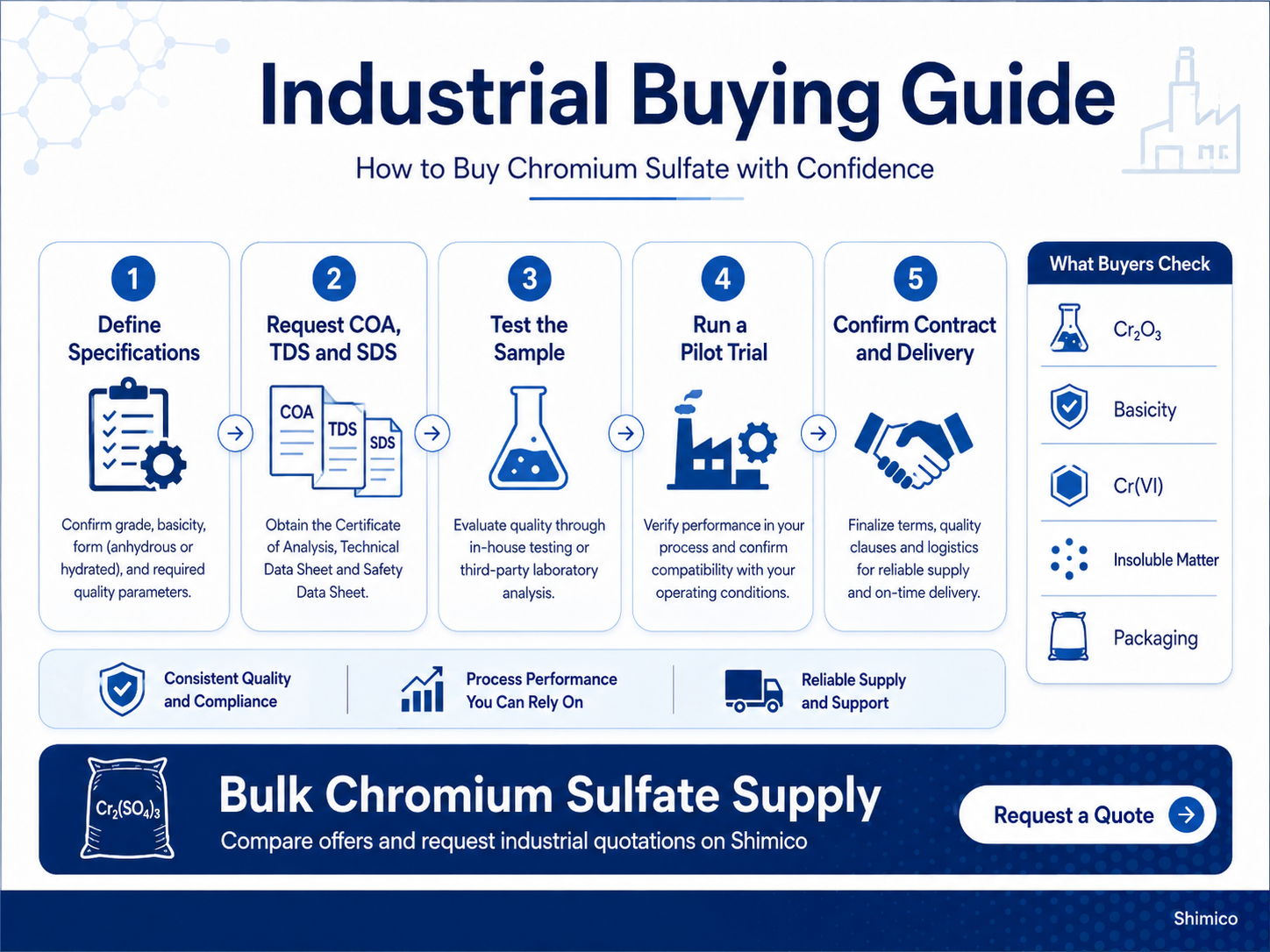
Industrial Basic Chromium Sulfate Purchasing Guide for Pakistan Tanneries and Trading Companies
A well-written inquiry should require the seller to submit a clear offer. State the grade name, specification, quantity, destination, and required documents from the beginning.
Step 1 in Purchasing Chromium Sulfate: Define the Specification
The technical and quality-control teams should approve the specification before price negotiations begin. Define Cr2O3, basicity, Cr6, insoluble matter, iron, moisture, physical form, packaging, and test methods.
Step 2 in Purchasing Chromium Sulfate: Sampling and Laboratory Testing
Evaluate the sample using the factory’s normal incoming-inspection methods. Run the solubility test with actual site water because hardness and temperature affect performance.
Step 3 in Purchasing Chromium Sulfate: Pilot Drum Trial
Record chromium uptake, bath pH, shrinkage temperature, cross-section color, penetration, grain quality, and residual chromium. One drum is not enough; several repeat trials against the approved reference product provide a more reliable picture.
Step 4 in Purchasing Chromium Sulfate: Contract and Delivery Inspection
The contract should state tolerances, sampling methods, the referee laboratory, rejection or discount conditions, delivery time, and responsibility for nonconforming material.
Basic Chromium Sulfate Price in Pakistan and Wholesale BCS Price Factors
Basic Chromium Sulfate does not have one fixed price in Pakistan. Chromium raw materials, sulfuric acid, reducing agents, energy, packaging, exchange rates, ocean or land freight, origin, order volume, customs costs, local inventory and payment terms all affect the quotation. A Pakistan buyer should compare the landed Basic Chromium Sulphate price per metric ton, not only the supplier’s factory price.
Searches such as Basic Chromium Sulphate price in Pakistan or BCS price Pakistan should therefore be answered with a dated quotation that identifies grade, Cr2O3, basicity, package size, origin and delivery term. A low price without these specifications is not a comparable offer.
Factors Affecting Chromium Sulfate Price per Kilogram and per Metric Ton
Cr2O3 percentage and basicity are the first specifications to compare, but brand, Cr6, insoluble matter, and quality consistency also carry economic value. A one-ton order and a 100-ton order will not receive the same pricing.
Why Is a Chromium Sulfate Price List Misleading Without a Specification?
Two sellers may both quote BCS 33, while one product has lower Cr2O3, higher moisture, or weaker packaging. A cheaper price is not economical if it increases dosage or produces more chromium-bearing wastewater.
“A 2025 SDS for chromium(III) sulfate hydrate records warnings for skin irritation, skin sensitization, serious eye irritation, and harmful effects if swallowed or inhaled.”English source: Thermo Fisher / Alfa Aesar SDS
⚠️ Warning About Buying Cheap Chromium Sulfate
Do not accept an unusually low offer without verifying the manufacturer, net weight, batch COA, solubility, and Cr6. The cost of a nonconforming shipment may include drum stoppage, rework, additional wastewater treatment, and damage to a leather order.
Why Buy Basic Chromium Sulfate for Pakistan Through Shimico?
Shimico is a B2B marketplace connecting buyers, sellers, manufacturers, and importers of chemicals. Buyers can submit precise order specifications and compare offers from several suppliers against common criteria. Sellers can present their products, grades, supply capacity, and sales conditions to an industrial audience.
For chromium sulfate purchasing, the request should clearly state monthly demand, technical specifications, destination, and document requirements. For chromium sulfate sales, uploading a TDS, sample COA, packaging images, and origin details builds stronger confidence. The platform does not replace quality control, contracting, or inspection, and both parties should complete those steps.
🚀 Ready to Buy Basic Chromium Sulfate for Pakistan?
Submit the BCS specification, Cr2O3 target, basicity, order volume, 25 kg bag or FIBC requirement, and delivery destination in Pakistan to compare Basic Chromium Sulphate offers more accurately.
✅ Request Basic Chromium Sulphate prices for Pakistan
✅ Compare wholesale sellers and import suppliers
✅ Post a free chemical product listing
✅ Present supply capacity, COA, packaging, and delivery terms
Industrial Buyer Feedback on Chromium Sulfate Purchasing
| Buyer Role | Example Feedback | Measurable Indicator |
|---|---|---|
| Tannery Purchasing Manager | “The main value for us was consistent basicity across three consecutive shipments.” | COA trend across multiple batches |
| Laboratory Supervisor | “The sample dissolved quickly in our factory water and left little residue.” | Solubility test |
| Production Manager | “The pilot showed lower residual chromium in the tanning bath.” | Wastewater measurement |
| Export Trader | “Matching the batch number to the packing documents simplified customer acceptance.” | Document traceability |
| HSE Officer | “An updated SDS and legible label were useful for unloading training.” | SDS and label inspection |
Frequently Asked Questions About Basic Chromium Sulfate in Pakistan, BCS Price and Supply
What is chromium sulfate?
Chromium sulfate is a salt of trivalent chromium and sulfate. Its basic form contains controlled hydroxyl groups and is used primarily in chrome tanning.
What is basic chromium sulfate?
BCS is a chrome tanning agent with a defined basicity. Basicity affects chromium penetration and fixation in collagen.
What is the price of chromium sulfate?
Price is quoted according to grade, Cr2O3 content, basicity, order volume, origin, packaging, currency, freight, and payment terms.
Which parameters matter in a chromium sulfate COA?
Cr2O3, basicity, Cr6, insoluble matter, iron, moisture, pH or solubility, and the batch number are important.
What does 33% basicity mean?
It means that roughly one third of the theoretical acidic capacity of the chromium complex has been replaced by hydroxyl groups.
Does chromium sulfate dissolve in water?
Many commercial grades are water-soluble. Temperature, concentration, water hardness, particle size, and addition method affect dissolution rate.
Is Russian chromium sulfate better than Chinese chromium sulfate?
Origin alone is not a quality criterion. Compare the batch COA, quality consistency, Cr6, solubility, drum-test performance, and manufacturer authenticity.
What is the difference between basic and normal chromium sulfate?
The basic form contains hydroxyl groups and is designed for controlled reaction with collagen.
Is chromium sulfate the same as Chromosal?
Chromosal may be a trade or market name for a chrome tanning agent. Verify the label and TDS.
How many ppm of Cr6 are acceptable in chromium sulfate?
The limit should be agreed according to finished-product requirements, destination regulations, and the test method. The detection limit should also be reported.
How much insoluble matter is acceptable in chromium sulfate?
Some TDS documents specify a maximum of 0.1%, but the contractual specification governs acceptance.
How does chromium sulfate tan leather?
Cr(III) complexes bond with collagen carboxylate groups and stabilize the protein network.
How can chromium uptake in leather be increased?
Control pickling, allow full penetration, raise pH gradually, manage temperature and time, and select a suitable BCS grade.
How can chromium in tannery wastewater be reduced?
Higher uptake, controlled pH and temperature, bath recycling, and suitable wastewater treatment can reduce chromium discharge.
Is chromium sulfate suitable for electroplating?
Some high-purity grades are used in trivalent chromium baths. Tanning-grade BCS should not be used without compatibility testing.
How much does one bag of chromium sulfate weigh?
A 25 kg bag is common. Bulk bags from 500 to 1,000 kg are also available.
What is the minimum order quantity for chromium sulfate?
It depends on the seller and inventory. For wholesale pricing, state the required volume and consumption schedule.
Which tests should be completed before purchasing?
Recommended checks include Cr2O3, basicity, Cr6, iron, insoluble matter, moisture, solubility, and a pilot drum trial.
How do exchange rates affect chromium sulfate prices?
For imported products, exchange rates directly affect purchasing, freight, and inventory replacement costs.
How should a chromium sulfate sample be collected?
The sample should represent the batch, be sealed and traceable, and have a contractually defined relationship to the shipment.
Where can I buy Basic Chromium Sulphate in Pakistan?
Industrial buyers can source BCS through Pakistani leather-chemical traders, importers, direct international suppliers, and B2B chemical platforms. Before ordering, compare Cr2O3, basicity, Cr6, COA, packaging, origin, landed price and delivery location.
What is the price of Basic Chromium Sulphate in Pakistan?
There is no single fixed Pakistan price. The quotation depends on BCS grade, Cr2O3 content, basicity, origin, quantity, exchange rate, freight, customs costs, local inventory and payment terms. Request a dated price per metric ton with delivery terms.
Is Basic Chromium Sulfate imported into Pakistan in 25 kg bags?
Yes. Published trade records include Pakistan-bound Basic Chromium Sulfate shipments packed in 25 kg bags and industrial lots of 20,000 kg or more.
Which Pakistan cities have strong demand for Basic Chrome Sulphate?
Demand is linked to leather-processing clusters and trading networks in Karachi and Korangi, Lahore, Kasur, Sialkot, Sheikhupura and other industrial areas in Punjab and Sindh.
What specification is commonly requested for tanning-grade BCS in Pakistan?
A common commercial starting point is around 25% Cr2O3 with about 33% basicity, but the purchase specification should also define Cr6, insoluble matter, iron, moisture, solubility, package type and test methods.
Scientific and Technical Sources for Basic Chromium Sulfate and Pakistan Market Context
- Chromic Sulfate, PubChem, no stated publication date; accessed July 20, 2026
- Chromium hydroxide sulphate, ECHA CHEM, no stated publication date; accessed July 20, 2026
- Chromium(III) compounds (as Cr), NIOSH Pocket Guide, reviewed October 30, 2019
- Chromium Chemicals, Şişecam, no stated publication date; accessed July 20, 2026
- Leather Chemicals, Cromital, no stated publication date; accessed July 20, 2026
- Basic Chromium Sulphate, Vishnu Chemicals, no stated publication date; accessed July 20, 2026
- Basic Chrome Sulphate, Chrompik, no stated publication date; accessed July 20, 2026
- BAT Reference Document for the Tanning of Hides and Skins, European Commission JRC, 2013
- Leather and Leather Goods, Trade Development Authority of Pakistan, accessed September 2026
- Pakistan Tanners Association – About the Leather Industry, Pakistan Tanners Association, accessed September 2026
- Leather Chemicals Product Range, AMA Enterprises Pakistan, accessed September 2026
- Leather Division – Basic Chromium Sulphate, Brothers Trading Corporation Pakistan, accessed September 2026
- HSN 32029010 Imports in Pakistan, Volza trade records, accessed September 2026
Final reminder:The contractual specification, batch COA, brand-specific SDS, laboratory testing, and production-line pilot take priority over any general figure. For export or import purchases, confirm customs classification and transport requirements with the customs broker and destination-country regulations.
Last Seen

Users Comment
Sulfur Fungicide: How It Works, Uses and Safety Precautions
Types of Sulfur Fertilizers: Powder, Granular, Liquid & Sulfate Forms
Sulfur for Soil: Benefits, Uses and How to Apply It
Sulphur 80 WDG: Technical Specifications, Uses & Bulk Supply
Sulfur WDG: Water Dispersible Granules, Uses & Bulk Supply
Sulphur WDG Pakistan: Bulk Supply, Prices & Import Guide
Sulfuric Acid Supply to Turkey: Price, Transport and Import Guide
Sodium Bicarbonate for Dairy Cows: Rumen Buffer, Dosage, Milk Fat
Why Sulfuric Acid Is King and Benzene Is Called Queen
How Urea Can Hydrate and Exfoliate Your Skin
Sodium carbonate| Soda ash; features and applications
Copper Sulfate; Features and applications