




Sodium Bicarbonate for Dairy Cows: Rumen Buffer, Dosage, Milk Fat
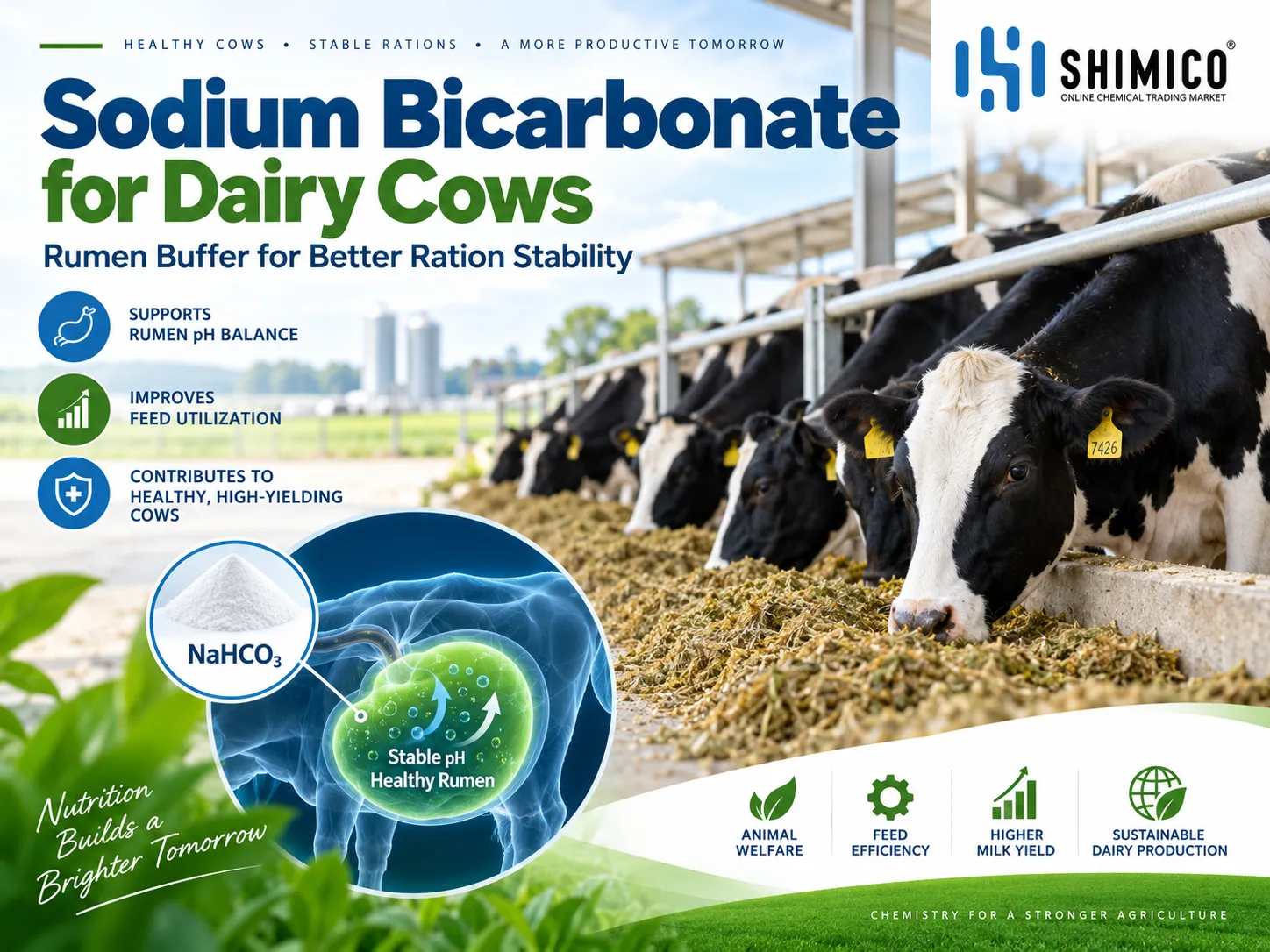
Sodium bicarbonate for dairy cows is often described as a simple rumen buffer. That description is incomplete. In a high-producing cow, bicarbonate sits at the intersection of rumen pH, starch fermentation, effective fiber, sodium supply, heat stress, milk fat and dietary cation-anion difference. Used in the right ration, it can support rumen stability. Used as a substitute for poor forage structure or an unbalanced diet, it can hide the real problem instead of fixing it.
For dairy nutritionists, feed mills and large farms, the practical question is not whether sodium bicarbonate can buffer acid. It can. The useful question is when the ration creates enough acid load to justify extra buffering, how much should be included on a dry-matter basis, and how should its sodium contribution be counted in the entire mineral program?
This guide focuses on lactating dairy cows, especially cows receiving high-starch total mixed rations, cows at risk of subacute ruminal acidosis, and cows exposed to heat stress. It also covers feed-grade purchasing points because particle consistency, purity, traceability and batch documentation matter when sodium bicarbonate is purchased by the ton rather than by the box.
Quick answer:
For lactating dairy cows, university guidance commonly places sodium bicarbonate around 0.5% to 1.0% of ration dry matter when extra buffering is justified. Penn State has also cited about 0.8% of total ration dry matter. These are ration-formulation ranges, not automatic prescriptions for every cow. Fiber level, starch fermentability, dry matter intake, sodium, DCAD, heat stress and production stage must be checked before the inclusion rate is set.
Sodium Bicarbonate for Dairy Cows: What It Is and Why It Works as a Rumen Buffer
Sodium bicarbonate, NaHCO3, is an alkaline sodium salt. In feed, it supplies bicarbonate and sodium. Its buffering value comes from the bicarbonate ion, which can accept hydrogen ions and resist large swings toward acidity. The chemistry is simple. The biology of the rumen is not.
The rumen produces large amounts of volatile fatty acids as microbes ferment carbohydrate. High-starch diets can produce acid quickly, especially when grain is highly fermentable, meals are large, cows sort against long fiber, or effective fiber is inadequate.
Saliva normally brings bicarbonate and phosphate into the rumen while the cow chews and ruminates. A ration that reduces chewing while accelerating acid production creates a mismatch.
Penn State Extension explains that sodium bicarbonate or sesquicarbonate at about 0.8% of ration dry matter can raise rumen pH and may improve dry matter intake, milk production or milk fat response when the diet is responsive to buffering.
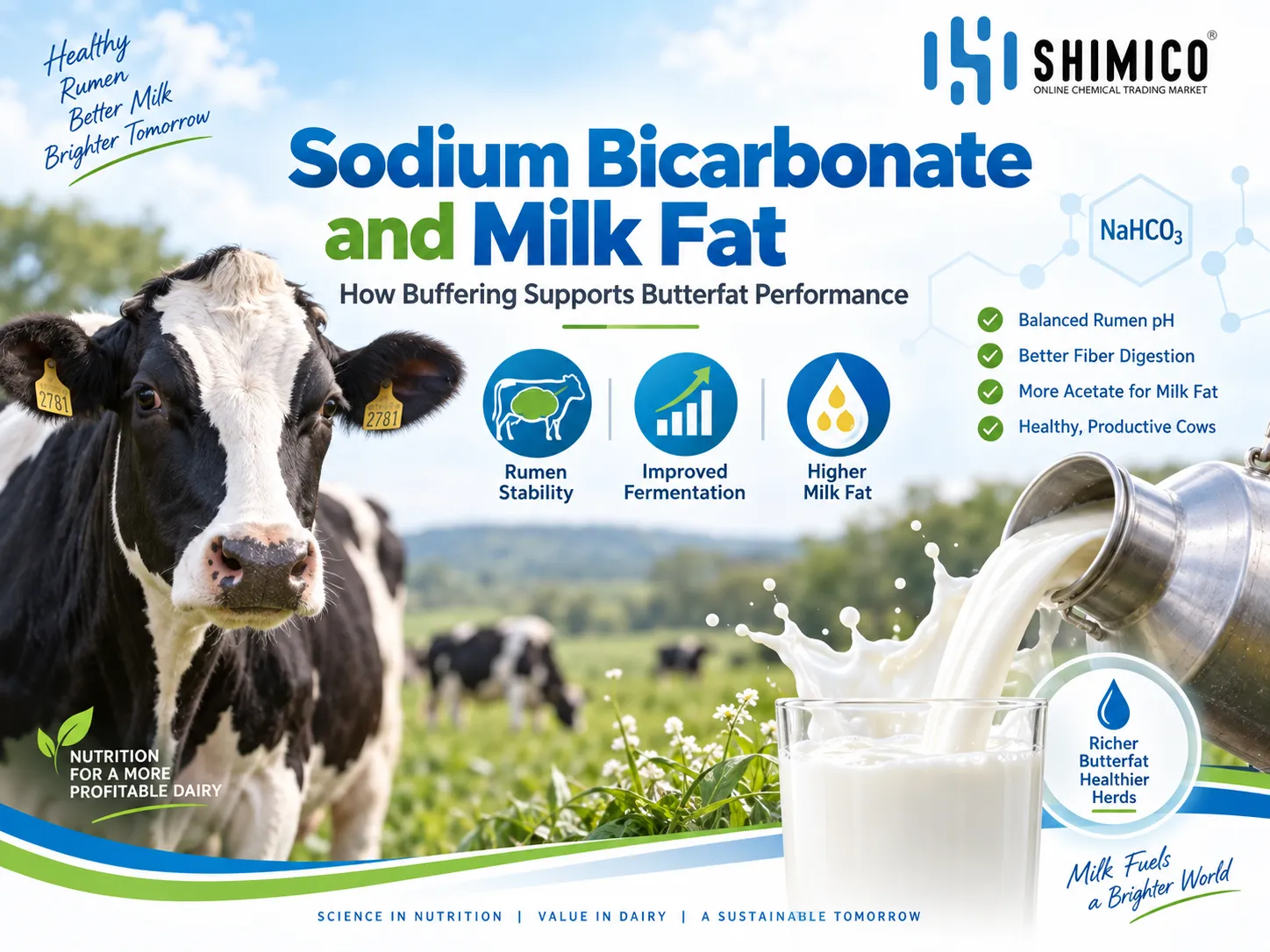
How Sodium Bicarbonate for Dairy Cows Supports Rumen pH
Sodium bicarbonate does not stop fermentation. It gives the rumen more buffering capacity while fermentation is taking place. This can reduce the depth or duration of low-pH periods in rations with a high acid load.
Research in lactating cows fed starch-rich diets has shown that sodium bicarbonate can shorten the time rumen pH remains below commonly used SARA thresholds and can shift rumen fermentation toward a more favorable acetate pattern.
A 2021 dairy-cow study using 8 g/kg dry matter of NaHCO3, equivalent to 0.8% of dry matter, found less time below rumen pH 5.8 and higher milk fat output than the unsupplemented high-starch control.
The study did not show that bicarbonate is a cure for every low-pH ration. It showed that the response depends on the dietary challenge. Read the study in Animal.
Sodium Bicarbonate for Dairy Cows Does Not Replace Effective Fiber
This point deserves emphasis. Coarse forage structure, chewing and saliva are part of the cow’s own buffering system. If a ration lacks physically effective NDF, adding bicarbonate can improve the chemical side of the problem while the cow still receives too little structural fiber. Long-term ration correction starts with forage quality, particle distribution, starch source and feeding behavior.
Recent ruminal acidosis research treats acidosis as a continuum rather than a single pH number. The duration, timing and biological response to low pH matter alongside the minimum pH itself.
Source: Journal of Dairy Science, Invited Review on Ruminal Acidosis, 2024
Sodium Bicarbonate for Dairy Cows Dosage: How Much Should Be Fed?
Searches for sodium bicarbonate dosage for dairy cows often return one number such as 200 g or 250 g per cow per day. That approach can be misleading because intake changes across lactation, season, parity and ration design. Dry matter percentage gives a more useful starting framework.
University of Wisconsin Extension states that when starch is increased, sodium bicarbonate may be raised to about 0.5% to 1.0% of dry matter to support rumen pH, alongside adequate fiber. Penn State gives about 0.8% of ration dry matter as a classic reference point.
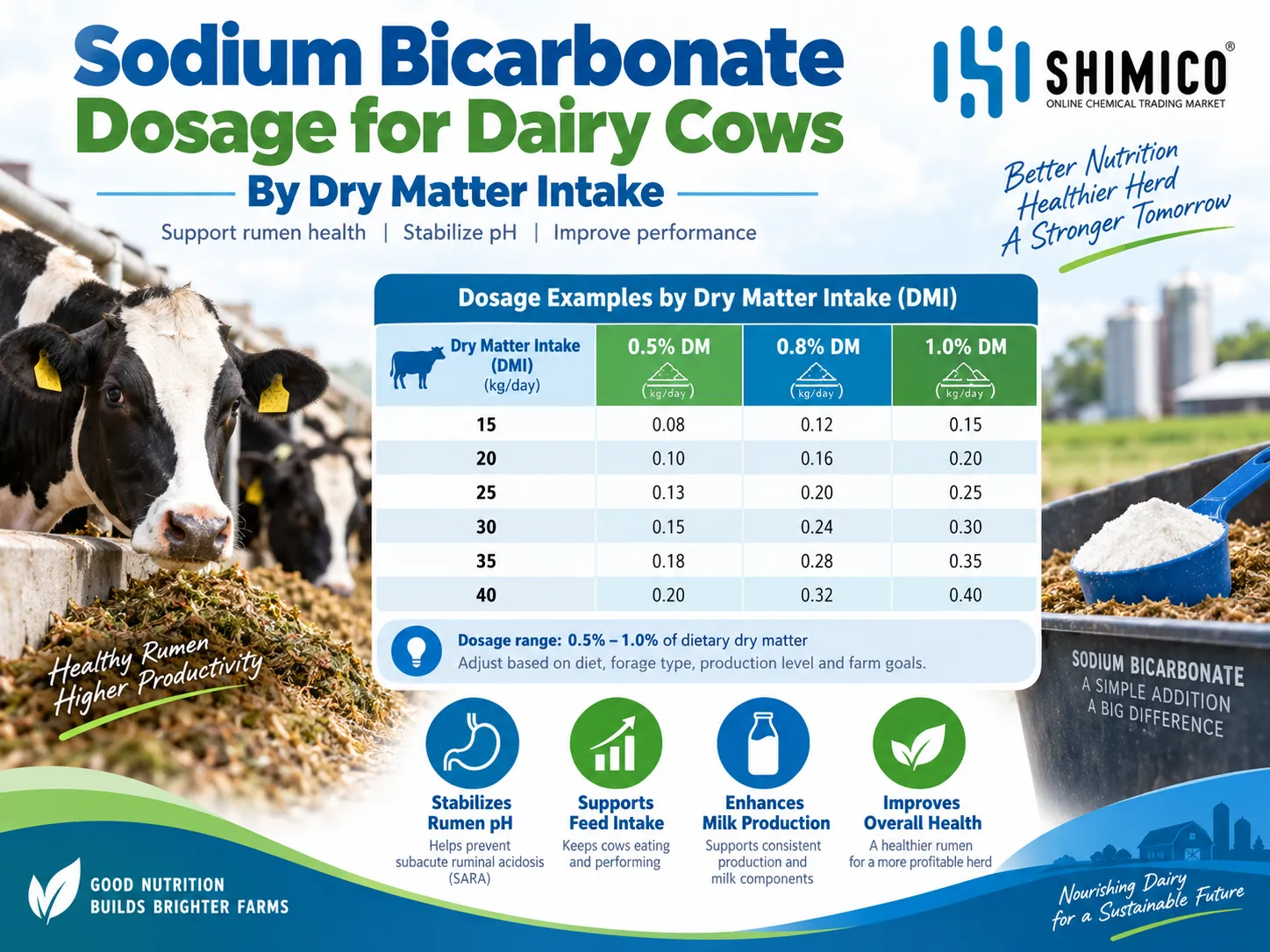
Sodium Bicarbonate for Dairy Cows Dosage by Dry Matter Intake
Dry matter intake converts the percentage into grams per cow. The math is straightforward, but the result is still a formulation example, not a universal prescription.
Consider a cow eating 24 kg of dry matter. At 0.8% of DM, the calculation gives 192 g of sodium bicarbonate per day. If intake falls to 20 kg during heat stress but the same grams are fed, the percentage of DM rises. That is why feed intake belongs in the calculation.
Sodium Bicarbonate for Dairy Cows: Grams per Cow vs Percent of Dry Matter
Grams per cow are convenient for the feed sheet. Percent of dry matter is better for ration design. A feed mill can formulate at the target inclusion rate, then the farm’s actual intake determines grams consumed. Both numbers should be visible to the nutritionist.
Feeding warning:
Do not copy a fixed 200 g, 250 g or 300 g dose into every dairy ration. Sodium bicarbonate contributes sodium and changes DCAD. The full mineral balance, starch load, NDF, intake and stage of production must be calculated first.
Sodium Bicarbonate for Dairy Cows and Subacute Ruminal Acidosis Risk
Subacute ruminal acidosis, often called SARA, is not diagnosed by one symptom. Low milk fat, loose manure, feed sorting, variable intake and reduced cud chewing can occur for many reasons.
Rumen pH also moves throughout the day. The 2024 Journal of Dairy Science review notes that ruminal acidosis is a continuum with major time-related variation and reports early-lactation prevalence estimates in the 10% to 26% range across dairy populations.
Sodium bicarbonate can be useful when the ration itself creates high acid pressure. It is less useful as a cosmetic fix for a badly structured TMR.
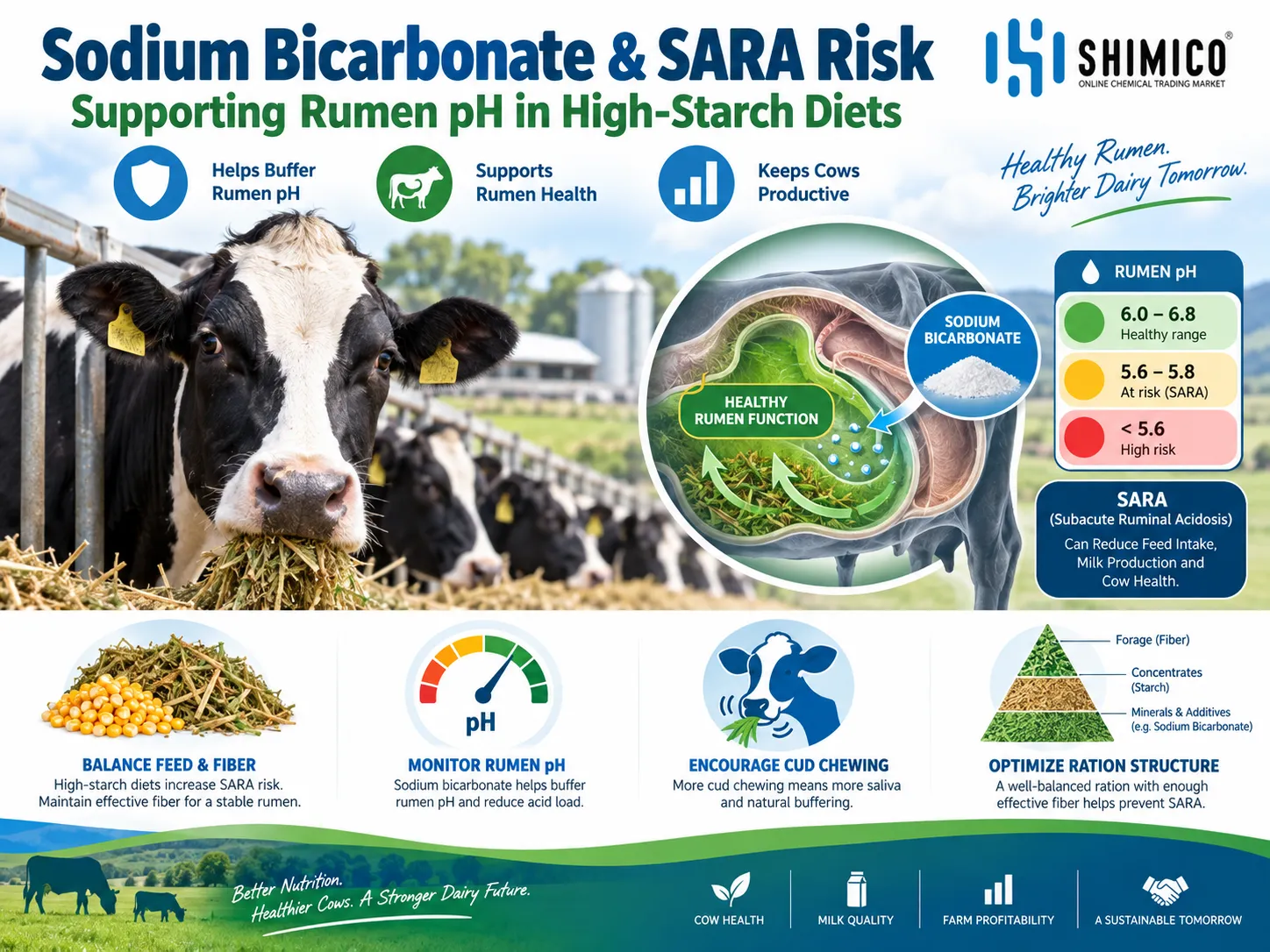
When Sodium Bicarbonate for Dairy Cows Is Most Likely to Help
Response is more likely when cows receive high-concentrate diets, highly fermentable starch, finely processed forage, limited effective fiber, or when milk fat is being suppressed by a low-pH fermentation pattern.
Cows that already receive adequate forage structure and moderate starch may show little production response to extra buffer.
An older but still informative review of neutralizing agents concluded that sodium bicarbonate responses are inconsistent in some high-forage situations. This is a useful reminder: buffer response is ration-dependent, not guaranteed.
Sodium Bicarbonate for Dairy Cows Is Not a Treatment for Acute Grain Overload
Acute grain overload is a veterinary emergency. A cow with severe depression, dehydration, weakness, ataxia, abdominal distention or signs of acute acidosis should not be managed by simply adding feed-grade bicarbonate to the bunk. Diagnosis, fluid therapy and other treatment decisions belong to a veterinarian.
Need Feed-Grade Sodium Bicarbonate in Bulk?
Shimico supplies Feed-Grade Sodium Bicarbonate for dairy farms, feed mills, livestock operations and industrial buyers in bulk and tonnage orders. Request current pricing based on required quantity, packaging, destination, COA and delivery terms.
Bulk & Tonnage Supply |
Feed-Grade Quality |
COA & Technical Documents |
25 kg Bags & Bulk Packaging |
Domestic & Export Orders
Request Bulk Sodium Bicarbonate Price
For pallet, truckload and high-volume purchasing, send your required tonnage and delivery destination to receive a commercial quotation.
Sodium Bicarbonate for Dairy Cows and Milk Fat: What the Research Shows
Milk fat response is one of the main reasons sodium bicarbonate remains common in dairy rations. Low rumen pH can change microbial biohydrogenation and increase trans-10 fatty acid intermediates associated with milk fat depression. A buffer does not create milk fat directly. It can change the rumen conditions that influence milk fat synthesis.
A 2025 review on milk fat depression describes sodium bicarbonate and magnesium-based alkalizing agents among nutritional tools used to stabilize ruminal conditions in high-starch diets. The review emphasizes that proper diet formulation remains the first line of prevention.
Sodium Bicarbonate for Dairy Cows and Butterfat Response
In a controlled dairy-cow trial comparing limestone, sodium bicarbonate and calcareous marine algae, both buffer treatments increased milk fat compared with the control, while the effects on rumen pH and production differed among buffer sources. Sodium bicarbonate was fed at 180 g per cow per day in that study. PubMed provides the study abstract.
The useful lesson is not that 180 g is the correct rate everywhere. The lesson is that milk fat response depends on the acid challenge, buffer type and entire ration.
Sodium Bicarbonate for Dairy Cows Cannot Fix Milk Fat Depression Caused by Every Diet
Milk fat depression can also involve unsaturated fat load, fermentable starch, forage particle size, feed sorting and specific biohydrogenation pathways. A buffer may help when low rumen pH contributes to the problem. It will not correct every cause by itself.
Sodium Bicarbonate for Dairy Cows During Heat Stress
Heat stress changes more than feed intake. Cows breathe faster to lose heat, which increases carbon dioxide loss. Blood bicarbonate can fall, saliva buffering can decline, drooling can increase, and cows often shift feed intake toward fewer, larger meals during cooler hours. That pattern can increase the risk of low rumen pH.
University of Wisconsin Extension explains that heat-stressed cows may need diet adjustments in sodium, potassium and magnesium, while adequate fiber and controlled starch remain central. Their guidance places sodium bicarbonate up to about 0.5% to 1% of DM when more buffer is needed.

Sodium Bicarbonate for Dairy Cows During Heat Stress Adds Both Buffer and Sodium
Sodium bicarbonate supplies sodium without chloride. That can be useful in a lactating-cow DCAD program when sodium needs rise during hot weather. It also means the nutritionist must count the sodium contribution. Buffer is not “free mineral space.”
UW Extension cites sodium around 0.4% to 0.6% of ration DM and potassium around 1.5% to 1.6% during heat stress as general targets in the referenced summer-management framework, with magnesium also adjusted when potassium rises. These are ration-level numbers that belong in a complete formulation.
Heat-stress point:
If cows eat less during heat stress, do not assume the same daily grams of sodium bicarbonate still represent the same percentage of dry matter. Recalculate on current intake and review total sodium, potassium and magnesium.
Sodium Bicarbonate for Dairy Cows and DCAD: Lactating Cows vs Close-Up Dry Cows
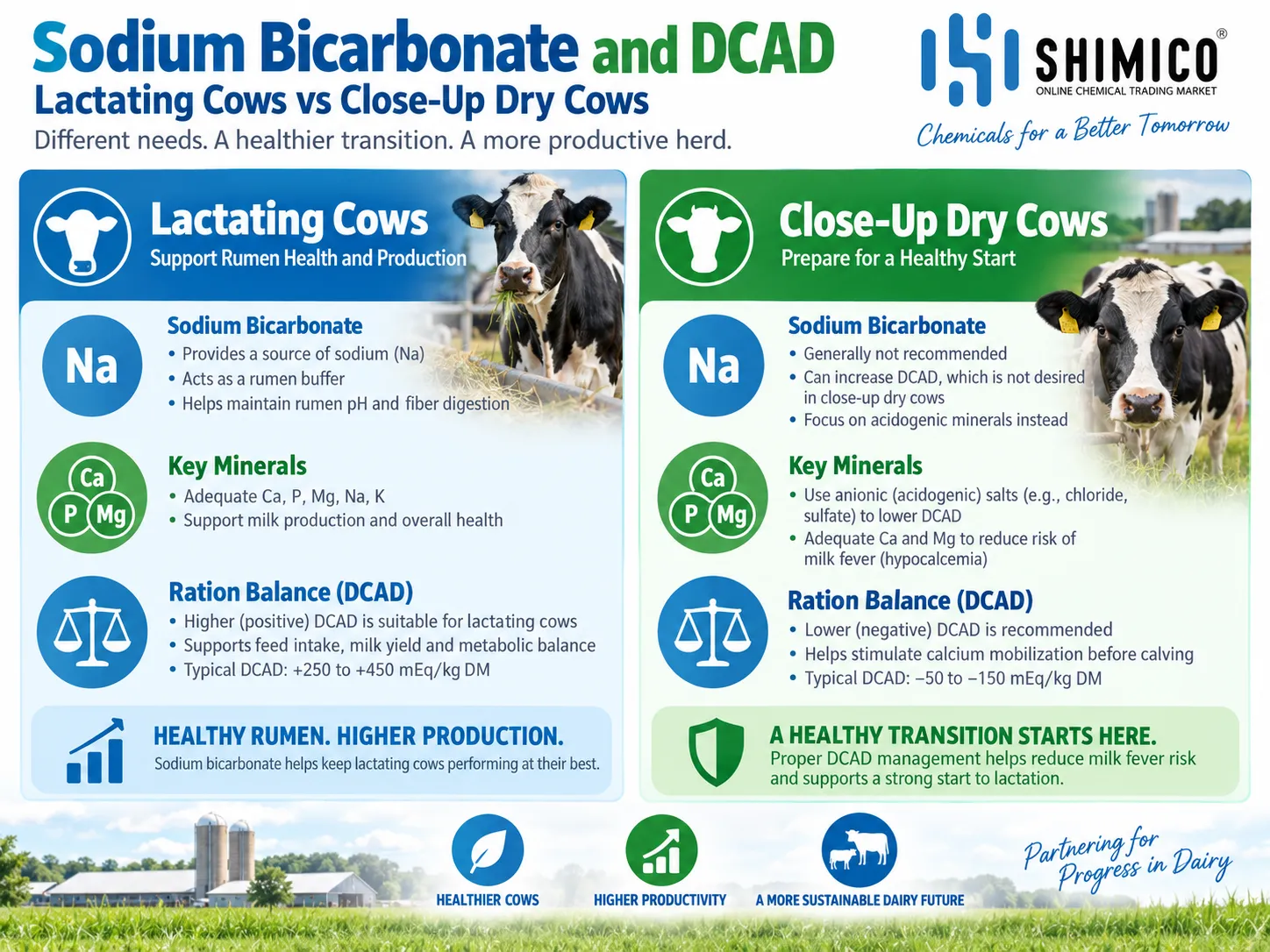
This is one of the most frequently missed points in generic articles. Sodium bicarbonate is a sodium source, so it raises the cation side of dietary cation-anion difference. That can be useful in lactating cows. It can conflict with a deliberately negative-DCAD close-up dry-cow program.
University of Wisconsin Extension explains that pre-fresh cows are often fed a negative DCAD diet for about 21 days before calving to support calcium homeostasis and reduce milk-fever risk. Sodium and potassium are cations in that calculation.
Should Sodium Bicarbonate for Dairy Cows Be Fed to Pre-Fresh Dry Cows?
Not automatically. If the close-up ration is designed to be negative DCAD, adding sodium bicarbonate without recalculating the ration can work against the target. The right answer depends on the dry-cow program, urine pH monitoring, forage mineral content and anionic supplement strategy.
Sodium Bicarbonate for Dairy Cows After Calving Is a Different DCAD Question
Postpartum lactating diets often use a positive DCAD, especially in hot weather. The mineral strategy before calving and after calving is not the same. Articles that discuss sodium bicarbonate without separating these two stages can lead to poor ration decisions.
Close-up cow warning:
Do not add sodium bicarbonate to a negative-DCAD prepartum ration unless the nutritionist recalculates DCAD. Sodium is a cation and can move the ration away from the intended acidogenic target.
Sodium Bicarbonate for Dairy Cows vs Magnesium Oxide and Sodium Sesquicarbonate
Sodium bicarbonate is not the only dietary buffer or alkalizing agent used in dairy nutrition. Magnesium oxide, sodium sesquicarbonate and other mineral products appear in commercial rations. They do not behave identically and they contribute different minerals.
The right comparison starts with the ration problem. If the diet needs rumen buffering plus sodium, sodium bicarbonate can fit. If magnesium supply is also a limiting factor, MgO may serve a separate mineral purpose.
Sesquicarbonate provides sodium with different neutralizing characteristics. The final choice should be made in the full ration, not by comparing price per kilogram alone.
Sodium Bicarbonate for Dairy Cows vs Magnesium Oxide
Research in starch-rich dairy diets has shown that both NaHCO3 and magnesium-based alkalizing agents can reduce the duration of low rumen pH and improve milk fat-related outcomes. Their mineral contributions differ, so one cannot be swapped gram-for-gram without reformulation.
Sodium Bicarbonate for Dairy Cows vs Sodium Sesquicarbonate
Penn State groups sodium bicarbonate and sesquicarbonate together as ration buffers in its discussion of rumen function. The purchasing decision should compare neutralizing value, sodium contribution, particle size, cost, availability and feed-mill handling.
Feed-Grade Sodium Bicarbonate for Dairy Cows: Quality, Purity and COA Checks
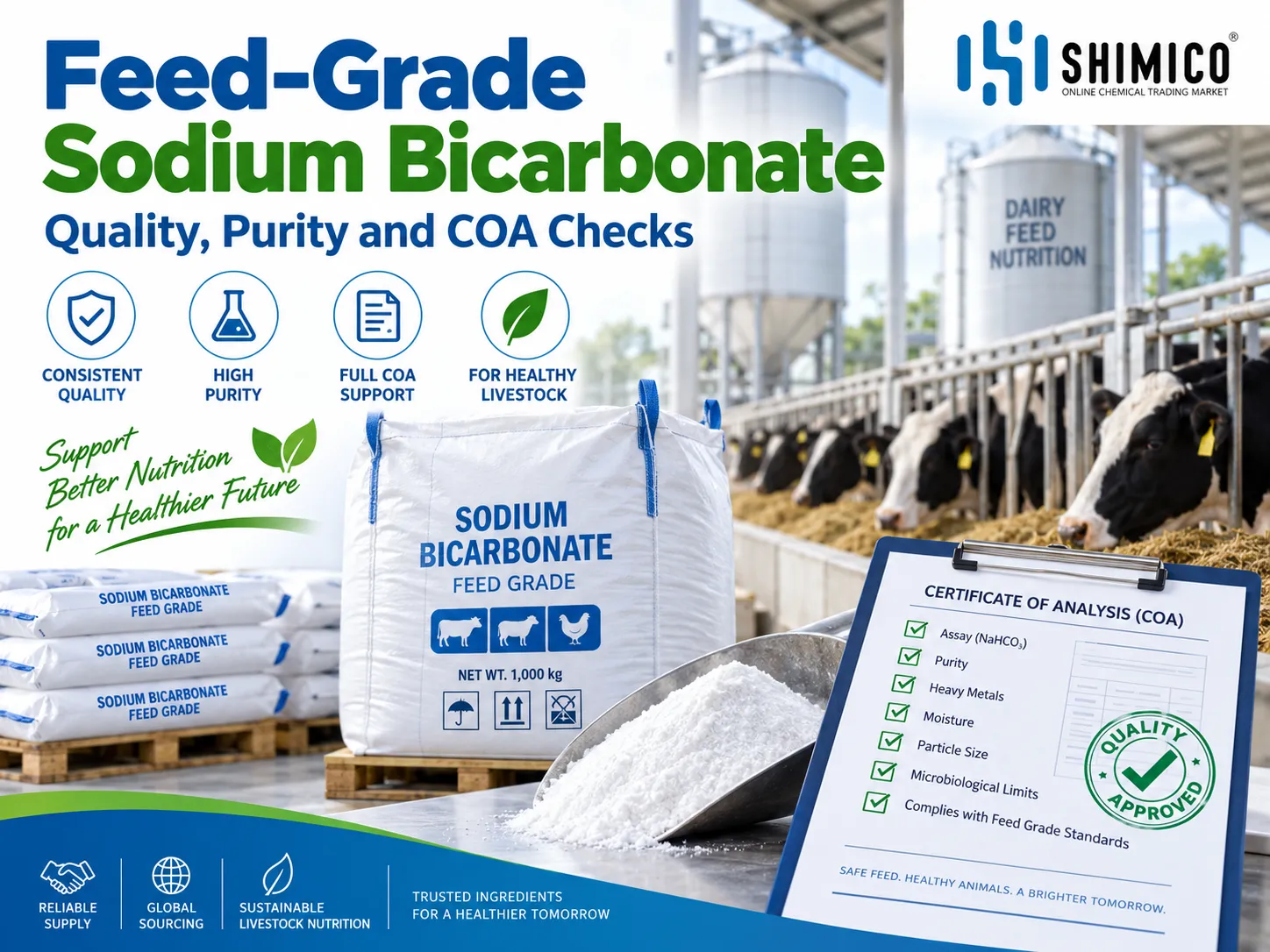
A dairy farm buying a few bags and a feed mill buying a full truckload face different quality risks. Feed-grade sodium bicarbonate should come with traceability and a specification suitable for animal feed. Industrial-grade material should not be assumed safe for feed simply because the chemical formula is NaHCO3.
Feed-focused manufacturers publish dedicated animal-nutrition grades. Solvay’s animal-feed sodium bicarbonate page identifies CAS 144-55-8 and positions the material specifically for animal nutrition. Its feed documentation also emphasizes traceability and product-quality controls.
Feed-Grade Sodium Bicarbonate for Dairy Cows: What Should Be on the COA?
The COA should identify the lot and show the parameters agreed in the purchase specification. Common purchasing points include NaHCO3 assay, moisture or loss on drying, carbonate-related alkalinity, particle-size range and limits for relevant contaminants. Exact limits depend on the applicable feed standard and supplier specification.
Food-Grade vs Feed-Grade Sodium Bicarbonate for Dairy Cows
Chemically, food-grade and feed-grade sodium bicarbonate are still NaHCO3. The difference is not the formula. The difference is the intended market, specification, documentation, certification, particle-size design and economics.
A high-purity food or USP grade may meet very tight chemical standards, but it can be unnecessarily expensive for bulk dairy feeding. Feed-grade material should meet the relevant animal-feed requirements and buyer specification.
Sodium Bicarbonate for Dairy Cows: How to Add It to a TMR
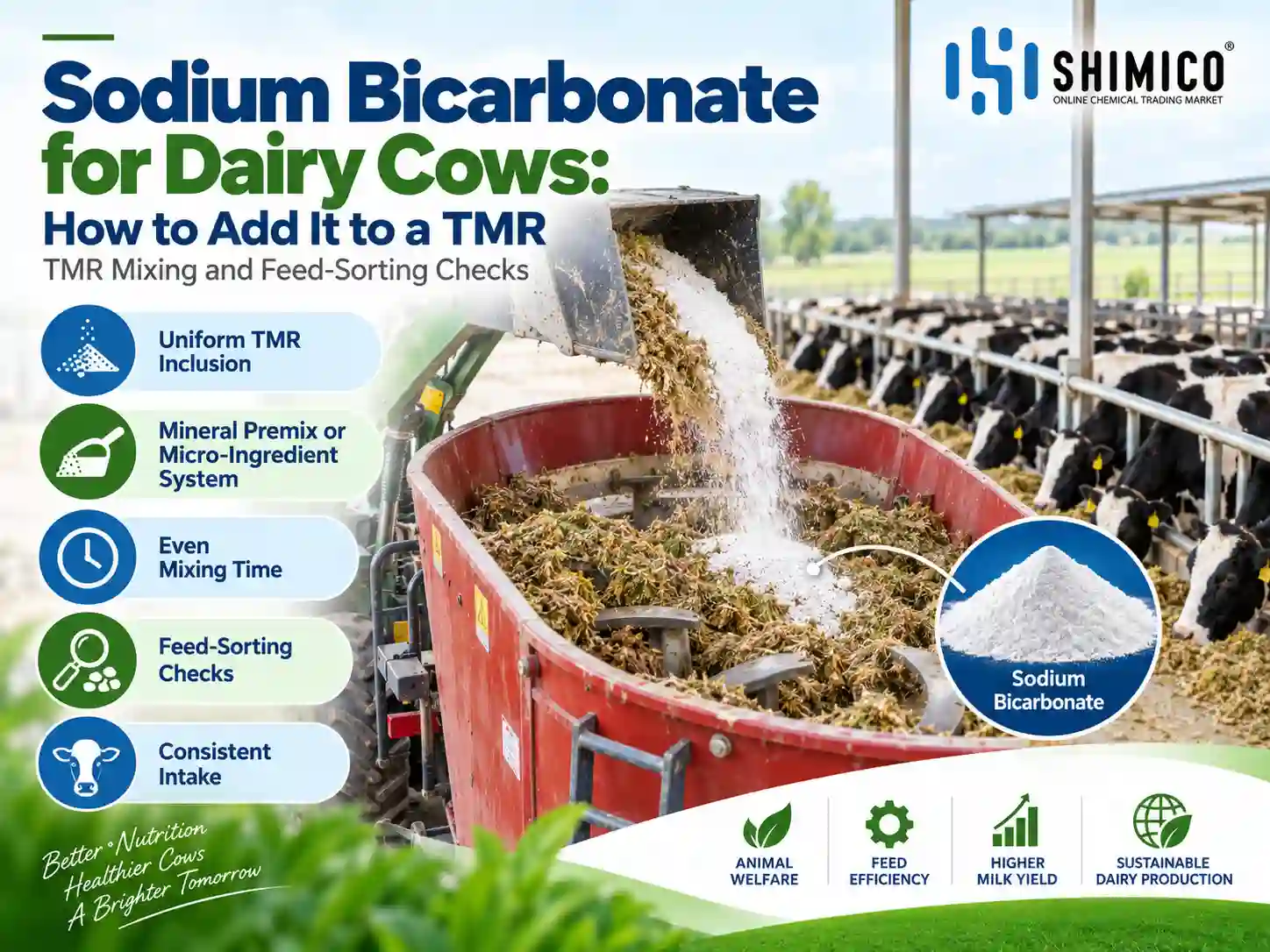
Uniform distribution matters because sodium bicarbonate is fed at a relatively small inclusion rate compared with forage and grain. Large feed mills usually add it through the mineral-premix or micro-ingredient system.
On-farm TMR mixers can add it with other dry minerals, provided mixer sequencing and mixing time give even distribution.
Adding it in one concentrated pocket of feed can cause inconsistent intake. Free-choice access can be used in some management systems, but intake becomes harder to quantify. For commercial dairies that formulate closely, controlled inclusion in the TMR gives better accounting of sodium and buffer intake.
Sodium Bicarbonate for Dairy Cows: TMR Mixing and Feed-Sorting Checks
Buffer use should be paired with feed-management checks. Look at refusals, particle distribution, bunk heating, feeding frequency and whether cows sort against longer forage. A Penn State Particle Separator can help evaluate TMR particle distribution. If cows sort heavily, the analyzed ration and the consumed ration are not the same ration.
Sodium Bicarbonate for Dairy Cows: Myths That Can Cost a Dairy Money
Several claims about bicarbonate are repeated so often that they sound like rules. They are not.
Myth: Sodium Bicarbonate for Dairy Cows Always Increases Milk Yield
Production response is inconsistent when the ration does not need extra buffering. Research responses are strongest when cows are exposed to a diet that creates an acid challenge. Buying buffer for a ration that is already stable may add cost without measurable return.
Myth: Sodium Bicarbonate for Dairy Cows Prevents All Acidosis
It can raise buffering capacity. It cannot compensate for severe feed sorting, poor bunk management, abrupt grain changes, inadequate fiber or acute grain overload.
Myth: More Sodium Bicarbonate for Dairy Cows Means Better Rumen pH
Higher inclusion also means more sodium and higher DCAD. The correct rate is the one that fits the total ration. Excess inclusion can disrupt mineral balance and add unnecessary cost.
Myth: Baking Soda and Feed-Grade Sodium Bicarbonate for Dairy Cows Are Always Interchangeable
The molecule is the same, but purchasing standards are not. A feed mill needs feed-suitable documentation, traceability, contaminant controls and consistent physical properties. Household baking soda is not a practical specification for a commercial TMR program.
Sodium Bicarbonate for Dairy Cows: A Practical Ration Review Before Increasing the Dose
Before increasing sodium bicarbonate, review the ration in the same order that a dairy nutritionist would diagnose the acid load.
Start with dry matter intake and forage analysis, then inspect NDF, physically effective fiber, starch percentage and starch fermentability. Review added fat, feed sorting and meal pattern. Only after that should the buffer rate be changed.
A buffer can be thought of as a shock absorber. A shock absorber helps when the road is rough. It does not repair a broken axle. If the TMR is fundamentally wrong, bicarbonate cannot make it right.
Ration review sequence:
Check actual DMI, forage NDF, effective fiber, starch level and fermentability, feed sorting, bunk management, total sodium, potassium, magnesium and DCAD. Then calculate sodium bicarbonate as a percentage of dry matter and convert it to grams per cow.
Buy Feed-Grade Sodium Bicarbonate for Dairy Cows: Bulk Purchasing Guide
Large dairies and feed manufacturers usually buy sodium bicarbonate by pallet, truck or bulk shipment. Price per ton matters, but the cheapest offer is not automatically the lowest-cost feed ingredient if the material cakes, segregates in the premix, lacks traceability or arrives without the required feed documentation.
A commercial RFQ should state the intended use as animal feed, requested assay or standard, particle-size preference, packaging, annual or monthly volume, delivery point, COA requirement, country of origin and required certifications. That produces comparable quotations.
Feed-Grade Sodium Bicarbonate for Dairy Cows: Bulk Packaging and Storage
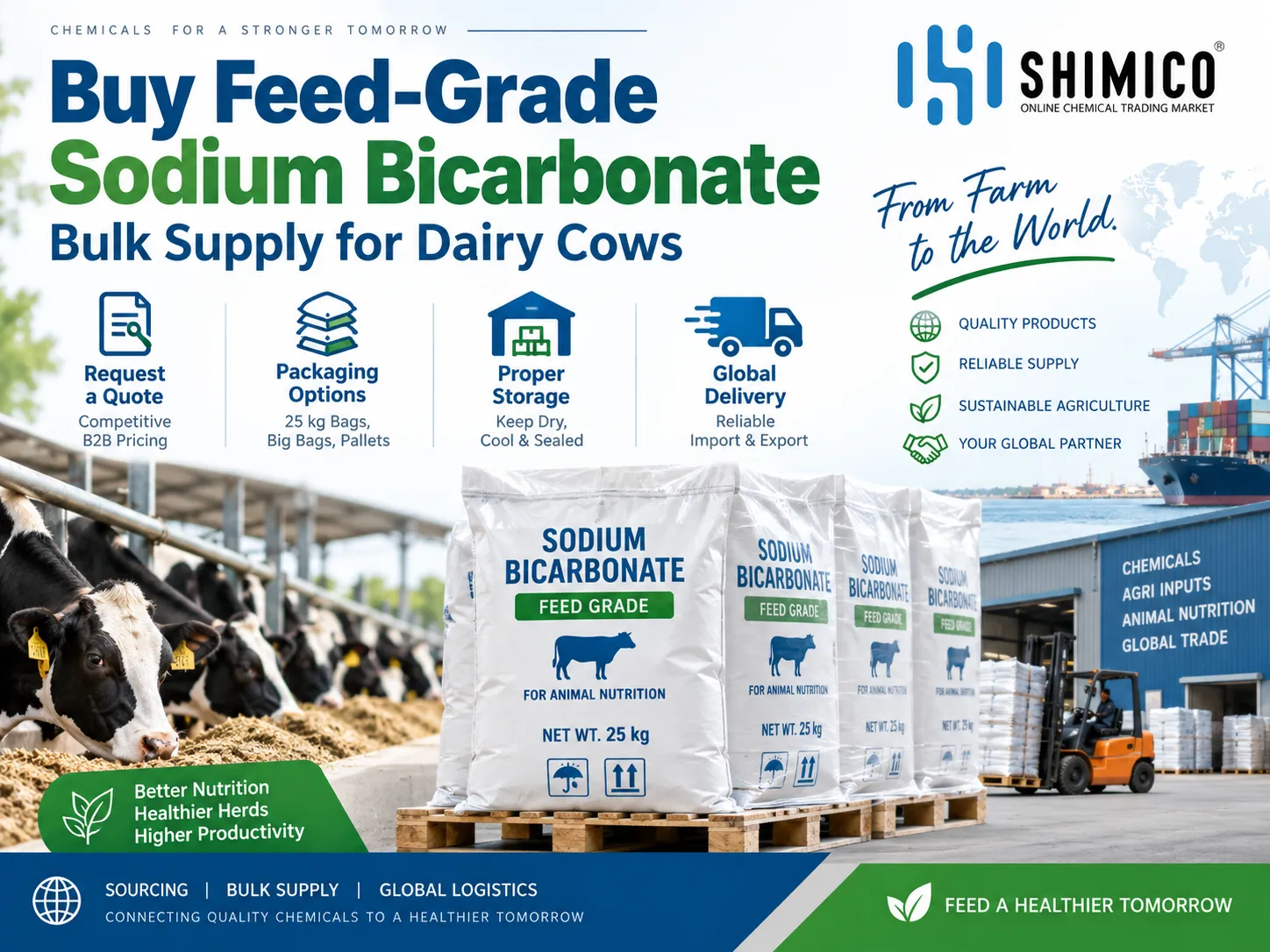
Common commercial formats include 25 kg bags, larger sacks and bulk systems depending on supplier and destination. Keep sodium bicarbonate dry. Moisture can cause caking and poor flow. Warehouses and feed mills should use lot rotation and retain receiving records that match the supplier COA.
For buyers comparing suppliers, Shimico can be used to review chemical and feed-related supply options. The existing sodium bicarbonate product page can also support internal linking from this educational article.
Buy Feed-Grade Sodium Bicarbonate for Dairy Cows in Bulk
Compare sodium bicarbonate suppliers by feed-grade documentation, assay, particle size, packaging, COA, origin, delivery terms and bulk price.
Sodium Bicarbonate for Dairy Cows FAQ
How much sodium bicarbonate should a dairy cow get per day?
University guidance commonly places sodium bicarbonate around 0.5% to 1.0% of ration dry matter when extra buffering is needed. A cow eating 24 kg of dry matter would receive 120 to 240 g/day across that range. The final rate must be calculated with the full ration.
What does sodium bicarbonate do in dairy cows?
It provides bicarbonate to increase rumen buffering capacity and sodium to the diet. It can help limit low-pH periods in acid-challenging rations and may support milk fat and feed intake when the ration is responsive to buffering.
Can sodium bicarbonate prevent SARA in dairy cows?
It can reduce acid pressure in suitable rations, but it does not replace effective fiber, gradual feed transitions or sound bunk management. SARA risk should be managed through the full ration and feeding system.
Does sodium bicarbonate increase milk fat?
It can improve milk fat in some high-starch or low-pH situations by supporting rumen conditions associated with normal fiber digestion and fatty-acid biohydrogenation. Response is not guaranteed in every ration.
Is sodium bicarbonate useful during dairy cow heat stress?
It can be useful because heat stress can reduce saliva buffering and alter feeding behavior, while sodium needs may also rise. The buffer rate and mineral program should be reformulated using current dry matter intake.
Should sodium bicarbonate be fed to close-up dry cows?
Not automatically. Sodium bicarbonate supplies sodium and raises DCAD. Many close-up dry-cow programs intentionally use negative DCAD before calving, so bicarbonate can conflict with the target unless the ration is recalculated.
What is the difference between feed-grade and food-grade sodium bicarbonate?
The chemical formula is the same, but specifications, certifications, traceability, particle size and intended use can differ. Commercial dairies and feed mills should buy material documented for animal-feed use.
Can sodium bicarbonate replace magnesium oxide in a dairy ration?
Not gram-for-gram. Both can affect rumen acidity, but their mineral contributions differ. Any substitution requires a ration reformulation.
Scientific Sources for Sodium Bicarbonate for Dairy Cows
1. From Feed to Milk: Understanding Rumen Function
Penn State Extension
Source link
2. Dairy Cattle Ration Management During Summer
University of Wisconsin-Madison Division of Extension, revised 2024
Source link
3. Invited Review: Ruminal Acidosis and Its Definition
Journal of Dairy Science, 2024
Source link
4. Modulation of Ruminal pH, Milk Fat Secretion, and Biohydrogenation Intermediates by Alkalizing Agents
Animal, 2021
Source link
5. Effect of Buffering Dairy Cow Diets with Limestone, Marine Algae, or Sodium Bicarbonate
Journal of Dairy Science, 2015
Source link
6. Milk Fat Depression in Dairy Cattle: Etiology, Prevention, and Recovery Approaches
Dairy, 2025
Source link
7. Negative DCAD Diets for Milk Fever Prevention in Dairy Cattle
University of Wisconsin-Madison Division of Extension
Source link
8. BICAR Z Animal Feed
Solvay, animal nutrition product documentation
Source link
Final feeding note: Sodium bicarbonate is a ration tool, not a stand-alone treatment. Set the inclusion rate from dry matter intake and the complete ration. Review fiber, starch, feed sorting, sodium, potassium, magnesium, DCAD and production stage before increasing the buffer.
Last Seen


Users Comment
Sulfur Fungicide: How It Works, Uses and Safety Precautions
Types of Sulfur Fertilizers: Powder, Granular, Liquid & Sulfate Forms
Sulfur for Soil: Benefits, Uses and How to Apply It
Sulphur 80 WDG: Technical Specifications, Uses & Bulk Supply
Sulfur WDG: Water Dispersible Granules, Uses & Bulk Supply
Sulphur WDG Pakistan: Bulk Supply, Prices & Import Guide
Sulfuric Acid Supply to Turkey: Price, Transport and Import Guide
Why Sulfuric Acid Is King and Benzene Is Called Queen
Buy Basic Chromium Sulfate in Pakistan: BCS Price, Wholesale Supply
How Urea Can Hydrate and Exfoliate Your Skin
Sodium carbonate| Soda ash; features and applications
Copper Sulfate; Features and applications