


Sulfur Fungicide: How It Works, Uses and Safety Precautions
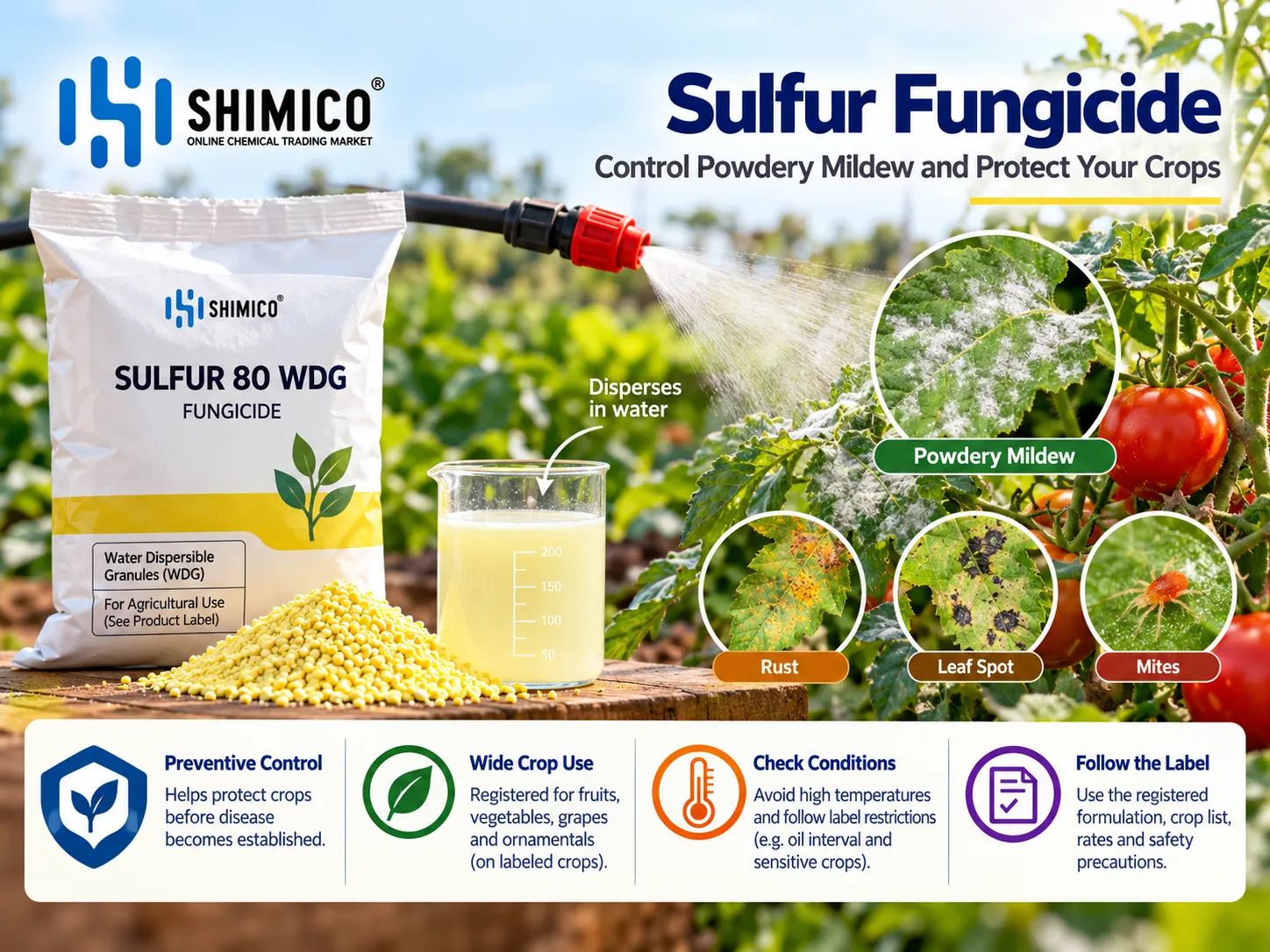
A sulfur fertilizer and a sulfur fungicide can carry the same chemical element, yet they are not interchangeable products. Sulfur fungicide is formulated and labeled to protect crops against specified fungal diseases and, on some labels, certain mites.
Agricultural sulfur sold for soil nutrition may have a different particle size, additives, purity standard and permitted use. A bright yellow powder does not become a legal or safe foliar pesticide merely because it contains sulfur.
What Is Sulfur Fungicide and How Does It Work?
If your question concerns nutrient uptake rather than disease control, compare the separate Sulfur WDG technical and supply guide and sulfur product listings. Plant nutrition, sulfur soil amendments and registered foliar pesticides serve different purposes.
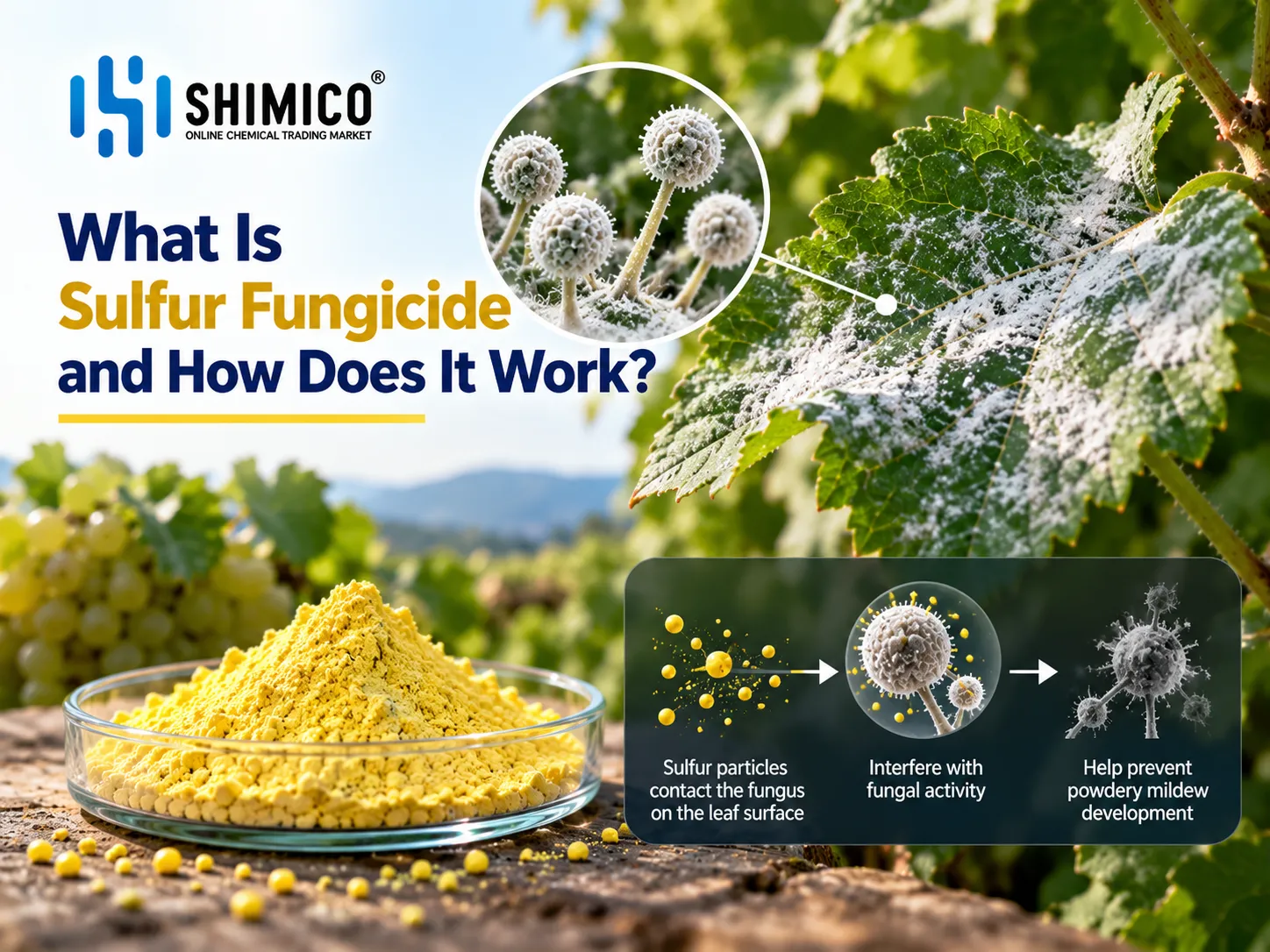
Sulfur has been used to manage fungal diseases for generations. Unlike a systemic fungicide that moves through plant tissues, most sulfur fungicide applications act mainly where they contact the plant surface. This makes good coverage important. It also means sulfur should not be treated as a guaranteed cure for a crop that is already heavily infected.
How sulfur fungicide works against powdery mildew
Powdery mildew often begins as small, white or gray powdery patches on leaves. The disease can spread as new tissue develops. Sulfur interferes with fungal activity at the treated surface and is widely used as a protectant. The University of California’s Integrated Pest Management guidance states that sulfur generally works best when applied before disease becomes established. UC IPM guidance for powdery mildew on vegetables explains both the preventive role and the possibility of plant injury.
Can sulfur fungicide cure an advanced infection?
It should not be presented as an instant rescue treatment. Once leaves are severely affected, the existing injury may remain even if disease pressure is reduced. A complete response may require removing badly infected material where appropriate, improving airflow, scouting new growth and choosing a treatment registered for the crop and disease. Follow local extension advice before combining multiple treatments.
Sulfur fungicide vs sulfur fertilizer
Sulfur fungicide targets disease under a pesticide label. Sulfur fertilizer supplies sulfur as a nutrient through an agricultural fertilization plan. The same active element does not erase the distinction between these end uses. For nutrient needs, consult the separate Shimico guide on types of sulfur fertilizers once its published URL is confirmed. For crop-protection formulation and trade specifications, see the Sulfur WDG technical overview.
Sulfur Fungicide Uses: Powdery Mildew, Mites and Crop Protection
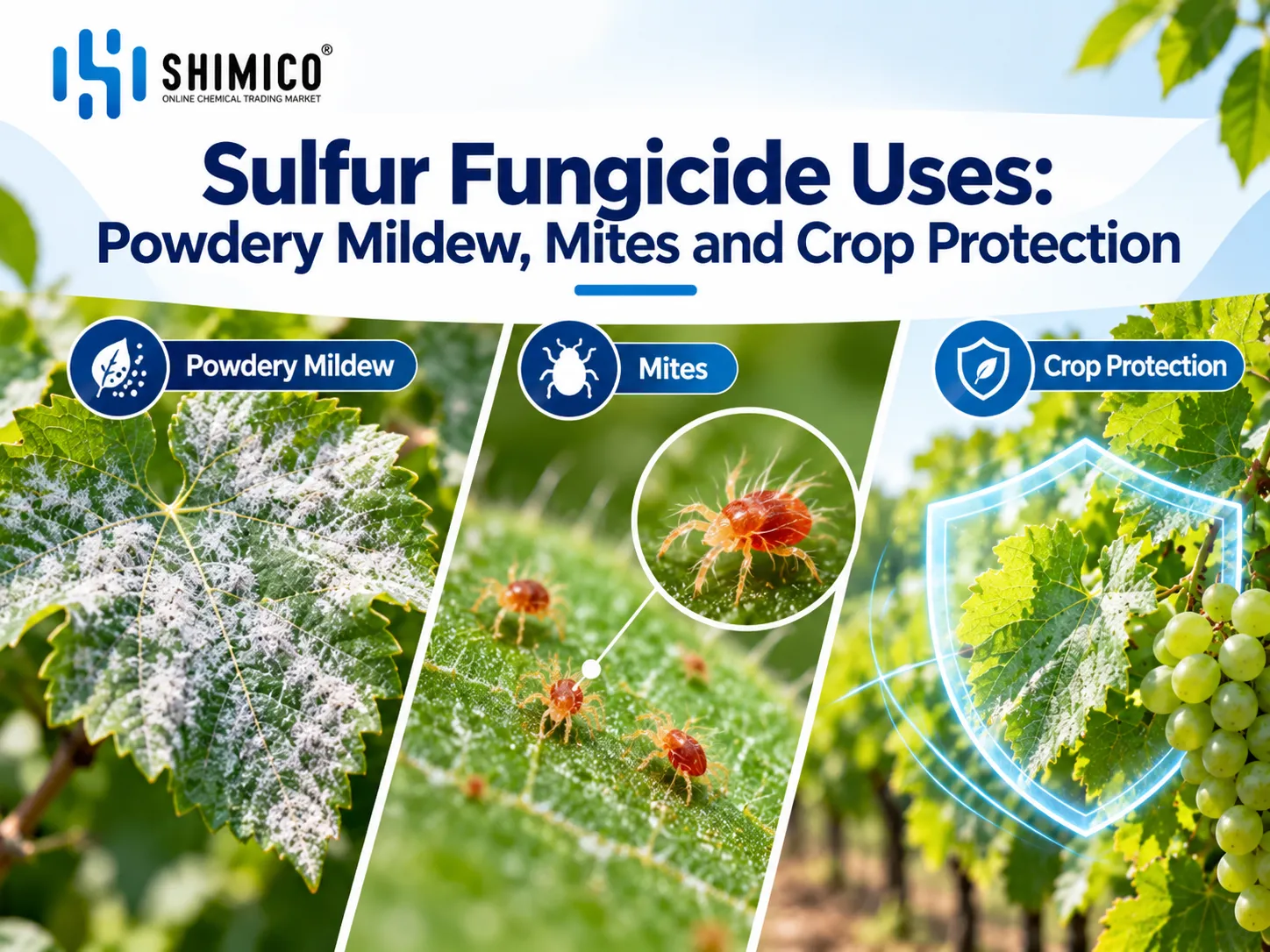
Powdery mildew is the most familiar reason growers search for sulfur fungicide. Some registered products also list certain mites, rust diseases or other pests. Those additional uses are product-specific. A label that permits sulfur on grapes against powdery mildew does not automatically authorize use on tomatoes, cucumbers or ornamentals.
Sulfur fungicide for powdery mildew
Powdery mildew fungi thrive under conditions that vary by crop and pathogen. White growth may appear on the upper leaf surface, stems or fruit. Applications made early, before extensive infection, have the best prospect of preventing further spread. Regular scouting and full coverage of susceptible tissue belong in the plan. UC IPM’s fruit and berry guide describes the protective role of sulfur on registered crops.
Can sulfur fungicide control spider mites?
Certain sulfur products are labeled for particular mite species, but this is not a blanket recommendation for every mite or crop. Identification is necessary because spider mites, broad mites and other species may require different management. Check the actual pest name in the registered label and consider biological-control compatibility where beneficial predatory mites are part of the program.
When sulfur is the wrong treatment
Sulfur is not a universal treatment for bacterial leaf spots, nutrient deficiencies, root problems or every fungal disease. Yellowing leaves caused by low sulfur nutrition will not be corrected by using a foliar pesticide as though it were fertilizer. The sulfur product listings on Shimico should be used to identify products and ask for their actual registered purpose, not to assume one product works for every agricultural need.
Sulfur 80 WDG vs WP vs Dust: Fungicide Formulations Compared
Buyers may see wettable powder, sulfur 80 WDG, sulfur dust and suspension concentrates. These names describe how the active ingredient is prepared and delivered. They do not mean sulfur has dissolved in water or that any grade can be used in any sprayer. The label, not the abbreviated formulation code alone, defines legal application.
Sulfur 80 WDG: water-dispersible granules
WDG stands for water-dispersible granules. The granules break into small particles when mixed as directed. They form a dispersion rather than a true solution. A commercial 80 WDG product typically contains an active sulfur percentage declared on its label, together with formulation aids. Buyers should inspect dispersion, suspended-particle behavior, equipment compatibility and the label’s crops and targets.
The EPA-accepted Sulfur 80 WDG label dated August 19, 2025 gives an example of product-specific spray, temperature, oil and crop restrictions. These directions apply to that registered product, not to every sulfur WDG sold worldwide.
Wettable sulfur powder and sulfur dust
WP, or wettable powder, is intended to disperse in water and commonly needs appropriate agitation. Dust products may be applied dry only when their labels authorize that use. Dry powders can raise inhalation and drift concerns, and the equipment differs from conventional liquid spraying. Mixing non-wettable industrial powder into a spray tank is not an acceptable substitute for a registered WP or WDG formulation.
| Form | Typical description | Handling consideration | Buyer must verify |
|---|---|---|---|
| WDG / WG | Water-dispersible granules | Dispersion and agitation | Label, particle performance and approved uses |
| WP | Wettable powder | Dust during loading, suspension | Wetting behavior and spray instructions |
| Dust | Dry application product | Drift, exposure and applicator equipment | Registered dry-use directions |
| Liquid suspension | Solid particles dispersed in liquid | Settling and nozzle compatibility | Stability, application label and storage |
How to Apply Sulfur Fungicide: Timing, Mixing and Coverage
A suitable sulfur fungicide program starts by answering three questions: Is the disease correctly identified? Does the label permit the product on the crop? Is the weather suitable during and after application? Only then should the applicator select equipment, water volume, mixing sequence and coverage methods.
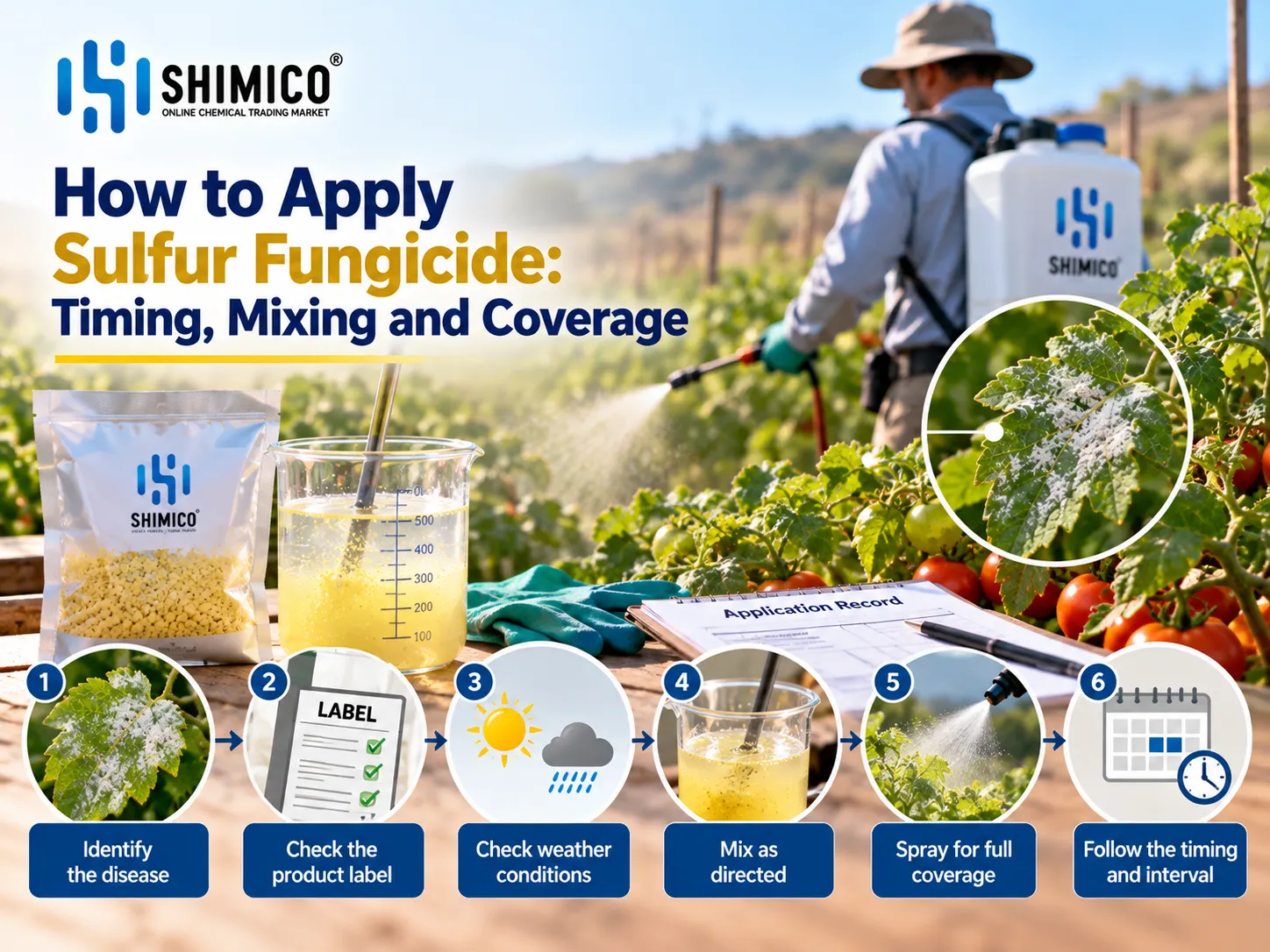
When to spray sulfur fungicide for powdery mildew
Preventive application is generally more useful than waiting for dense white fungal growth. Scouting, local disease forecasts and the crop’s growth stage help determine the treatment window. Do not assume every crop needs a seven-day schedule. Different products, regions, weather patterns and disease pressures result in different permitted intervals, stated on the label.
How to mix wettable sulfur or WDG
Use the manufacturer’s mixing instructions, including the order of loading, agitation and compatibility checks. For some WDG products, the label instructs applicators to prepare a slurry and add it to a partially filled tank. A different product may specify a different sequence. Keep the mixture moving as required so suspended particles do not settle. Follow the most restrictive label when a permitted tank mix involves more than one pesticide.
Does sulfur fungicide require complete leaf coverage?
Contact products need access to susceptible surfaces. Coverage matters on young leaves, leaf undersides and dense canopies, but excessive run-off and spray drift are undesirable. Calibrate nozzles, check pressure and inspect coverage according to label and local applicator guidance. New growth may not carry the protective deposit left on older leaves.
How to Apply Sulfur Fungicide: A Label-Based Spray Sequence
Begin by matching the disease and host crop to the product label. Read the restricted-entry interval, preharvest interval, permitted application equipment, personal protective equipment and mixing instructions. Measure only the labeled product quantity for the required spray volume. Prepare clean equipment, follow the specified mixing order and maintain agitation where the formulation needs suspension.
Aim for the coverage described on the label without assuming that heavier deposits give better control. Check underside exposure and dense foliage where relevant, while respecting drift rules, worker safety and nearby sensitive plants. Record product name, lot, crop, target, treatment date, weather and permitted re-entry or harvest dates. A spray record supports both field follow-up and buyer documentation.
How often should sulfur fungicide be sprayed?
There is no universal interval for every sulfur fungicide. Growth of new foliage, disease pressure, rainfall and the particular label can all change the schedule. Do not convert an interval published for one crop or product into a general recommendation. If infection is established, a preventive sulfur treatment alone may not reverse existing injury. Seek crop-specific disease advice and choose a registered program.
Sulfur Fungicide Safety: Temperature, Oil Sprays and Phytotoxicity
The same treatment that reduces powdery mildew pressure can injure foliage in unsuitable conditions. Air temperature, forecast heat, crop sensitivity, water stress and recent oil applications all change the risk of phytotoxicity. This is the strongest reason not to copy application instructions from an unrelated crop or foreign market.
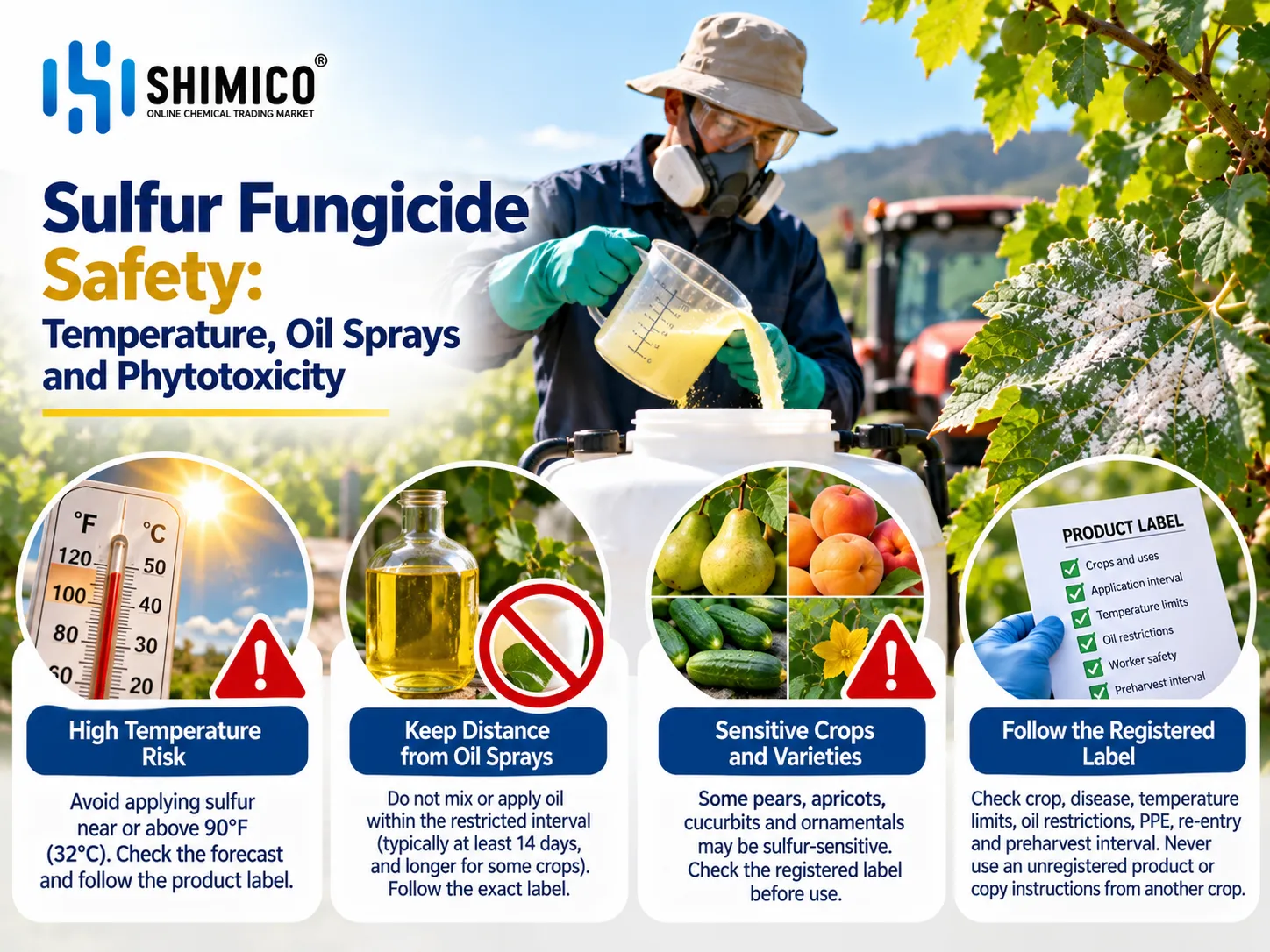
At what temperature is sulfur fungicide unsafe?
UC IPM advises avoiding sulfur applications near or above 90°F (about 32°C) for the crops covered in its home-garden guidance. The cited 2025 EPA label for a specific sulfur 80 WDG product states that the material must not be applied if the temperature is expected to exceed 90°F within three days following treatment. This is not a universal rule for all sulfur products. Local registration and the particular label control the application.
How long between sulfur fungicide and horticultural oil?
Oil can increase the likelihood of sulfur injury. UC IPM commonly warns against applying oil within two weeks of sulfur. The 2025 EPA WDG label includes distinct restrictions, with a longer specified interval for citrus. Other labels can require different separation periods. Never assume a single 14-day period applies to every crop and product.
Can sulfur fungicide damage sensitive crop varieties?
Yes. Certain pear types, apricots, some cucurbits and other plants may be sulfur-sensitive according to relevant pesticide labels. Crop variety and conditions can matter. A registered label may prohibit use on a species altogether or require local experience showing adequate tolerance. Do not experiment with a commercial crop if the label forbids the use.
Sulfur Fungicide for Grapes, Vegetables and Roses
A product can be an appropriate protectant in one crop and unsuitable in another. Crop coverage and disease status must be verified on the label. A vineyard spray program, a tomato greenhouse program and a home rose garden have different conditions, permitted products and exposure risks.
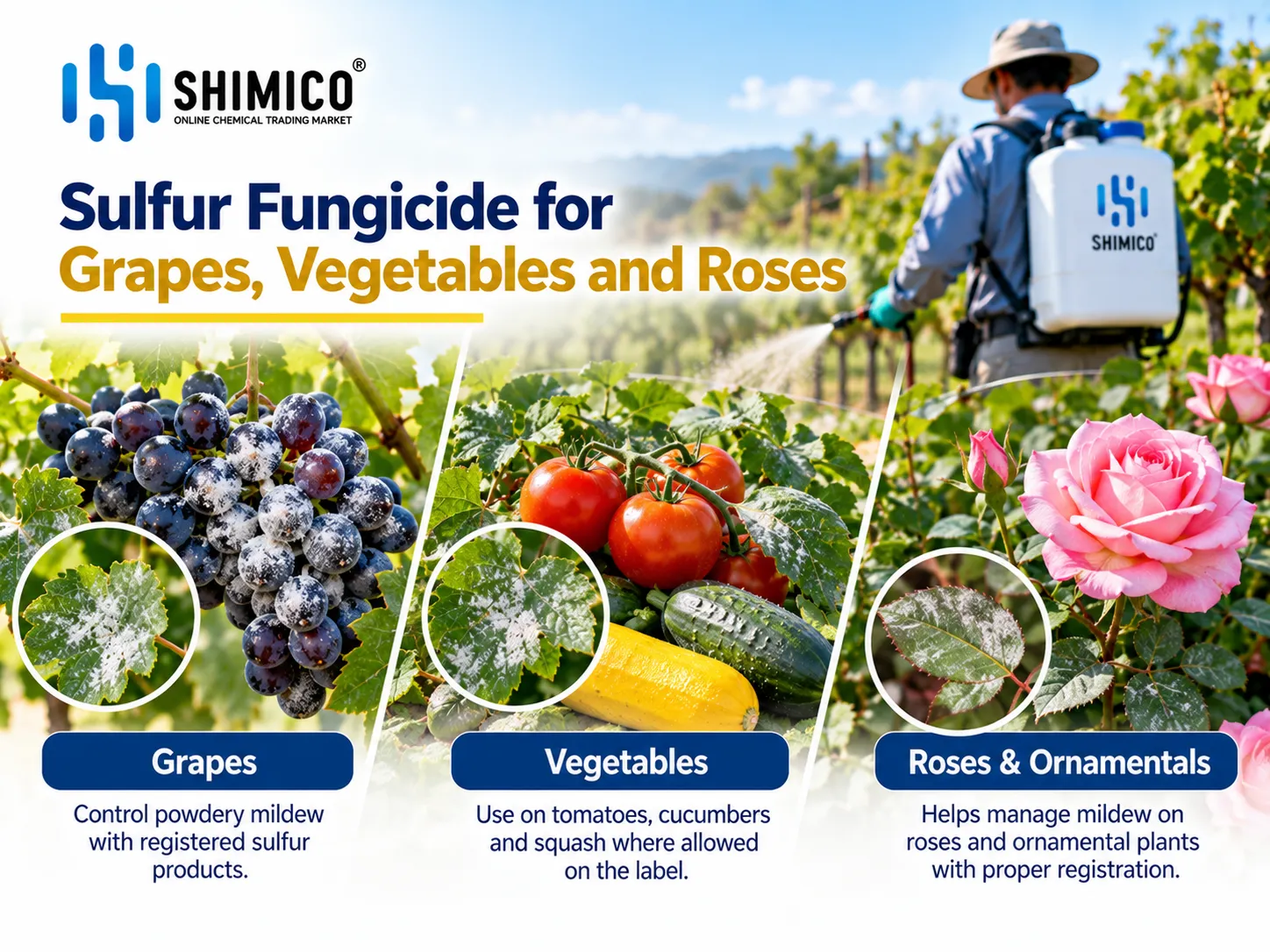
Sulfur fungicide for grape powdery mildew
Powdery mildew is an important vineyard disease, and sulfur has a long history in grape protection programs. Successful use depends on cultivar, timing and weather. Sulfur-sensitive grape varieties may be damaged. Check label requirements concerning treated acreage, re-entry time and the harvest period. For a separate discussion of chemical properties and formulation supply, use Shimico’s global Sulfur WDG guide.
Sulfur fungicide for tomatoes, cucumbers and squash
Some wettable sulfur labels include certain vegetables, but not every label does. Cucurbits can be sensitive, and different melon or squash varieties may respond differently. A label approved for tomato powdery mildew cannot be carried over to cucumbers by assumption. In greenhouses, heat and exposure conditions may add another layer of risk.
Sulfur fungicide for roses and ornamental plants
Many growers encounter mildew or rust-like symptoms on ornamental foliage. Sulfur may be an option where registration allows it, but ornamental cultivars can differ in tolerance. Confirm the actual disease rather than treating any yellow leaf or brown spot with sulfur. This is where an extension disease-identification guide can prevent unnecessary spraying.
Best Sulfur Fungicide for Tomatoes: Disease Identification Comes First
The phrase best sulfur fungicide for tomatoes sounds like a simple product-shopping question. The useful answer begins with diagnosis. Tomato leaves can show powdery fungal growth, speckled lesions, early blight, bacterial spots or nutrient-related discoloration.
These problems do not call for the same treatment. A pale leaf or brown patch alone cannot confirm powdery mildew. Check the pattern of symptoms, recent weather, affected plant tissues and local extension photographs before deciding to spray.
For tomato powdery mildew, a sulfur product may be an option only when the exact formulation is registered or labeled for tomatoes and the disease in the country of use. Some product labels include greenhouse or field distinctions. Others exclude certain crops or have limitations for sensitive varieties. A generic bag of agricultural sulfur is not a substitute for a tomato-labeled pesticide.
When sulfur fungicide for tomatoes is a poor choice
Sulfur is a poor fit if the apparent disease is bacterial rather than fungal, the canopy is heat-stressed, plants recently received horticultural oil, or the selected sulfur product lacks tomato instructions. Visible, widespread infection also calls for an integrated management plan rather than an assumption that a protectant spray will restore damaged leaves. Scout the youngest foliage, check ventilation and avoid crowding that allows disease to spread.
Sulfur Fungicide for Cucumbers and Squash: Check Variety Sensitivity
Cucurbits are frequent targets of powdery mildew, yet certain cucumber, squash and melon cultivars can be sensitive to sulfur. UC IPM guidance for vegetable powdery mildew warns about crop injury and emphasizes preventive use. Never transfer a tomato or grape mixing rate to cucurbits. If a registered product is appropriate, begin with its crop-specific directions, crop condition, weather forecast and local pest guidance.
Sulfur Fungicide for Roses and Grapes: Different Crop Calendars
Rose beds, table grapes and wine grapes have different disease pressures, canopy structures and label requirements. Sulfur residue on the upper leaf surface does little for untreated surfaces. In grapes, spray coverage, new growth, vineyard disease monitoring and potential market or winery restrictions may influence the program. Ornamentals may show cultivar-specific leaf damage. The label and crop program must settle application timing, not a universal internet spray calendar.
Sulfur Fungicide vs Copper Fungicide and Neem Oil
Sulfur, copper and horticultural oils are not interchangeable merely because they appear in the same garden-care aisle. Their registered targets, mode of action, plant tolerance and safety restrictions differ.
Choosing among them requires a diagnosed problem and a legal label for the target crop. An oil may have activity against established superficial mildew in some situations where a preventive sulfur spray is less helpful, yet combining or sequencing the two products incorrectly can burn foliage.
UC IPM guidance for ornamentals describes different preventive and treatment roles for sulfur, oils and bicarbonate products. The goal is not to find a universally strongest fungicide. It is to choose an approved material at an appropriate disease stage without damaging the crop.
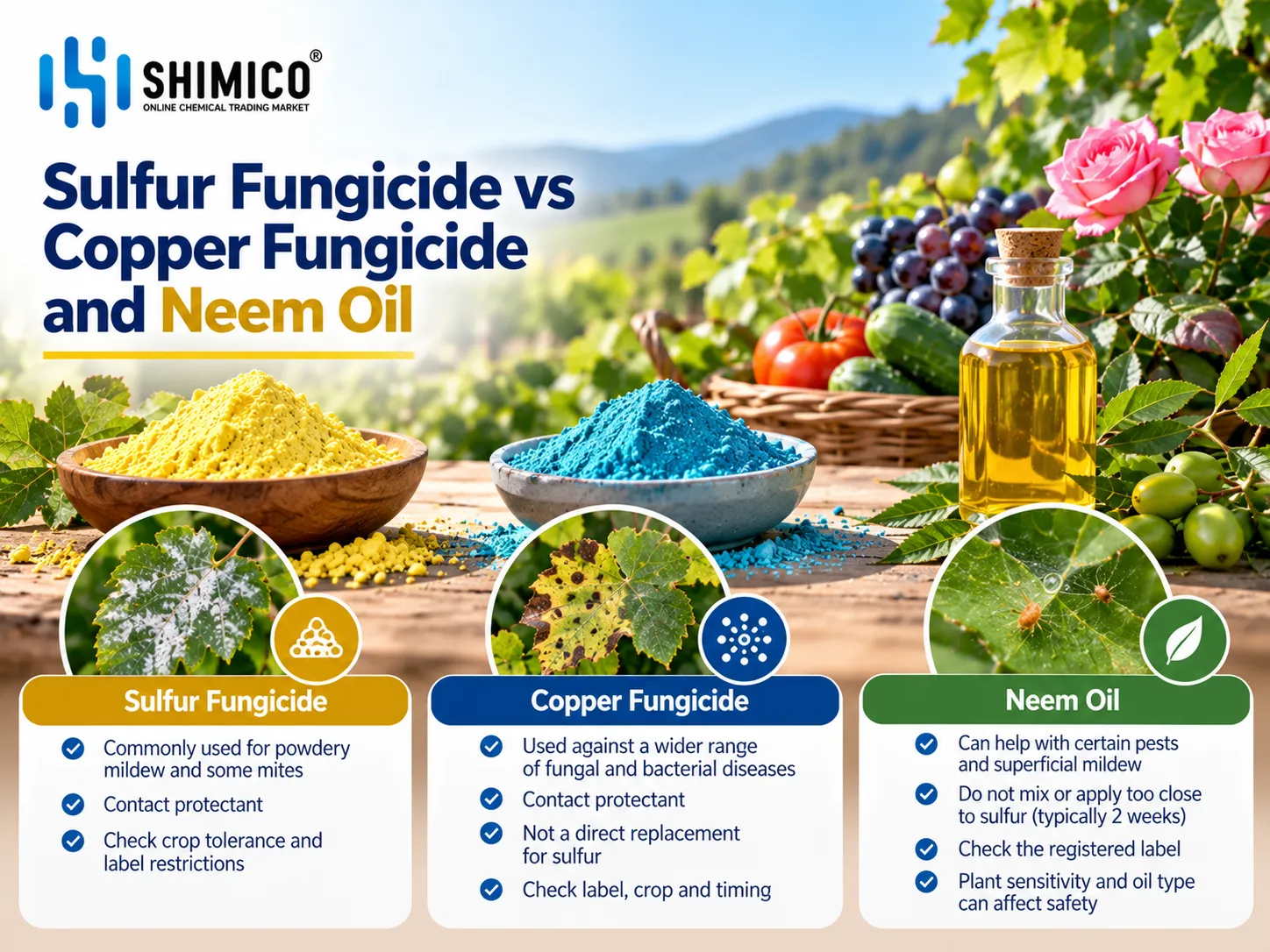
Sulfur Fungicide vs Copper Fungicide: Which Disease Is Being Targeted?
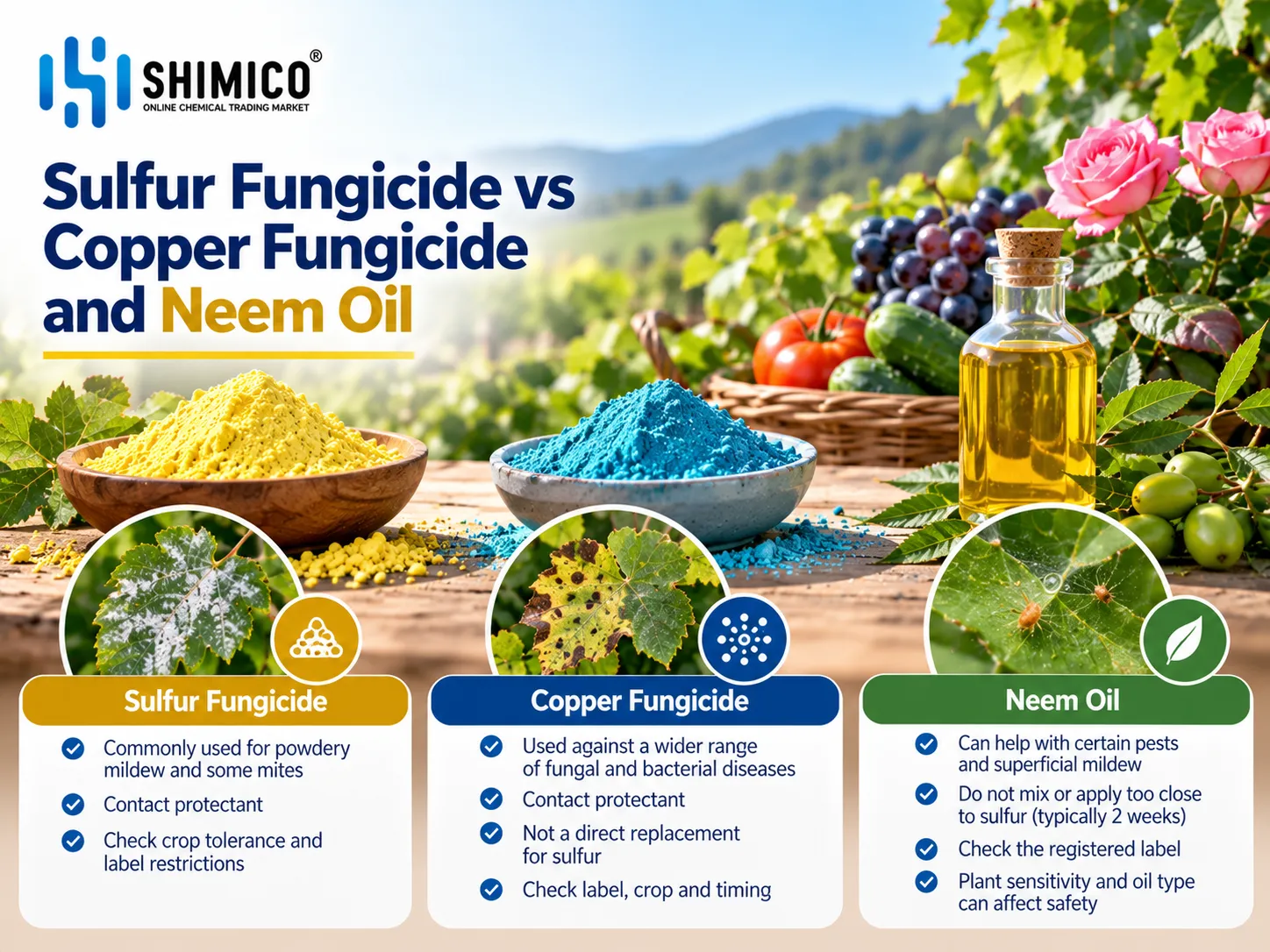
Sulfur and copper fungicides are both used as contact protectants in some crop programs, but they are not interchangeable. Sulfur is commonly associated with preventive powdery mildew management and some label-listed mites.
Copper products are frequently used against a wider mix of label-listed fungal and certain bacterial diseases. Whether either product is suitable depends on the pathogen, crop, local registration, timing and tolerance of the plant. Copper is not a blanket replacement for sulfur in a powdery mildew program.
A buyer comparing these products should start with a confirmed diagnosis, then compare the active ingredient, crop and disease listings on each registered label. Copper formulations differ among themselves, and repeated copper inputs may accumulate in soil. Both sulfur and copper can injure susceptible foliage under unsuitable conditions. Claims that one product is always safer, stronger or more effective are not defensible without a crop and disease context.
Sulfur fungicide vs copper fungicide: comparison for growers
A useful comparison starts with four questions: Is the problem powdery mildew, a bacterial leaf spot or another disease? Does the label name the crop? Is the material suitable during the current growth stage? How will this spray fit the broader resistance-management and residue program? The relevant choice may be neither sulfur nor copper if the diagnosis or label points elsewhere.
Sulfur Fungicide vs Neem Oil: Why Spray Intervals Matter
Neem and horticultural oils can have roles in some disease-management programs, but mixing them with sulfur or scheduling them too closely can cause phytotoxicity. UC IPM warns about a two-week separation around sulfur and oil in its home garden guidance, and some crops or registered products require longer. Treat that guidance as a warning, not permission to ignore the exact local label. A tank mixture is not proven safe because each ingredient is used separately in agriculture.
Organic Sulfur Fungicide: Does Organic Mean Crop-Safe?
Sulfur may be allowed in certain organic production systems subject to the applicable national standard and input approval, but an “organic” description does not establish unrestricted use.
Organic farms still need registered, crop-appropriate products and must follow application restrictions. Spray injury is possible on an organic crop just as on a conventional one. Verify program acceptance with the certifier and confirm the formulation, not just the active ingredient.
Buying Sulfur Fungicide in Bulk: WDG Specifications, COA and Supplier Checks
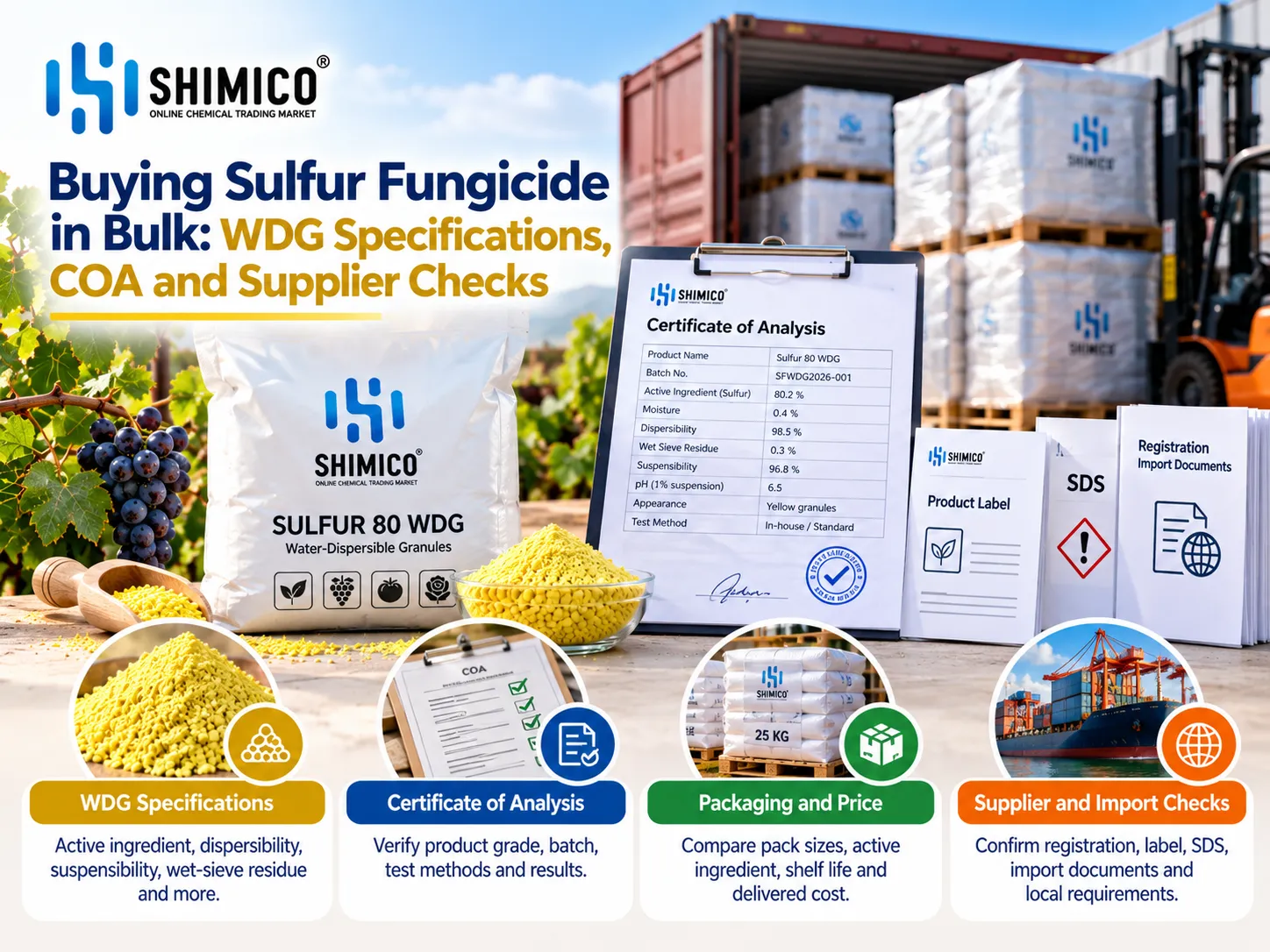
Commercial buyers may request sulfur 80 WDG, wettable sulfur, a suspension formulation or another registered pesticide product. A bulk order needs more than a price per metric ton. The buyer should establish the destination country’s registration requirements, intended crop uses, active ingredient declaration, packaging, shelf-life evidence and lot-level quality documents.
What should a sulfur fungicide COA include?
A certificate of analysis should identify the manufacturer, product grade, batch or lot, test methods and results required by the purchase contract. For WDG, relevant parameters may include sulfur content, dispersibility, suspensibility, wet-sieve residue, wettability, moisture and physical stability, depending on the specification.
Ask separately for the product label, SDS, registration evidence and any import documents. A COA alone does not prove permission to market or apply a pesticide.
How do sulfur fungicide packaging and price affect buying?
Packaging can include smaller labeled containers and commercial sacks. Availability depends on supplier and destination market. Compare delivered cost, active ingredient concentration, physical properties, shelf life, registration expenses and transport conditions. A cheap commodity sulfur powder is not an equivalent quote for formulated sulfur 80 WDG. For broader sourcing context, Shimico’s sulfur category lists the product family, while the Sulfur WDG page addresses formulation-oriented purchasing.
A buyer ordering for Pakistan should review country-specific registration and import documentation separately. The Sulphur WDG Pakistan guide is a related resource, although its published URL and current regulatory details should be verified before commercial reliance.
Compare Sulfur Formulations and Suppliers on Shimico
Specify your destination, formulation, batch documentation, intended crop-protection use and required registration evidence when requesting a quote. Chemical sellers can also list products on the platform.
Frequently Asked Questions About Sulfur Fungicide
These answers address common questions while preserving one important distinction: exact rates and timing come from the current registered product label. A general article cannot replace it.
What is sulfur fungicide used for?
Registered sulfur fungicides are used mainly to prevent or suppress certain fungal diseases, especially powdery mildew, and some products list particular mites. Use depends on the crop and label.
Does sulfur fungicide kill existing powdery mildew?
Sulfur is generally more useful as a preventive contact fungicide than as a cure for established heavy infection. Select an approved management plan based on disease stage.
Can sulfur fungicide burn plants in hot weather?
Yes. Crop injury is more likely in hot conditions and on sensitive crops. Many guidance documents caution against application near or above 90°F, while exact restrictions vary by label.
Can sulfur fungicide be applied with neem oil?
Do not mix or sequence sulfur with horticultural oils, including relevant neem formulations, unless the registered labels permit it. Required separation intervals differ by product and crop.
What is the difference between sulfur 80 WDG and WP?
WDG contains water-dispersible granules, while WP is a wettable powder. Both form dispersions and need the application and mixing instructions listed for the individual product.
Is sulfur fungicide the same as elemental sulfur fertilizer?
No. One is a pesticide formulation subject to crop-protection labeling, while the other supplies sulfur for crop nutrition or soil management. Similar chemistry does not authorize the same end use.
Scientific Sources for Sulfur Fungicide Uses and Safety
Additional registration example: US EPA registration record for Sulphur 80% WDG (86873-1). The listed crops and pest targets demonstrate why the specific product label matters more than the generic name sulfur fungicide. Registration in one jurisdiction does not authorize use in another.
The following resources provide pesticide-label restrictions and research-based crop protection guidance. Product directions take priority where they differ from general information.
- Sulfur 80 WDG Pesticide Product Label, US Environmental Protection Agency, August 19, 2025.
- Powdery Mildew on Vegetables, University of California Statewide IPM Program, date not specified on accessed page.
- Powdery Mildew on Fruits and Berries, University of California Statewide IPM Program, date not specified on accessed page.
- Powdery Mildew on Ornamentals, University of California Statewide IPM Program, date not specified on accessed page.
- Powdery Mildew: Floriculture and Ornamental Nurseries, UC IPM Pest Management Guidelines, date not specified on accessed page.
Last Seen


Users Comment
Types of Sulfur Fertilizers: Powder, Granular, Liquid & Sulfate Forms
Sulfur for Soil: Benefits, Uses and How to Apply It
Sulphur 80 WDG: Technical Specifications, Uses & Bulk Supply
Sulfur WDG: Water Dispersible Granules, Uses & Bulk Supply
Sulphur WDG Pakistan: Bulk Supply, Prices & Import Guide
Sulfuric Acid Supply to Turkey: Price, Transport and Import Guide
Sodium Bicarbonate for Dairy Cows: Rumen Buffer, Dosage, Milk Fat
Why Sulfuric Acid Is King and Benzene Is Called Queen
Buy Basic Chromium Sulfate in Pakistan: BCS Price, Wholesale Supply
How Urea Can Hydrate and Exfoliate Your Skin
Sodium carbonate| Soda ash; features and applications
Copper Sulfate; Features and applications