


Sulphur Import to Pakistan: Suppliers, Documents and Shipping Steps
Picture this scenario common across industrial trading desks. A procurement director signs what looks like an exceptional spot deal on raw elemental sulfur. The commercial invoice states 99.5 percent purity.
Everything seems secured until three thousand metric tons discharge into the plant hopper. The material has transformed into a cake of wet, sulfurous sludge.
Burner nozzles clog within forty-eight hours, and furnace refractories begin showing acid erosion. Sourcing industrial commodities across volatile international corridors requires more than comparing basic refinery gate numbers. It demands total mastery over physical morphology, freight route bottlenecks, third-party inspection rigors, and cross-border settlement.
Let us examine how experienced procurement teams navigate bulk sulfur sourcing from Iranian primary refiners without compromising continuous plant operations.
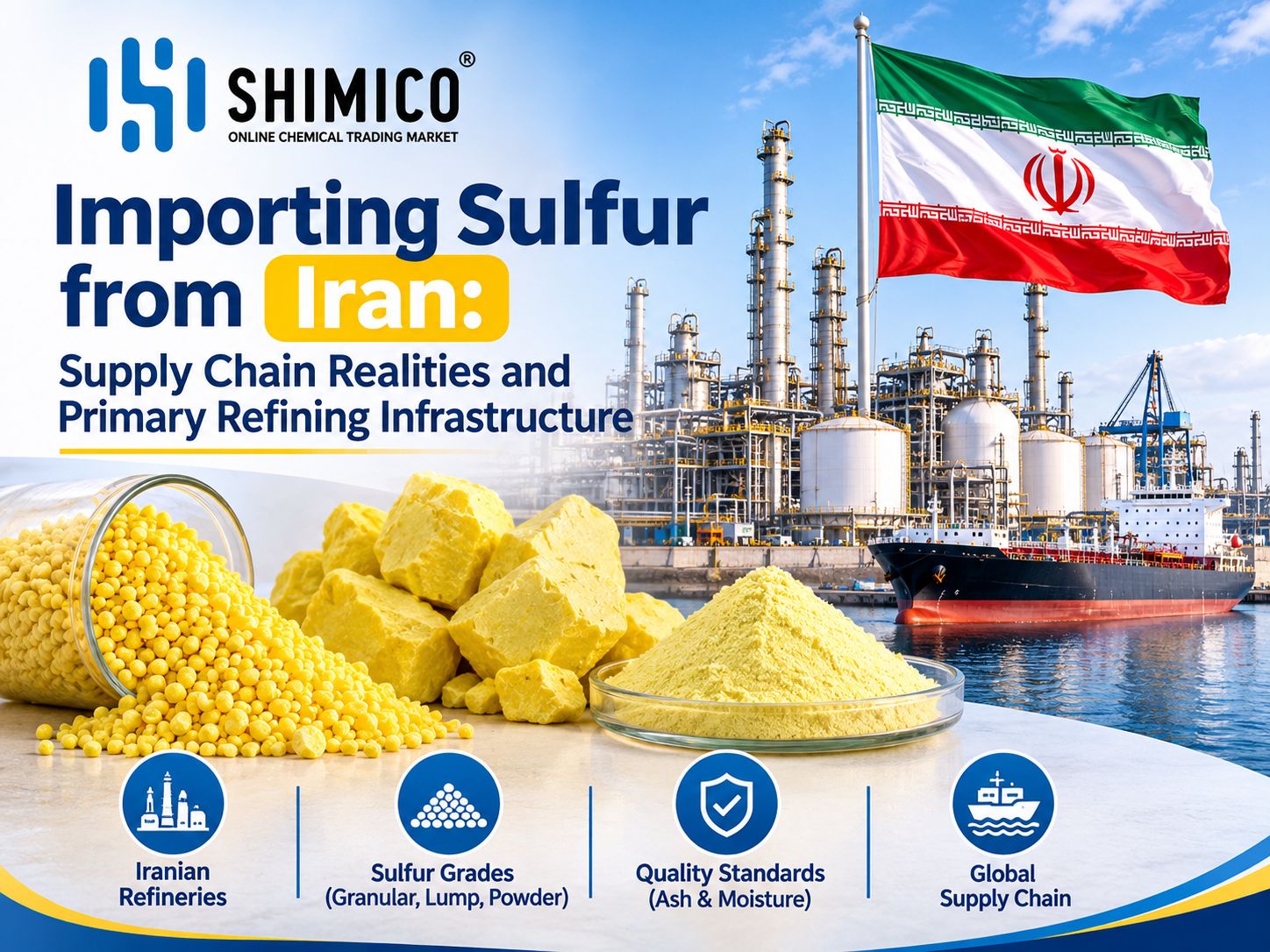
Importing Sulfur from Iran: Supply Chain Realities and Primary Refining Infrastructure
Elemental sulfur functions as the lifeblood of modern industrial manufacturing. Without reliable sulfur feedstocks, commercial phosphoric acid production halts, ammonium sulfate fertilizer blending stops, rubber vulcanization lines shut down, and nickel-cobalt hydrometallurgical leaching plants grind to a standstill.
As global commodity markets absorb sharp shifts in regional transport networks and energy balances, chemical buyers turn their attention toward the world’s most concentrated refining corridors.
Iran represents an anchor supplier within the Eurasian commodity matrix. Vast natural gas treatment facilities and crude oil hydrodesulfurization installations recover massive annual volumes of high-assay elemental sulfur as an unavoidable co-product of petroleum refining.
Sourcing directly from these primary refining complexes provides access to exceptionally pure product pools. Successful trade execution requires understanding the exact operational origins of these volumes, from coastal deepwater hubs to inland gas treatment networks.
Importing Sulfur from Iran: Natural Gas Recovery Units and Crude Refineries
The quality of elemental sulfur begins thousands of meters below ground in natural gas and petroleum reservoirs. Raw wellhead gas contains significant fractions of hydrogen sulfide, a toxic and corrosive compound that refiners must remove before natural gas enters domestic pipelines or liquefied gas terminals.
Sour gas sweetening units strip out hydrogen sulfide and route the acid gas into multi-stage Claus process units, achieving elemental recovery rates above ninety-eight percent.
Two distinct processing regions dominate commercial export supply. In the northeast, the Hasheminejad Khangiran Gas Refinery purifies sour gas reservoirs, yielding millions of tons of dry, low-carbon sulfur distributed across overland rail networks.
Along the Persian Gulf coast, massive South Pars gas processing phases, alongside coastal refineries like the Bandar Abbas Oil Refining Company and Bandar Imam facilities, generate immense quantities of molten sulfur that are prilled into uniform granular beads or solidified into raw lump blocks for marine transshipment.
International analytical benchmarks and global mineral flow assessments maintained by the U.S. Geological Survey Mineral Resources Program confirm that hydrotreated recovered sulfur yields minimal hydrocarbon contaminants compared to older mined deposits.
Importing Sulfur from Iran: Evaluating Granular, Lump, and Micronized Forms
A common purchasing pitfall involves selecting sulfur based entirely on elemental assay percentages while disregarding the material’s physical morphology. A laboratory report stating ninety-nine point five percent purity can represent a uniform spherical granule, a massive irregular rock fragment, or a volatile powder with severe dust hazards.
Automated contact-process sulfuric acid plants require free-flowing granular beads between two and six millimeters in diameter. These spherical beads roll smoothly through rotary valves, resist crushing during hopper discharge, and maintain minimal dust emissions.
In contrast, older manual operations and sugar bleaching furnaces often favor raw lump sulfur due to lower per-ton production premiums at loading gates. The comprehensive technical matrix below details the mechanical and chemical parameters across each commercial sulfur grade.
Importing Sulfur from Iran: Critical Limits on Ash and Moisture
Industrial specifications establish strict thresholds for moisture and inorganic ash. When moisture in bulk sulfur storage exceeds half a percent, water combines with ambient oxygen to generate localized sulfurous acid. This acidic moisture corrodes hopper steel and causes granular beads to cement into stubborn blocks that halt plant conveyor belts.
Ash values reflect fine mineral grit, silica, and refractory particles swept up during processing. Keeping ash below zero point zero five percent ensures converter beds avoid particulate buildup, protecting downstream vanadium pentoxide catalyst assets from premature pressure drops.
Technical Certificate of Analysis (COA) and ASTM Standards Verification
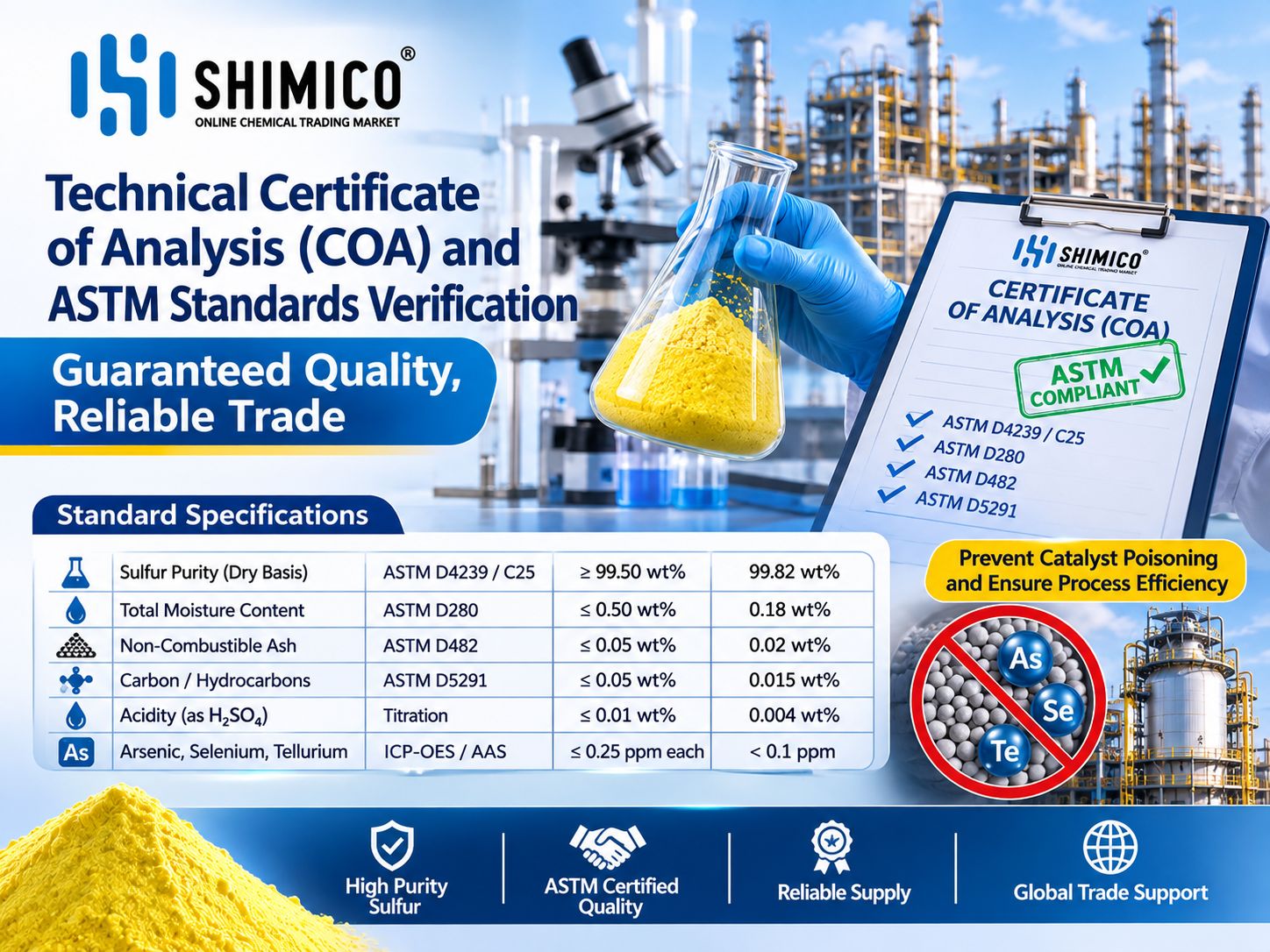
A rigorous Certificate of Analysis serves as the core legal instrument governing bulk sulfur sales contracts. When negotiating procurement terms, commercial managers must not accept generic technical sheets. Every batch delivery requires an authenticated, lot-specific COA referencing recognized testing methods from the American Society for Testing and Materials.
Specific ASTM standards dictate how sulfur parameters are established in certified laboratories. Purity must be determined via gravimetric or combustion methodology under ASTM D4239 or ASTM C25.
Moisture determination follows ASTM D280, while non-combustible ash content is quantified via ignition testing under ASTM D482. The detailed analytical breakdown below illustrates the standard parameters of a certified export consignment.
Chemical Trace Contaminants and Catalyst Poisoning Risks
Even minute trace quantities of heavy metals can have devastating economic consequences for downstream industrial operations. Vanadium pentoxide catalysts, which drive sulfur dioxide oxidation in contact towers, are exceptionally sensitive to arsenic and tellurium poisoning.
Once catalyst active sites bind to volatile arsenic compounds, conversion efficiency plummets permanently, forcing premature replacement of catalyst beds costing upwards of several hundred thousand dollars.
Similarly, excessive free acidity indicates that sulfur has been improperly stored in open stockpiles exposed to rain and microbial action. Testing for free sulfuric acid before dispatch ensures that the cargo will not degrade the mechanical integrity of marine holds or bulk road tankers during long-distance transit.
Incoterms Risk Architecture: FOB, CFR, and CPT Landed Cost Economics
Selecting the correct trade term under the International Chamber of Commerce Incoterms framework represents a decisive risk allocation choice. An attractive spot price on paper can quickly become a loss-making transaction if the buyer fails to account for terminal handling surcharges, laytime allowances, and demurrage liabilities.
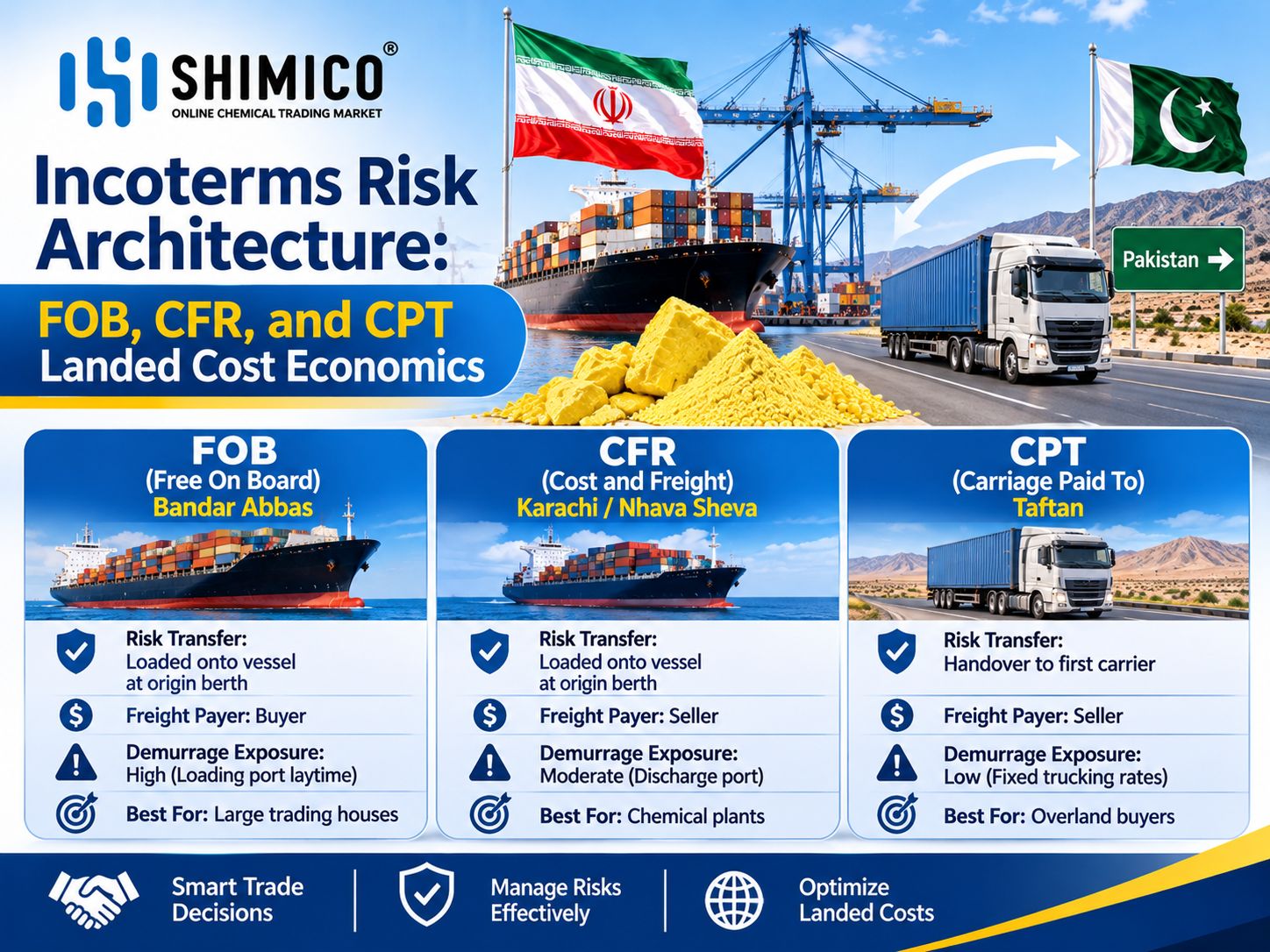
In commodity sulfur trading, buyers balance three primary Incoterms frameworks depending on their logistical reach, banking arrangements, and physical destination. Understanding the precise point where risk, title, and operational expenses transfer is fundamental to maintaining procurement margins.
FOB Bandar Abbas vs. CFR Destination Port: Marine Freight Realities
Under FOB (Free On Board) Bandar Abbas, the supplier is responsible for domestic transportation, export customs clearance, and loading the cargo past the ship’s rail onto the buyer’s chartered vessel.
The buyer assumes all risk and marine freight costs the moment the sulfur clears the ship’s manifold or hatch coaming. While FOB offers the buyer full control over freight negotiations and carrier selection, it exposes the importer to heavy demurrage risks if their chartered vessel fails to meet the agreed laycan loading window.
Conversely, under CFR (Cost and Freight) Karachi or Nhava Sheva, the seller contracts and pays for maritime freight to the named discharge port. The physical risk still transfers to the buyer upon loading, but the buyer eliminates exposure to fluctuating tanker and bulk carrier spot rates. In volatile shipping markets, CFR terms provide predictable landed input costs for chemical plant budgets.
CPT Taftan: Overland Transit and Trucking Economics
For importers across Pakistan, CPT Taftan (or CPT Quetta) has emerged as the most resilient contract structure. Under CPT terms, the seller manages all Iranian domestic freight and delivers cargo directly to the bonded border terminal. The buyer takes over clearance and transloading onto Pakistani fleets.
This eliminates exposure to maritime chokepoints and avoids expensive ocean freight demurrage that can run between fifteen and twenty-five thousand dollars daily for delayed bulk vessels. Overland trucking contracts typically allow generous free-time hours for cross-stuffing, ensuring predictable landed logistics budgets.
Logistics Routing and Transit Bottlenecks: Maritime and Overland Corridors
Moving bulk sulfur requires proactive routing architecture. While southern maritime terminals historically handled massive spot tonnages, regional maritime constraints, bunker surcharges, and vessel insurance multipliers frequently complicate seaborne movements out of the Persian Gulf.
Modern commodity traders manage supply continuity by balancing marine vessel chartering with overland rail and heavy trucking networks. Sourcing agreements that integrate dual-corridor logistics allow procurement managers to switch delivery legs smoothly whenever maritime routes experience transit friction.
Importing Sulfur from Iran: Southern Deepwater Berths and Container Operations
The vast majority of bulk commodity volume routes through deepwater maritime terminals located at Bandar Abbas, Bandar Imam Khomeini, and Bushehr. For massive destination buyers across South Asia and the Far East, Handysize and Supramax dry bulk vessels load via high-speed belt conveyor systems directly from coastal stockpiles.
For smaller industrial accounts requiring five hundred to two thousand metric tons, containerized shipping provides tighter physical control. Cargo moves inside heavy-duty FIBC jumbo bags or twenty-foot sea containers fitted with protective bulk liners. Marine carriers operate under international safety conventions governed by the International Maritime Organization regarding solid bulk hazardous materials handling, dynamic cargo stability, and fire suppression rules.
Importing Sulfur from Iran: Overland Multi-Modal Corridors and Border Crossings
When marine passages face geopolitical congestion or war-risk insurance premiums make vessel chartering uneconomic, overland corridors offer direct delivery certainty. Industrial buyers throughout Pakistan, Turkey, and Central Asia increasingly depend on direct road and railway links:
1. The Southeast Border Corridor (Mirjaveh to Taftan): Serves as the primary logistics artery into Pakistan. Flatbed truck convoys and freight trains deliver palletized bags or covered bulk loads directly into the Taftan dry port terminal for transshipment toward Quetta, Karachi, and agricultural consumption centers.
2. The Northern Rail Interchanges (Sarakhs and Incheh Borun): Originating directly from the Khangiran gas processing complex, this rail line links into the broad-gauge Central Asian railway network, supplying chemical plants and mining sites across the region.
3. The Northwest Commercial Gateways (Bazargan and Razi): Direct truck transit and rail bogie transfers move raw material straight into the Turkish manufacturing heartland, servicing detergent and fertilizer producers.
Importing Sulfur from Iran: Packaging Standards for FIBC Bags
Quality packaging preserves raw materials throughout tough transshipment journeys. Standard commercial configurations rely on reinforced polypropylene woven bags with high tensile strengths. Bags must incorporate ultraviolet stabilizers to prevent thread embrittlement under intense sun exposure in terminal yards.
For hygroscopic safety, high-grade big bags include an inner tubular polyethylene liner with sealed bases. Lifting straps require heavy corner stitching to allow direct overhead crane hoisting into vessel holds without tearing fabric walls.
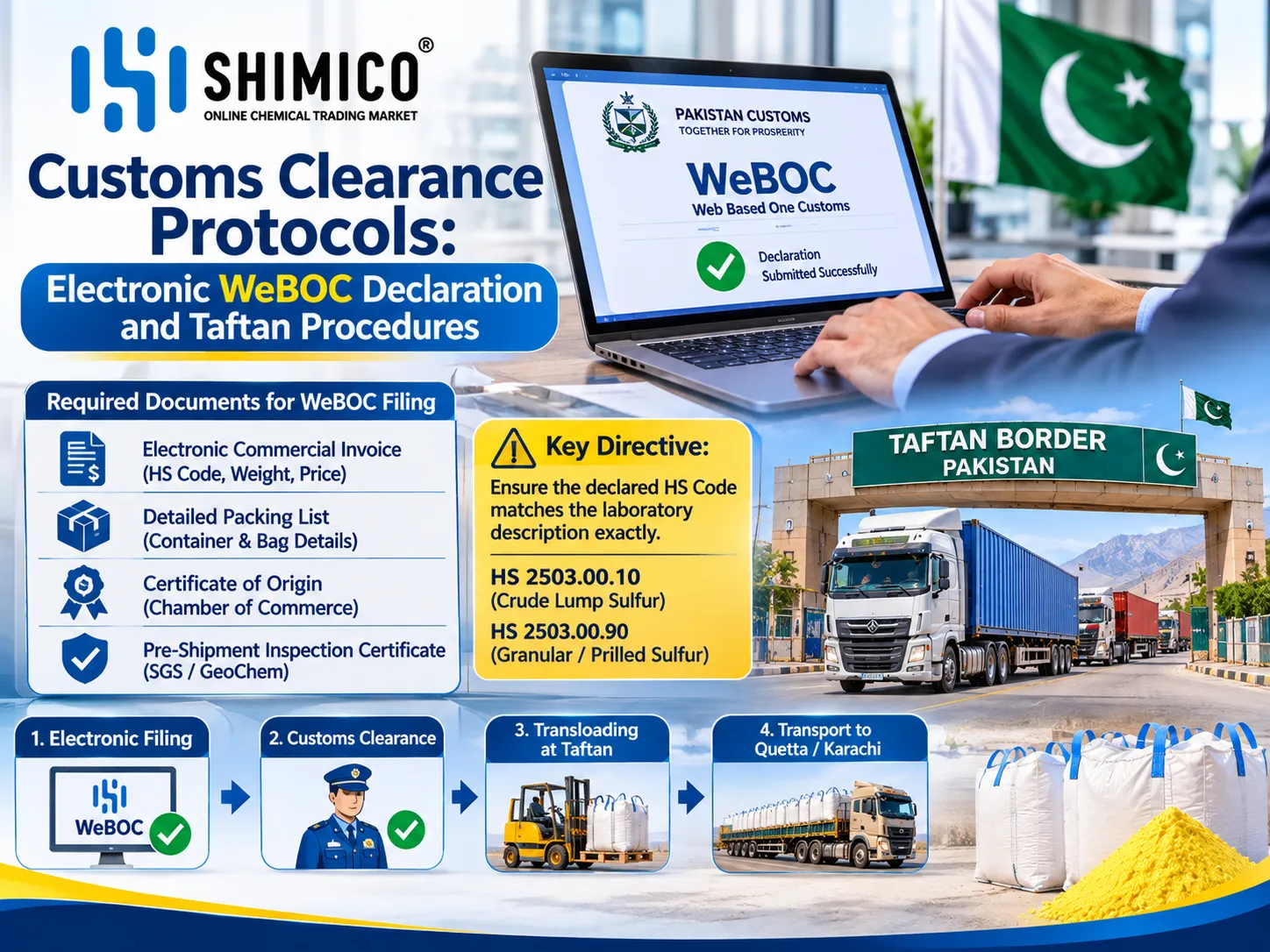
Customs Clearance Protocols: Electronic WeBOC Declaration and Taftan Procedures
Clearing industrial sulfur through Pakistan Customs demands exact statutory execution. Pakistan manages all commercial import clearances electronically through its Web-Based One Customs platform known as WeBOC. Any document discrepancy between electronic filings and physical manifests triggers mandatory consignment examination, laboratory re-sampling, and heavy demurrage fees.
The clearance workflow follows strict administrative milestones. Importers must work with licensed clearing agents registered on WeBOC to lodge the electronic Goods Declaration (GD) well in advance of border crossing.
WeBOC Electronic Document Assembly and Statutory Filing
To ensure immediate pass-through via the WeBOC Yellow or Green channels, the importer’s clearing agent must upload authentic electronic copies of the primary commercial set:
1. Electronic Commercial Invoice: Explicitly detailing gross weight, certified net dry weight, unit price per metric ton, terms of delivery (CPT Taftan or CFR Karachi), and exact tariff HS Code.
2. Detailed Packing List: Itemizing container numbers, truck registration plates, tare weights of wooden pallets, and serial tags corresponding to certified FIBC bags.
3. Authenticated Certificate of Origin: Issued and countersigned by the regional Chamber of Commerce in the origin jurisdiction to validate preferential duty rates under bilateral trade protocols.
4. Pre-Shipment Inspection Certificate: Issued by accredited independent laboratories (such as SGS or GeoChem) confirming chemical compliance with Pakistan Environmental Protection Agency regulations for non-radioactive, combustible solids.
Taftan Border Transloading and Transport Logistics
Cargo entering via the land route arrives at the Mirjaveh customs terminal on Iranian multi-axle trailers. After Iranian customs seal checks and exit processing, the trucks cross into the Federal Board of Revenue customs compound at Taftan.
Because direct foreign vehicle entry into the interior of Pakistan requires special permits, cargo is systematically transloaded at Taftan. Dedicated mobile conveyors and heavy forklifts transfer big bags from Iranian trailers onto Pakistani National Logistics Cell (NLC) trucks or private fleets heading across Balochistan toward Quetta and Karachi manufacturing corridors.
Strategic Sourcing and Direct Supply Execution with Shimico
Securing consistent raw chemical feedstocks requires moving past fragmented broker networks and establishing direct connections with accredited primary producers. Navigating market price swings and logistics disruptions demands a professional trading partner with genuine field capabilities.
Shimico operates as an integrated commercial trading platform, structuring end-to-end supply contracts for chemical manufacturers, agricultural distributors, and industrial processing complexes across the region. We ensure complete transparency, strict laboratory verification, and reliable multi-modal delivery from origin gates to destination plant yards.
🚀 Secure Your Bulk Industrial Chemical Supply with Shimico
Access guaranteed refinery allocations, competitive contract terms, and comprehensive logistics execution for high-purity sulfur, caustic soda flakes, and essential industrial minerals.
✅ Direct Allocation: Dependable supplies of high-purity Elemental Sulfur Products in granular, lump, and agricultural formulations.
✅ Primary Petrochemicals: Direct wholesale contracting for essential Industrial Chemical Lines including caustic soda flakes and soda ash.
✅ Agricultural Mineral Supply: Bulk sourcing for Fertilizer and Mineral Products with verified laboratory moisture testing.
✅ Specialized Compounds: Commercial procurement options for Potassium Carbonate from Shimico supporting advanced manufacturing lines.
Why Global Procurement Desks Choose Shimico:
🔹 Guaranteed primary refinery contracts providing steady deliveries during market shortages.
🔹 Pre-dispatch lot testing and accredited third-party inspection certifications with every cargo.
🔹 Complete export manifest execution matched to destination customs clearance frameworks.
🔹 Transparent trade platform serving vetted industrial buyers and verified regional producers.
Industrial manufacturing demands unwavering feedstock reliability. Build your chemical supply lines on certified, transparent execution.
Frequently Asked Questions: Bulk Sulfur Procurement and Trade Logistics
Navigating international commodity contracts involves technical and commercial inquiries. Below are direct answers to common questions regarding physical specifications, logistics lanes, and quality verification.
What are the primary logistical alternatives when maritime sulfur shipments via the Strait of Hormuz face disruption?
When maritime corridors out of southern terminals experience freight insurance surges or congestion, buyers utilize overland transit corridors via Mirjaveh-Taftan to South Asia or northern railway links via Sarakhs and Incheh Borun through Central Asian corridors, reducing dependency on marine carrier slots.
What purity levels are standard for Iranian recovered elemental sulfur?
Refinery recovery units from natural gas and crude processing typically yield bright yellow elemental sulfur with a minimum purity of 99.5 percent to 99.8 percent on a dry basis, maintaining ash content below 0.05 percent and moisture levels under 0.5 percent for granular grades.
How does moisture content impact recovery efficiency in sulfuric acid plants?
Excess moisture above 0.50 percent in granular sulfur forms dilute sulfuric acid during storage, attacking steel silos, creating caking issues in conveyor hoppers, and requiring elevated thermal inputs during initial melting.
What parameters are strictly verified during an independent SGS inspection for sulfur export?
Inspectors conduct sampling to confirm purity above 99.50 percent dry basis, maximum ash content under 0.05 percent, total carbon residue below 0.03 percent, and physical sizing distribution to prevent fine particle contamination.
How do Pakistani importers manage electronic declaration through the WeBOC customs portal for sulfur?
Importers submit the electronic Goods Declaration under HS Code 2503.00.10 or 2503.00.90 via Pakistan Customs WeBOC portal, attaching the electronic bill of lading, chamber authenticated Certificate of Origin, certified packing list, and commercial invoice alongside the accredited pre-shipment laboratory test certificate.
Can bulk buyers arrange direct refinery allocation through the Shimico trading platform?
Yes, Shimico connects international industrial procurers directly with verified allocations from primary refining complexes, handling domestic customs export clearance, laboratory assay certifications, and multi-modal freight logistics.
Summary: Successful raw sulfur procurement rests on managing physical and logistical risks before cargo leaves the terminal. By verifying physical granulometry against plant equipment capabilities, mandating third-party pre-shipment inspections, selecting flexible transportation corridors, and partnering with verified primary suppliers, industrial chemical importers preserve operating margins and ensure dependable feedstock security.
Last Seen

Users Comment
Feed Grade Sodium Bicarbonate: High-Purity Rumen Buffer & Livestock
Food Grade vs Industrial vs Feed Grade Sodium Bicarbonate: Which Grade
Top 10 Sodium Bicarbonate Suppliers in India
Sodium Bicarbonate Price: Cost per Ton, per kg and Bulk Market Rates
Iran Sulfur Price: Domestic Market, FOB Export Price and Price per Ton
Sulfur Export Price FOB Iran: Bulk Sulfur Price per Ton
Sulfur Fungicide: How It Works, Uses and Safety Precautions
Types of Sulfur Fertilizers: Powder, Granular, Liquid & Sulfate Forms
Sulfur for Soil: Benefits, Uses and How to Apply It
Sulphur 80 WDG: Technical Specifications, Uses & Bulk Supply
Sulfur WDG: Water Dispersible Granules, Uses & Bulk Supply
Sulphur WDG Pakistan: Bulk Supply, Prices & Import Guide