


Food Grade vs Industrial vs Feed Grade Sodium Bicarbonate: Which Grade
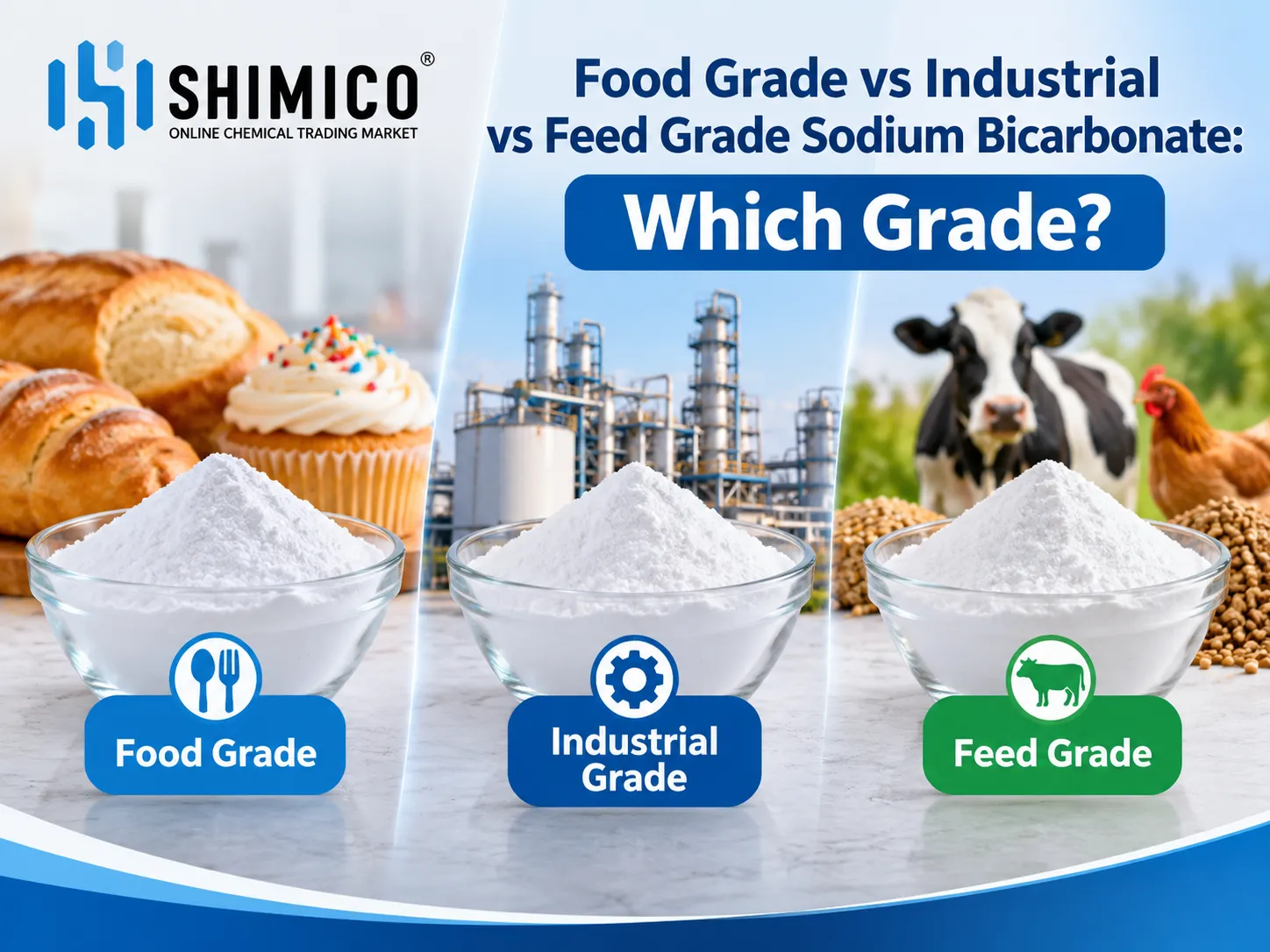
Two bags of sodium bicarbonate can sit side by side on a pallet and look exactly the same. Same white powder. Same label font. Same weight printed on the side. Yet one bag might be fit for a bakery and the other might fail a food safety audit.
This is where many buyers get burned. The chemical formula, NaHCO3, does not change between grades. What changes is the purity target, the limits on heavy metals and other contaminants, the particle size, and the paperwork that proves the lot meets its specification.
If you buy sodium bicarbonate for a living, you already know the price list tells you very little. This guide walks through each grade, explains where it belongs, and shows you how to read a certificate of analysis (COA) before you sign a purchase order. We will also cover trade rules, packaging, storage, and the questions that come up most often in procurement meetings.
Tip: Same formula, different promise
When a supplier offers sodium bicarbonate without naming a grade, ask three things: the grade, the specification sheet, and the COA for the exact lot you are buying. The chemical name alone tells you almost nothing about fitness for use.
Food Grade vs Industrial vs Feed Grade Sodium Bicarbonate: The Short Answer
Here is the short version. Food grade sodium bicarbonate goes into products people eat or drink, so it carries the tightest limits and the most testing. Feed grade goes into animal rations, usually for rumen buffering, and it follows feed rules and contaminant limits set for animals. Industrial grade serves water treatment, cleaning, and process chemistry, where the specification matches the job rather than a consumer label.
Price usually follows that order. Food grade costs the most, feed grade sits in the middle, and industrial grade is often the least expensive per tonne. But a low price only helps if the grade fits the use. A cheaper bag used in the wrong place is an expensive mistake.
Food Grade vs Industrial vs Feed Grade Sodium Bicarbonate: Why Grade Matters at All
Sodium bicarbonate is a mild alkaline salt. You probably know it as baking soda. It reacts gently with acids, releasing carbon dioxide, which is why it lifts dough, buffers pH, and neutralizes spills. Chemists call it sodium hydrogen carbonate. The chemistry is simple. The supply chain is not.
Think of flour. Bread flour, cake flour, and whole wheat flour all come from wheat, yet a baker would never swap them without thinking. Sodium bicarbonate works the same way. The grade tells you how tightly the material was controlled, what it was tested for, and which rules it must follow.
Two grades of the same salt can differ in heavy metal limits, moisture, insoluble matter, and particle size. Those differences decide whether the product is safe in a loaf, a ration, or a boiler feed line.
Physical and Chemical Properties Buyers Should Know
Sodium bicarbonate has a molar mass of about 84 g/mol. It dissolves in water, though not endlessly. At room temperature, a common reference value is roughly 9 to 10 grams per 100 mL of water at 20 °C, which is enough for most dosing and dissolution work. Heat changes the picture.
Sodium bicarbonate begins to break down into sodium carbonate, water, and carbon dioxide at moderate temperatures, so drying conditions during manufacture and storage conditions after delivery both matter.
The table below gives a general view of these properties. Use it as a reference point, then confirm the exact values on the specification sheet for your lot.
The table shows that solubility and heat sensitivity sit at the center of most handling decisions. A powder that dissolves fast suits a dosing pump. A powder that holds up under warm storage suits a warehouse in a hot port city. Neither property appears on a label, so you need the specification and the COA to confirm them.
Food Grade Sodium Bicarbonate: Specifications and Regulation Under the Food Grade vs Industrial vs Feed Grade Sodium Bicarbonate Framework
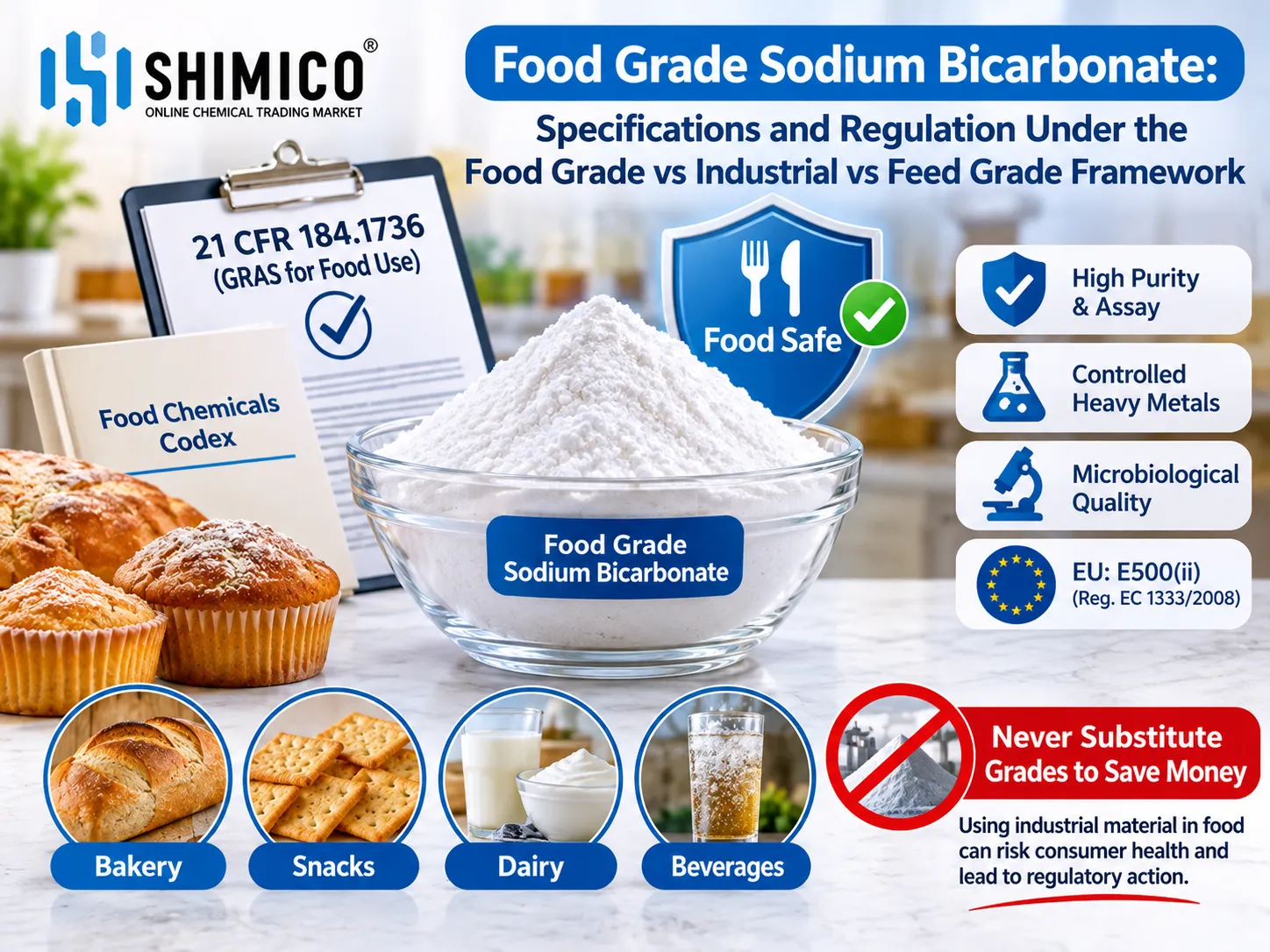
Food grade sodium bicarbonate is made for people. It shows up in baking powders, leavening blends, effervescent tablets, some beverages, and certain food processing steps. Since people eat it, this grade has the strictest requirements of the three.
In the United States, sodium bicarbonate is listed in the federal food additive regulations at 21 CFR 184.1736 as generally recognized as safe (GRAS) for food use under the conditions the rule describes. You can read the current text on the eCFR entry for 21 CFR 184.1736.
Food manufacturers also refer to monograph requirements in the Food Chemicals Codex, which define identity, assay, and impurity tests. Monograph versions change, so confirm which version your supplier uses.
What a Food Grade Lot Should Show
Food grade material should come with a high assay and documented limits on heavy metals such as lead, arsenic, and mercury. It should also meet microbiological and physical requirements suited to food handling. A general “food grade” label does not prove any of this. Ask which monograph the lot meets, and check that each result on the COA names a test method.
Heavy Metals and Trace Contaminants
Heavy metal limits protect consumers from cumulative exposure. Some producers test every lot for these elements. Others test per batch and keep records. Ask which approach the supplier follows, and whether testing happens on the finished product or on an intermediate stream. Results should list the detection method and the detection limit, not just “pass.”
Microbiological Quality
Because food grade powder goes into products that may not get cooked, microbial counts matter. Ask for the test plan and the sampling frequency. Ask whether the plant runs food and non-food products on the same line and, if so, how it cleans between runs. A documented cleaning validation tells you more than a generic certificate on the wall.
Food Additive Status Outside the United States
Outside the United States, the framework changes. In the European Union, sodium hydrogen carbonate is authorized as the food additive E500(ii) under Regulation (EC) No 1333/2008 on food additives, and purity criteria appear in the relevant EU specification.
Exporters should confirm the additive name, the E number where required, and the purity criteria in the destination market. A grade accepted in one country may need extra documents in another.
Source note: food additive rules
The EU food additive regulation lists sodium hydrogen carbonate under E500(ii), and member states enforce the rules through national authorities. Read the consolidated text on EUR-Lex and confirm the current version before you publish or certify anything.
Where Food Grade Fits Best
Bakeries use food grade bicarbonate as a leavening agent. Snack producers use it for texture and pH control. Some dairy and cheese processes use it for buffering. Home baking packs almost always use this grade, because the product goes straight into a kitchen. If the end product is eaten, start your search here.
Warning: Never substitute grades to save money
Industrial material used in food can carry contaminants that no label can fix after production. The saving on the invoice rarely covers a recall, a customer claim, or a regulatory action.
Feed Grade Sodium Bicarbonate: Rumen Buffering in Food Grade vs Industrial vs Feed Grade Sodium Bicarbonate Decisions
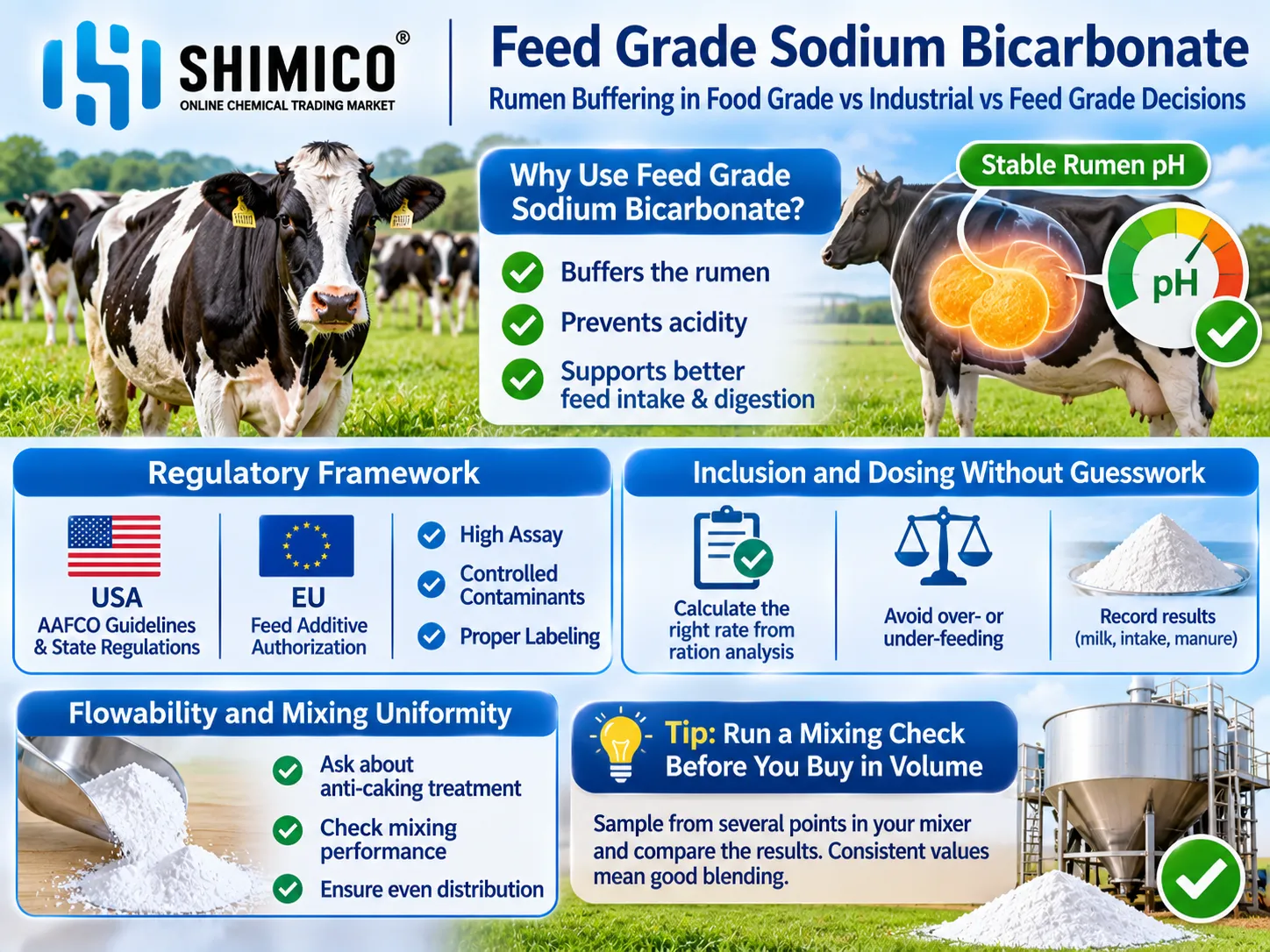
Feed grade sodium bicarbonate has one main job in most farms. It buffers the rumen. Dairy and beef cattle eat diets high in grain or fast-fermenting feeds, and the rumen can turn acidic. When acid builds up, intake can drop, and the animal’s digestion can suffer.
Bicarbonate helps keep the rumen pH steadier. Results vary with the ration, forage quality, water access, and herd management, so treat bicarbonate as one tool among several.
Many farmers have seen this firsthand. A dairy manager might switch to a higher-grain ration to chase milk output, then notice that milk fat slips over a few weeks. Adding a feed grade buffer can help, but only when the ration itself is balanced. Bicarbonate cannot fix a ration that is short on effective fiber.
Regulatory Framework for Feed Grade Material
Feed rules differ by country and by region. In the United States, the Association of American Feed Control Officials (AAFCO) publishes ingredient definitions that feed manufacturers use for labeling, and state feed regulators enforce them.
In the European Union, feed additives need authorization for a specific product and animal category. Confirm which regulator covers your market and the country where the finished feed is sold.
Feed grade material usually targets a high assay, but contaminant limits and labeling statements can differ from food grade. A feed mill must keep documents that match its ingredient declaration. If the mill exports, the import rules of the destination country apply on top of the source country rules.
Inclusion and Dosing Without Guesswork
Inclusion rates depend on the ration, not on a rule of thumb copied from another farm. A nutritionist should calculate the rate from the herd’s ration analysis, including forage fiber, starch level, and sodium and potassium content.
Overfeeding adds sodium to the diet, can change water intake and manure consistency, and shifts the dietary cation-anion difference. Underfeeding leaves the buffering benefit unused. Record the rate, the mixing method, and the herd response so the next adjustment has a baseline.
Flowability and Mixing Uniformity
Caked material mixes unevenly. Uneven mixing means some animals get too much buffer and others get too little. Ask the supplier about flowability and anti-caking treatment, and check how the product behaves in your mixer before you commit to a large volume.
Tip: Run a mixing check before you buy in volume
Sample from several points in your mixer and compare the results. Consistent values mean the product flows well and blends evenly. Repeat the check with a second lot before you switch suppliers.
Industrial Grade Sodium Bicarbonate: Uses in Water, Cleaning, and Process Plants
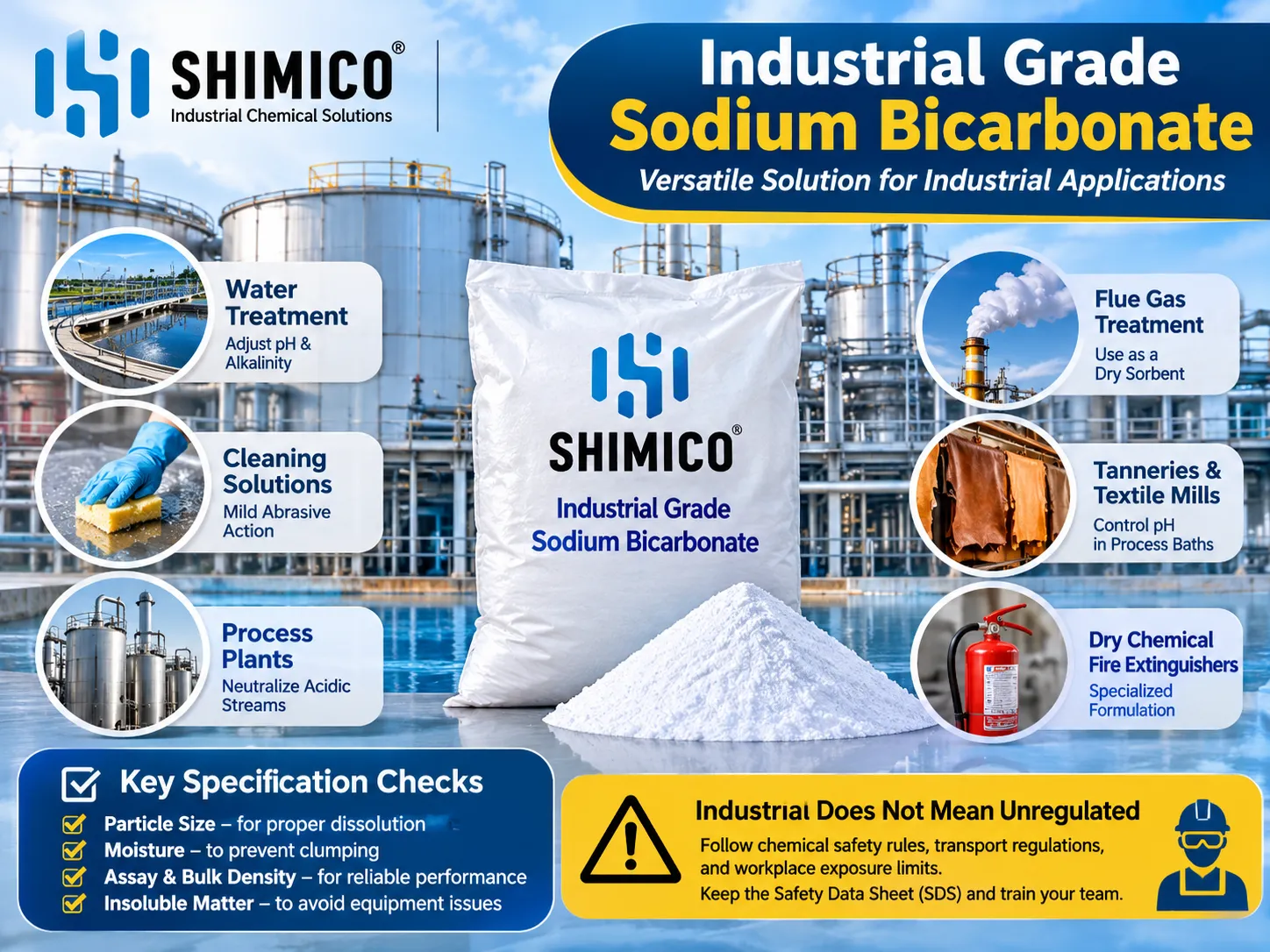
Industrial grade sodium bicarbonate works in places where nobody eats or drinks the product. Water treatment operators use it to adjust alkalinity and buffer pH. Cleaning companies use it for mild abrasive action on surfaces. Some plants use it to neutralize acidic streams. Flue gas treatment systems in some facilities use it as a dry sorbent. Tanneries and textile mills use it to control pH in process baths.
Industrial grade usually carries looser contaminant limits than food or feed grade. That does not make it poor quality. It means the specification matches the process. A wastewater plant adjusting pH does not need food-level cleanliness. It does need steady alkalinity, predictable dissolution, and low insoluble content, because insoluble residue can foul pumps and nozzles.
Specialized Industrial Uses
Some dry chemical fire extinguishers use sodium bicarbonate based powders. These products are formulated for flow and moisture resistance, and they must meet fire safety standards. General industrial bicarbonate is not a substitute for a tested extinguishing agent. Use the agent specified by the equipment manufacturer and the fire code that applies to your site.
Blasting grades remove paint, rust, or residue from surfaces that cannot take harsh abrasives. Particle size and hardness control how aggressive the blast is. Follow the equipment maker’s guidance on pressure and nozzle size, and manage dust and waste disposal under local rules.
What to Check on an Industrial Specification
Check particle size, because it controls dissolution speed and dust. Check moisture, since wet material clumps in storage and inside dosing equipment. Review assay, bulk density, and insoluble matter, which can clog lines and settle in downstream equipment. Then confirm that the lot suits the process, not only that it carries a chemical name.
Warning: Industrial does not mean unregulated
Industrial material still falls under chemical safety rules, transport regulations, and workplace exposure limits. Keep the safety data sheet on file and train staff on dust control.
Side-by-Side Comparison of Food Grade vs Industrial vs Feed Grade Sodium Bicarbonate
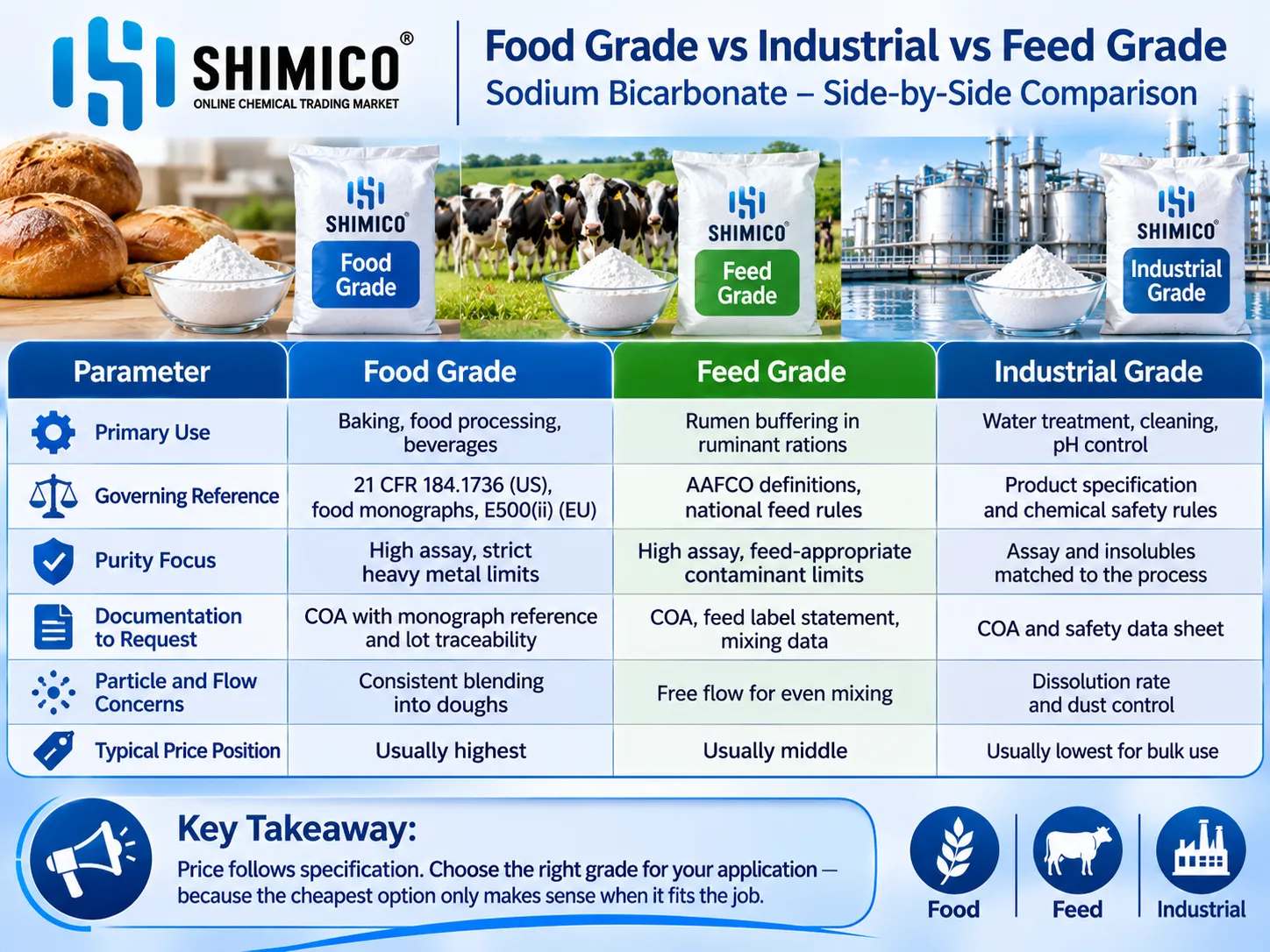
The table below puts the three grades next to each other. It shows the typical focus of each grade, not the exact limits, which vary by supplier and by market. Read the table as a starting map. The supplier’s specification and the rules that apply to your product always take priority.
The table can be scrolled sideways on small screens. Each row answers a question buyers ask most often: where the product goes, which rules govern it, what the purity focus is, and what paperwork to request.
Now read the table row by row. Food grade costs the most because it carries deeper testing and stricter limits. Feed grade often sits in the middle, since it needs documented contaminant control without the full food monograph workload.
Industrial grade costs the least because it skips testing that a non-food process does not need. Price follows specification. The cheapest option only makes sense when it fits the job, and a grade that fails your specification costs more than any saving on the invoice.
How to Read a COA for Food Grade vs Industrial vs Feed Grade Sodium Bicarbonate
The certificate of analysis is the document that decides most grade questions. It lists the tests run on the lot you are receiving and shows whether the material meets the grade you ordered. Many buyers skim it. That habit causes most of the trouble later.
Start with the product name and grade. Confirm the lot number matches the delivery note. Find the assay, which states the percentage of sodium bicarbonate. Check heavy metal results, moisture, and microbiological data if the product goes into food or feed. Look at the production date, then decide whether the material suits your storage timeline.
Red Flags on a COA
Watch for missing test methods, vague wording such as “conforms” with no values, and lot numbers that do not match the delivery. A COA that looks copied from another product is another warning sign. Ask the supplier to explain any unclear result before you accept the shipment.
Questions to Ask the Supplier About a COA
Ask which laboratory ran the tests and whether it holds accreditation for those methods. Ask whether the COA is issued per lot or per batch, and how the two differ in that plant. Ask for the retained sample reference so you can match future disputes to the right record.
Tip: Store every COA with its lot
Keep a digital copy of each COA linked to its lot number in your inventory system. When an auditor or customer asks for traceability, you can answer in minutes instead of days.
Production Route and Grade Control in Food Grade vs Industrial vs Feed Grade Sodium Bicarbonate
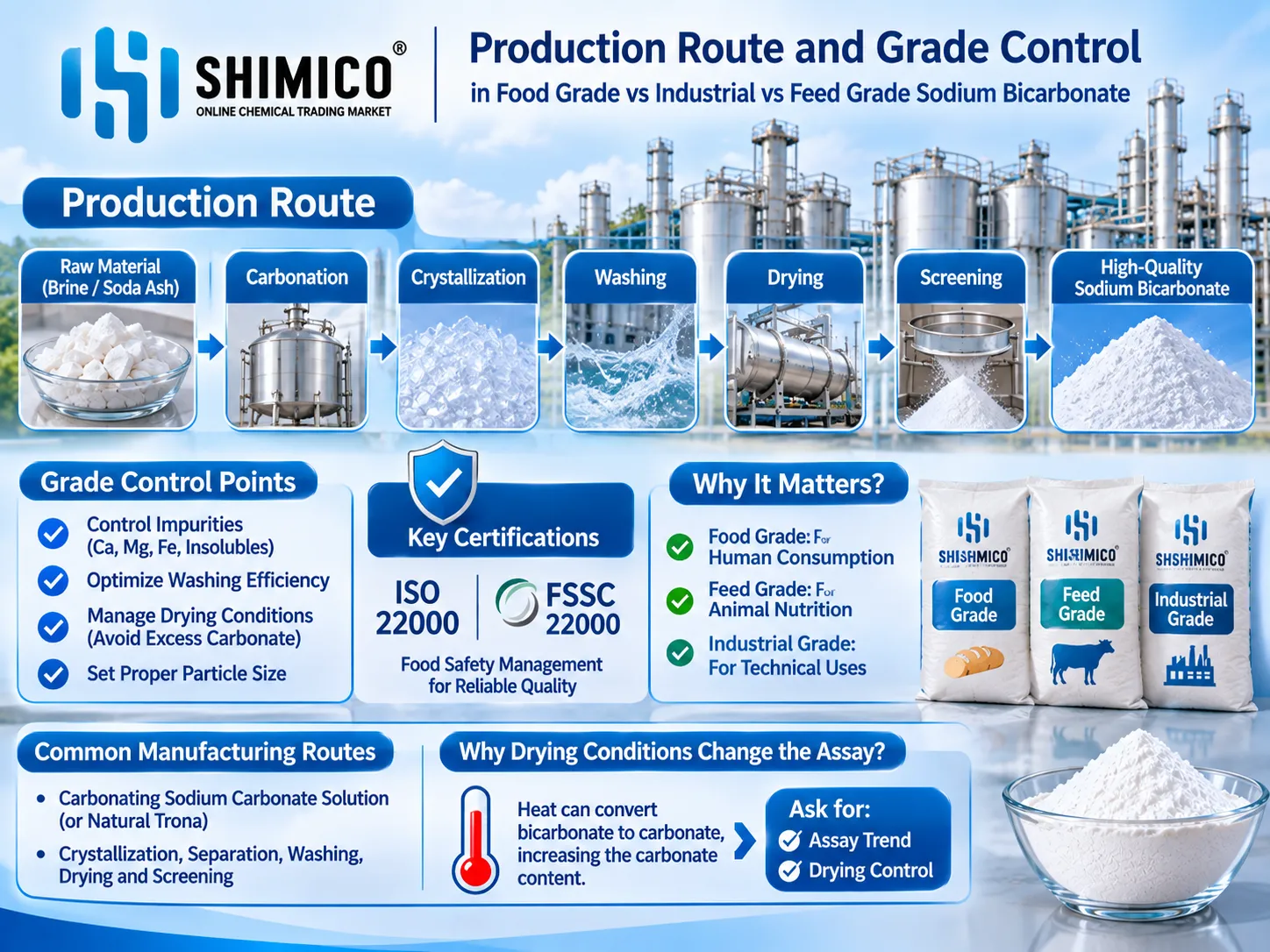
Production route shapes the impurity profile. Raw brine and soda ash can carry calcium, magnesium, iron, and insoluble matter. Washing efficiency determines how much soluble residue stays in the product. Drying conditions influence how much bicarbonate converts to carbonate, which changes the assay. Screening sets the particle size distribution. Each step is a chance to control the grade, or to lose it.
A plant that runs food and industrial output on the same equipment still needs tighter controls for food lots. Ask suppliers whether food grade runs use dedicated equipment or a validated cleaning procedure.
Ask whether the site holds a food safety management certification such as ISO 22000 or FSSC 22000. Certifications do not guarantee every lot, but they show a documented system for catching problems before shipment.
Common Manufacturing Routes Buyers Hear About
Most commercial sodium bicarbonate comes from carbonating a sodium carbonate solution, then crystallizing, separating, washing, drying, and screening the product. Some producers also work from natural trona-based feedstocks. The route matters less than the controls around it. Ask for the process flow, the washing and drying steps, and the points where the plant tests for impurities.
Why Drying Conditions Change the Assay
Heat drives the conversion of bicarbonate to carbonate. If the dryer runs too hot or too long, the assay can shift, and the product can carry more carbonate than the specification allows. A supplier with tight drying control and regular assay testing will show consistent results across lots. Ask for the assay trend, not just a single number.
Particle Size, Bulk Density, and Flowability in Food Grade vs Industrial vs Feed Grade Sodium Bicarbonate
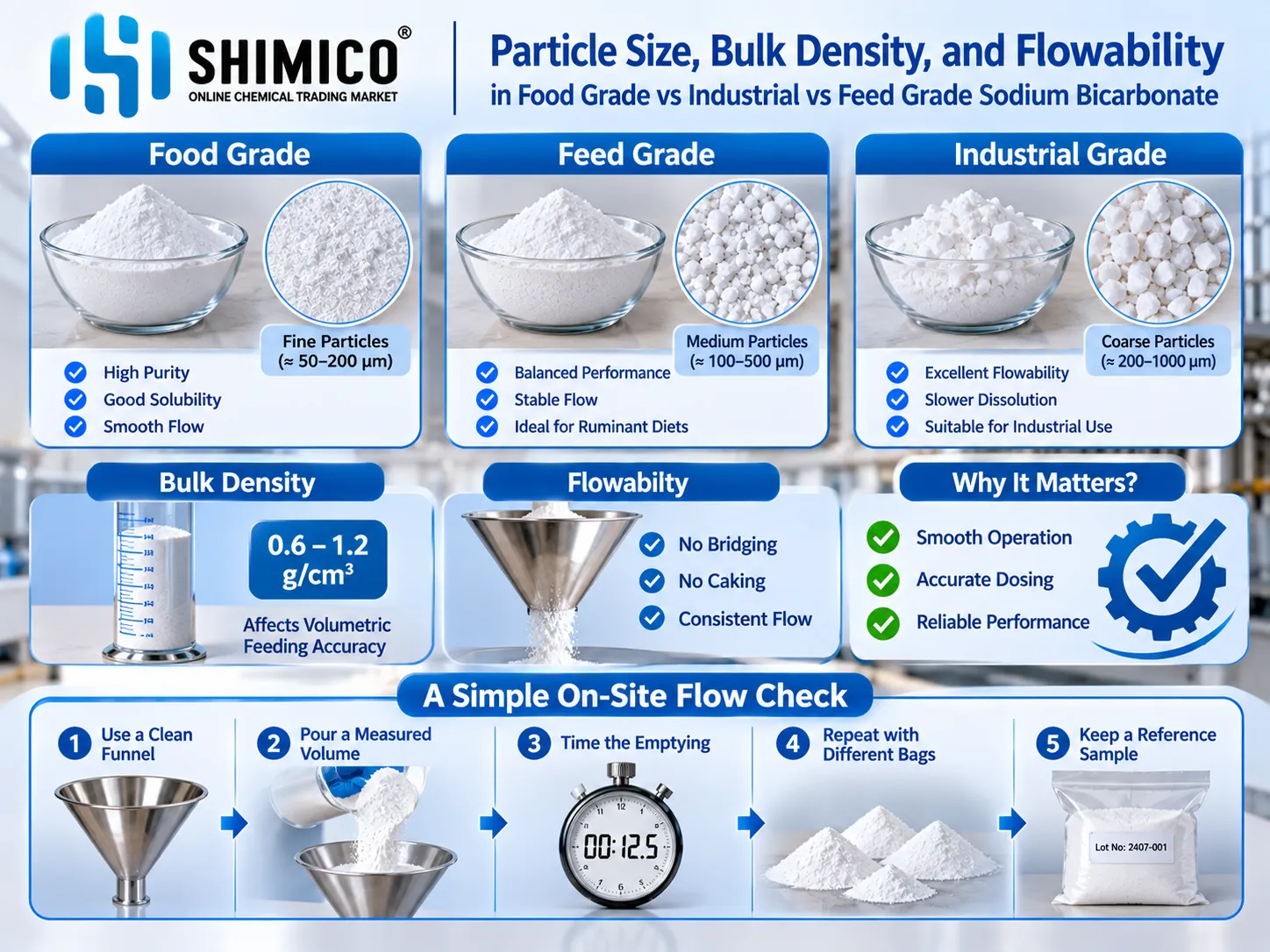
Many buyers focus on assay and price, then find that a lot behaves badly in their equipment. The cause is often physical, not chemical. Particle size, bulk density, and flowability decide how the powder moves through a silo, hopper, screw feeder, pneumatic line, or mixer.
Coarse material flows more easily and dusts less, but dissolves more slowly. Fine material reacts quickly, but it can bridge in hoppers, pack down, or release dust. Pick the distribution that fits your equipment and your timing, then verify it on each lot. Your dosing system sets the target, not the supplier’s brochure.
Bulk density affects how a volumetric feeder delivers mass. If density shifts from one lot to the next, the weight delivered per turn shifts too. Check bulk density on each specification, and recalibrate the feeder when the grade or the supplier changes.
A Simple On-Site Flow Check
You do not need a laboratory for a first look. Pour a measured volume through a clean funnel of the size your system uses, and time how long it takes to empty. Repeat with samples from different bags in the same lot. Large differences between bags point to a homogeneity problem. Keep a retained sample from each delivery so you have a reference for future lots.
Packaging, Storage, and Safety for Food Grade vs Industrial vs Feed Grade Sodium Bicarbonate
Sodium bicarbonate is stable under normal storage conditions, but it still needs care. Humidity causes caking. Strong acids release carbon dioxide on contact, which can pressurize containers. Dust irritates eyes, skin, and airways. Good storage protects the grade you paid for, and good handling protects the people who move it.
Common packaging includes multi-layer paper or woven polypropylene bags, often around 25 kilograms, and flexible intermediate bulk containers for large industrial users. Ask whether inner liners are food-safe when the product goes into food, whether bags resist moisture, and how pallets are wrapped for transport.
Storage Rules That Prevent Grade Mix-Ups
Grades can look identical once a bag is opened. Store each grade in its own zone with clear signage and color-coded tags. Never move material into an unmarked container. Use first-in, first-out rotation, and keep the safety data sheet and lot COA where the warehouse team can reach them.
Handling Dust and Spills
Use local exhaust where dust builds up. Wear gloves and eye protection as your risk assessment requires. Clean spills with methods that avoid airborne dust, such as damp wiping or a vacuum fitted with a suitable filter. Your safety data sheet lists the exact precautions for your lot, so keep it on hand.
Warning: Keep acids and bicarbonate apart
Mixing bicarbonate with strong acids releases carbon dioxide quickly. Store them in separate areas, and never seal a container that could react with the other material.
Import, Export, and Trade Rules for Food Grade vs Industrial vs Feed Grade Sodium Bicarbonate
Cross-border trade adds a layer that domestic buyers often miss. Customs authorities check classification codes, and the code you declare must match the product’s real use. A food grade shipment declared as industrial can stall at the border. An industrial shipment declared as food can trigger inspection and penalties.
Export buyers should ask for documents that match the destination’s rules. These often include a COA for the specific lot, a certificate of origin, a safety data sheet in the local language, and sometimes a free sale certificate or a health certificate for feed products. The list varies by country, so confirm it with the importer and a licensed customs broker before the vessel sails.
Contract Terms That Protect Both Sides
A bulk contract should name the grade, the specification version, the test methods, the sampling plan, and the acceptance criteria. It should state the remedy for a failed lot, such as replacement, credit, or return. It should also define delivery terms, including who pays freight and insurance and when risk passes to the buyer. For international trade, the Incoterm you choose sets these responsibilities clearly.
Ask for a retained sample policy as well. If a complaint arrives months later, both parties can test the same material. Without retained samples, disputes turn into arguments about memory.
Documents Checklist for Export Shipments
Build a shipment file before the goods leave the plant. Include the lot COA, the safety data sheet, the packing list, the commercial invoice with the correct classification, and any origin or health certificates the destination requires. Matching documents speed up clearance and reduce the chance of a held container.
What Drives the Price of Food Grade vs Industrial vs Feed Grade Sodium Bicarbonate
Raw material and energy form a large share of production cost. Soda ash, carbon dioxide, water treatment, and drying energy all feed into the final price. Purification, testing, packaging, and certification add cost, especially for food grade lines that must hold recognized certificates. Each extra test costs money, and each extra control adds time.
Volume and contract length also move the price. Large, regular orders often secure better terms. Freight, currency movements, and import duties can shift the landed cost a lot, so compare offers on a delivered basis rather than an ex-works basis. Above all, compare quotes on the same specification. A quote for industrial material cannot be set against a food grade quote, even when the chemical name is identical.
A Quick Way to Compare Two Offers
Line up both offers on the same grade, the same packaging, the same delivery point, and the same payment terms. Then add the cost of rejected lots, extra testing, and storage. The offer with the lower headline price may end up costing more once those items are included.
Choosing the Right Grade of Food Grade vs Industrial vs Feed Grade Sodium Bicarbonate: A Practical Framework
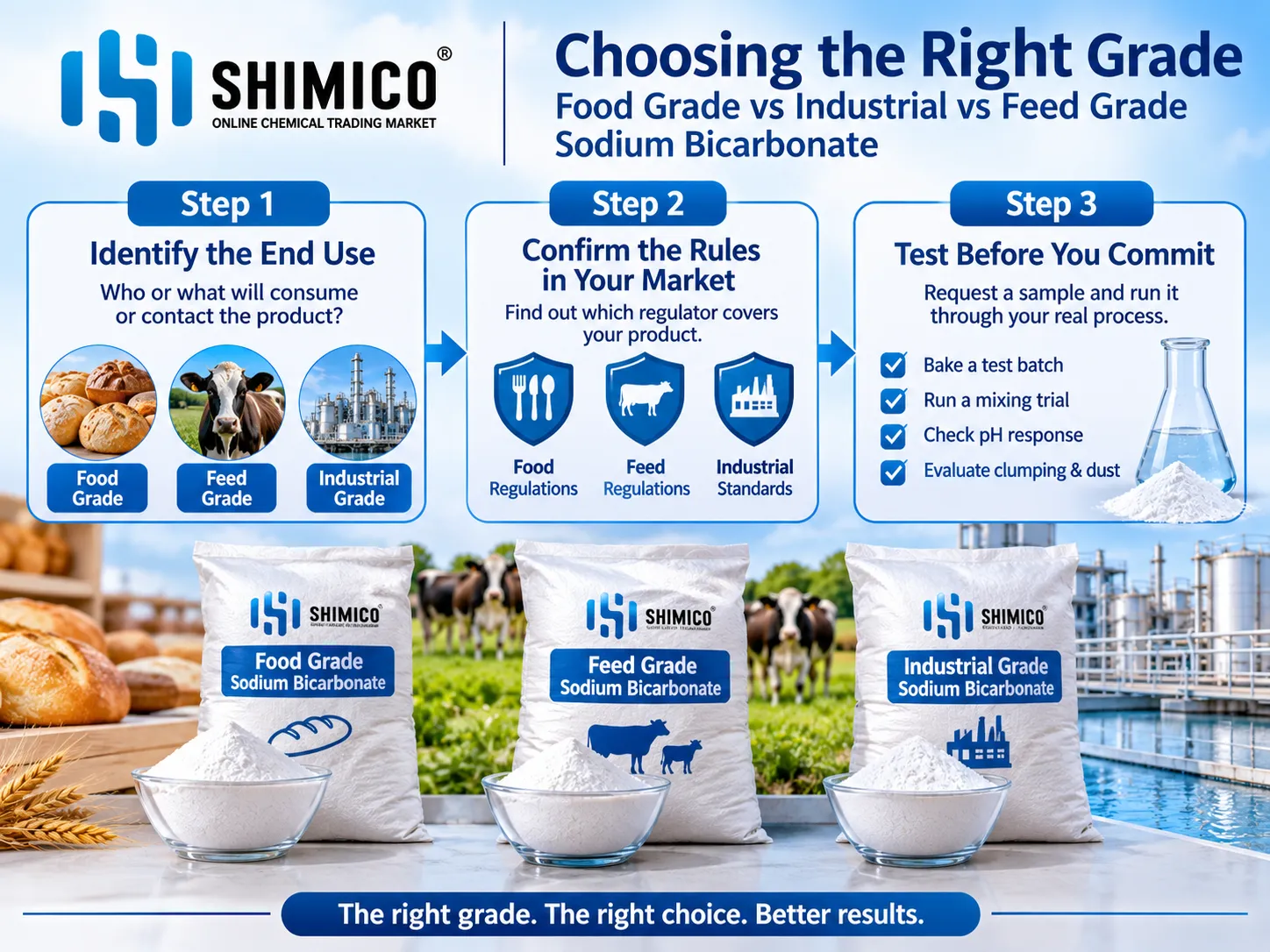
Most buyers can sort their choice by answering three questions in order. The answers take ten minutes. Skipping them can cost months.
Step One: Identify the End Use
Ask who or what will consume or contact the product. If a person eats it, you need food grade. If an animal eats it in a ration, you need feed grade. If it only touches equipment, water, or surfaces, industrial grade may fit, provided the specification suits the process.
Step Two: Confirm the Rules in Your Market
Find out which regulator covers your product where it will be sold. Food, feed, and industrial chemicals follow different rules, and one product can fall under several at once. Your compliance team or a qualified regulatory adviser should confirm the exact obligations before you commit.
Step Three: Test Before You Commit
For any new supplier, request a sample and run it through your real process. In a bakery, bake a test batch. On a dairy farm, run a small mixing trial. In a water plant, test dosing and the pH response. A sample shows clumping, dust, and dissolution behavior that a specification sheet cannot show.
Common Mistakes When Buying Food Grade vs Industrial vs Feed Grade Sodium Bicarbonate
Most grade problems come from a few habits. The first is buying on price alone. A low invoice can hide higher costs in rejected batches, downtime, and compliance work. The second is trusting a label instead of a COA. The third is assuming a product approved for one use is approved for another.
Many buyers also ignore particle size. Two lots with the same assay can behave very differently in a dosing screw or a mixer. Finally, buyers often forget to update their approved supplier list when a specification changes. A short review each time a new lot arrives catches problems early.
Myth: All Sodium Bicarbonate Is the Same
The formula is the same, but the grade controls contaminant limits, testing depth, and regulatory status. The molecule does not change. The promise attached to it does.
“Specifications, monograph versions, and regulatory limits change over time. Confirm current requirements with the supplier and the relevant authority before purchasing or publishing compliance claims.”
Source paraphrase: general guidance on checking current rules. Verify the wording against the regulator’s live site, for example the eCFR text for 21 CFR 184.1736.
Three Scenarios for Food Grade vs Industrial vs Feed Grade Sodium Bicarbonate
The three scenarios below are illustrations, not reports about specific clients. They show how the framework works when details get messy.
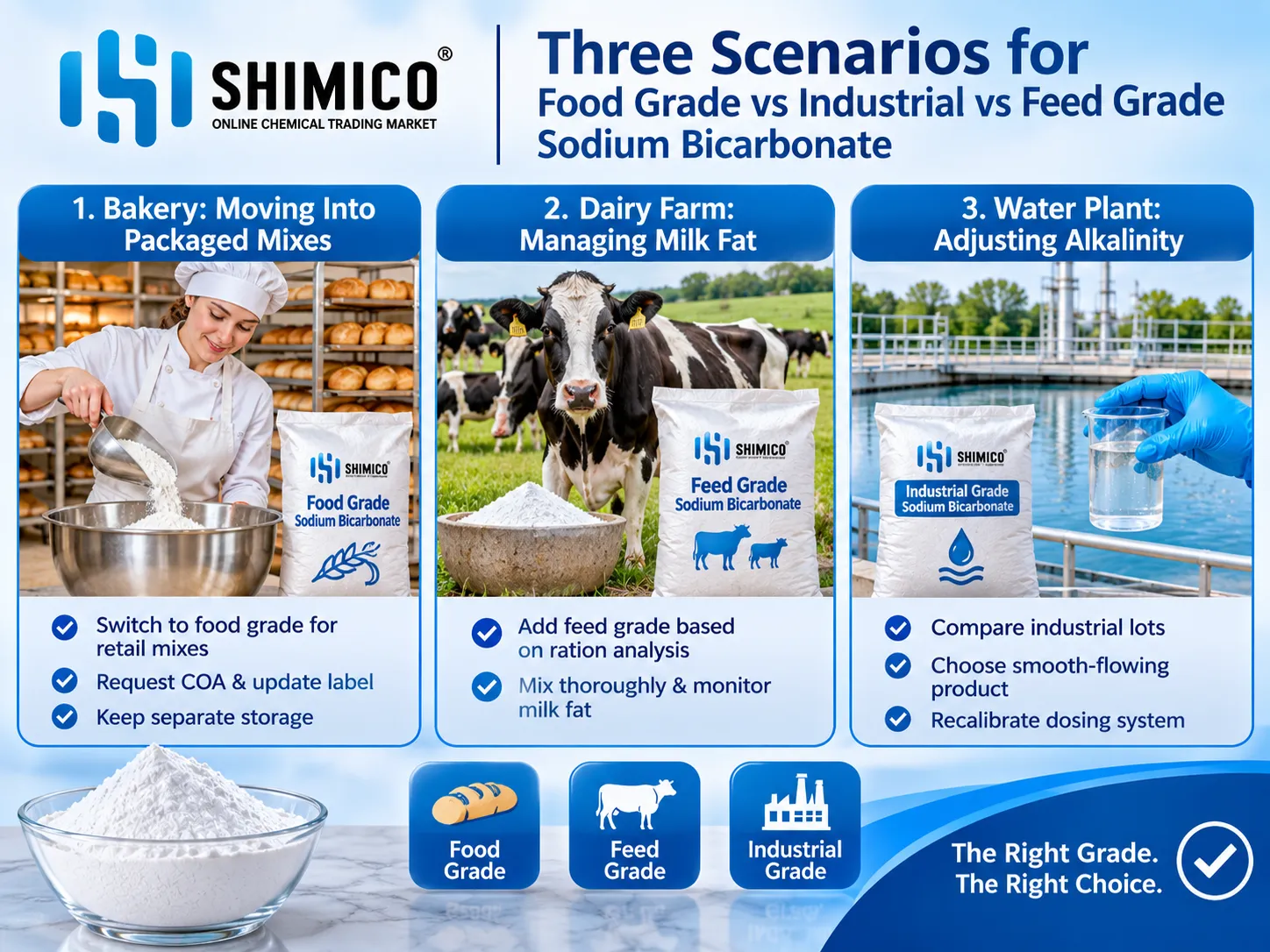
Scenario One: A Bakery Moving Into Packaged Mixes
A bakery that sells fresh bread starts packing a dry pancake mix for retail. The owner’s first thought is to keep using the industrial bag already in the storeroom, since it costs less. Once the mix is sold to consumers, the ingredient must be food grade. The bakery moves to a food grade supplier, requests the COA and specification, updates the label to match the ingredient declaration, and separates storage for the two grades.
Scenario Two: A Dairy Farm Managing Milk Fat
A farm sees milk fat slipping over several weeks after a silage shortage forces a higher-grain ration. The nutritionist reviews rumen buffering and recommends a feed grade bicarbonate inclusion calculated from the ration analysis. The farm mixes it thoroughly and logs intake, milk fat, and manure consistency against the baseline. The lesson: bicarbonate was one part of a managed change, not a quick fix.
Scenario Three: A Water Plant Adjusting Alkalinity
A water plant needs more alkalinity during a seasonal shift in source water. Operators compare two industrial lots with similar assays. One lot has finer particles and dissolves quickly, but it clogs the dosing line within days. The other flows smoothly and gives a steady pH response. The plant chooses the second lot and recalibrates its feeder for the bulk density. The decision came from a short trial, not from the price list.
Where to Buy Food Grade vs Industrial vs Feed Grade Sodium Bicarbonate in Iran With Shimico
Shimico lists chemical products for buyers who need a clear grade, a specification, and a documented lot. Start with the chemical products category to compare available grades. Then request the specification and the COA for the exact lot before you place an order. Buyers who sell material can also post a free listing on the platform.
Ready to Source the Right Grade?
Compare chemical products on Shimico, request the specification and COA for your lot, and match the grade to your use before you buy.
View Chemical Products on Shimico
View Sodium Bicarbonate Products on Shimico
Post a Free Chemical Listing
Frequently Asked Questions About Food Grade vs Industrial vs Feed Grade Sodium Bicarbonate
These questions come up often among buyers, food producers, and farm advisors. Each answer stands on its own.
Can I use industrial grade sodium bicarbonate in food?
No. Industrial grade material is not made or tested for human consumption, and its contaminant limits may not meet food safety requirements. Use food grade material for any product people eat or drink, and check the grade documentation against the rules in your market.
What is feed grade sodium bicarbonate used for?
It is mainly used as a rumen buffer in dairy and beef rations. It helps keep rumen pH steadier when animals eat high-grain diets. A nutritionist or veterinarian should set the inclusion rate for a specific herd, based on the ration analysis.
Is food grade sodium bicarbonate more expensive than industrial grade?
Usually, yes. Food grade carries stricter limits, deeper testing, and more documentation. Compare cost per usable outcome, not cost per kilogram. A cheaper grade that fails your specification costs more in the end.
Are food grade and feed grade sodium bicarbonate the same product?
They share the same chemical identity, but they are not interchangeable without checking. Each grade is documented against different rules. Confirm the grade on the label and the COA before you use a product in a different application.
What should I look for on a sodium bicarbonate COA?
Look for the grade, product name, lot number, and production date. Then check the assay, heavy metal results, moisture, and any microbiological data relevant to your use. Confirm that test methods are named and that each value falls within the specification you ordered.
Does particle size matter for sodium bicarbonate?
Yes. Particle size affects dissolution speed, flow through equipment, mixing uniformity, and dust. Choose the particle size that matches your dosing system and your process timing.
How should I store different grades of sodium bicarbonate?
Store all grades in sealed, dry containers away from moisture and strong acids. Keep food and feed grade physically separated from industrial material, label every bag with its grade and lot number, and use first-in, first-out rotation.
Does sodium bicarbonate need an export document set?
Often, yes. Export shipments commonly need a lot COA, a safety data sheet, correct customs classification, and sometimes origin or health certificates. The exact list depends on the destination, so confirm it with the importer and a licensed customs broker.
Where can I buy food, feed, or industrial grade sodium bicarbonate?
Shimico lists chemical products, so you can compare grades and request the specification and COA for the lot you need before ordering. Start here: Shimico chemical products.
Sources for Food Grade vs Industrial vs Feed Grade Sodium Bicarbonate
The sources below support the regulatory and technical points in this guide. Check each page for its current revision date before you publish or rely on it, because monographs and rules change.
- Title: 21 CFR 184.1736, Sodium bicarbonate. Publisher: U.S. Government Publishing Office, eCFR. Publication date: current revision (check the page). URL: https://www.ecfr.gov/current/title-21/chapter-I/subchapter-B/part-184/subpart-B/section-184.1736
- Title: Regulation (EC) No 1333/2008 on food additives. Publisher: Publications Office of the European Union, EUR-Lex. Publication date: consolidated version (check the page). URL: https://eur-lex.europa.eu/eli/reg/2008/1333/oj
- Title: Sodium bicarbonate, compound summary. Publisher: National Center for Biotechnology Information, PubChem. Publication date: check the page. URL: https://pubchem.ncbi.nlm.nih.gov/compound/Sodium-bicarbonate
- Title: Official Publication, ingredient definitions. Publisher: Association of American Feed Control Officials (AAFCO). Publication date: annual edition (check the page). URL: https://www.aafco.org
Last Seen


Users Comment
Feed Grade Sodium Bicarbonate: High-Purity Rumen Buffer & Livestock
Sulphur Import to Pakistan: Suppliers, Documents and Shipping Steps
Top 10 Sodium Bicarbonate Suppliers in India
Sodium Bicarbonate Price: Cost per Ton, per kg and Bulk Market Rates
Iran Sulfur Price: Domestic Market, FOB Export Price and Price per Ton
Sulfur Export Price FOB Iran: Bulk Sulfur Price per Ton
Sulfur Fungicide: How It Works, Uses and Safety Precautions
Types of Sulfur Fertilizers: Powder, Granular, Liquid & Sulfate Forms
Sulfur for Soil: Benefits, Uses and How to Apply It
Sulphur 80 WDG: Technical Specifications, Uses & Bulk Supply
Sulfur WDG: Water Dispersible Granules, Uses & Bulk Supply
Sulphur WDG Pakistan: Bulk Supply, Prices & Import Guide