




Urea Prices During the Iran War: Is the Shortage Over or Just Shifting
UREA MARKET ANALYSIS · UPDATED 16 SEPTEMBER 2026
Urea Prices During the Iran War: Is the Shortage Over or Just Shifting?
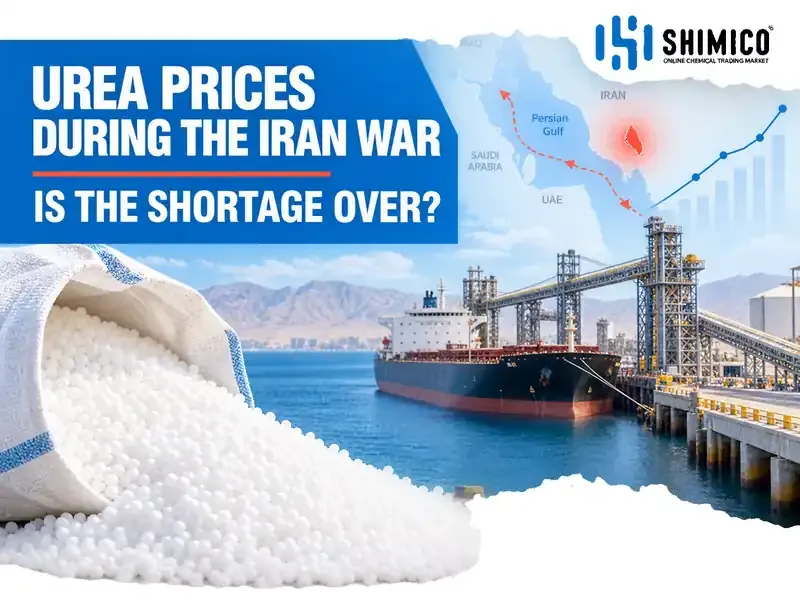
Urea prices have retreated from their 2026 peak as buyers found replacement supply outside the Gulf. Yet gas costs, export routes, freight, insurance and fresh demand can still change delivered prices quickly.
Urea prices during the Iran war have followed two very different phases. The first phase brought plant outages, blocked cargoes, scarce vessels and a sharp price jump.
The second phase brought new exporters, rerouted trade and lower import prices in several markets. That price correction raises a question with direct consequences for importers, distributors and agricultural buyers: has the global urea shortage ended, or has supply risk simply moved to a different part of the chain?
The answer is not a clean yes or no. Global trade adapted faster than many early forecasts assumed. Egypt, Nigeria, Russia, China, the United States and other suppliers gained business as Gulf flows declined.
Yet replacement supply does not erase the war. It changes origins, sailing distances, freight exposure, payment routes and delivery confidence. A market can have enough tonnes on paper while prompt cargoes for a specific destination remain expensive or difficult to secure.
Direct answer: The acute global urea shortage has eased, but the supply chain has not returned to its pre-war condition. Buyers should now track whether alternative exporters can keep replacing Gulf volumes while energy and shipping costs remain elevated.
Urea Prices During the Iran War: What Changed After the Initial Shock?
The early shock was severe because the conflict affected production and transport at the same time. Iran halted ammonia and urea output, Qatar stopped downstream production after damage to facilities, gas availability tightened and vessel traffic through the Strait of Hormuz fell sharply.
The World Bank reported that urea posted the largest fertilizer price gain during the disruption. Prices climbed above $850 per metric ton in April, up 80% from February.
Supply then began to reorganize. Buyers widened approved origin lists, traders redirected cargoes and producers outside the Gulf raised exports.
The Financial Times reported on 16 September 2026 that imports from Gulf exporters had dropped 85%, while total global fertilizer imports fell only 6%. The same report said urea prices were still 70% higher year on year in the second quarter, even though they had recently declined.
“Alternative supply prevented the collapse in Gulf exports from becoming an equal collapse in global fertilizer trade.” This interpretation follows current trade data reported by the Financial Times on 16 September 2026.
Urea Price Correction After the Iran War Peak
Lower prices do not mean that the original risk analysis was wrong. Commodity shocks often pull supply from new regions. High prices reward exporters that can add tonnes, encourage buyers to delay non-urgent purchases and reduce demand from farms that cannot recover fertilizer costs through crop revenue. Those reactions cool the market.
India offers a useful example. The Financial Express reported that Indian urea import prices had fallen about 57% from a May peak of $947 per tonne to roughly $406 per tonne by August.
Diversified sourcing from Oman, Russia and Nigeria contributed to the decline. Larger domestic stocks also reduced the urgency behind new purchases.
Urea Prices and Iran War Supply: Why the Strait of Hormuz Still Matters
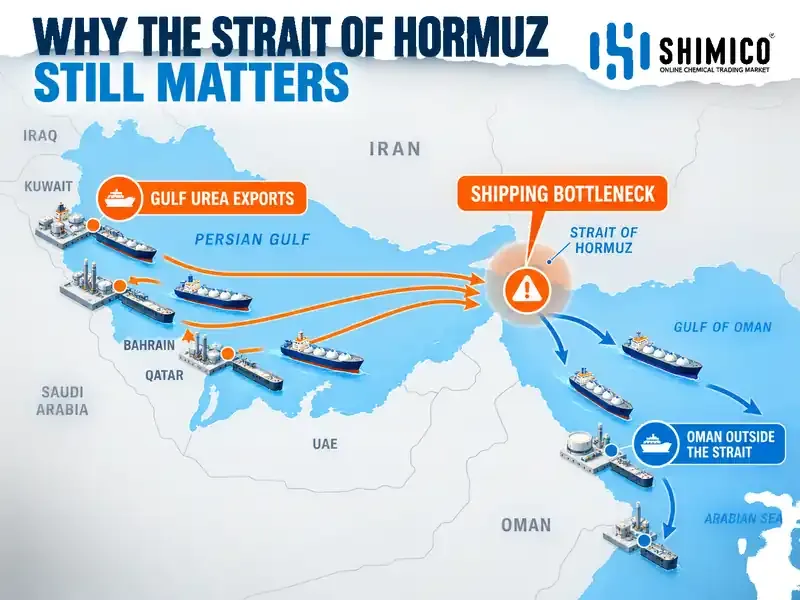
The Strait of Hormuz remains central to urea pricing because Gulf producers hold a large position in seaborne nitrogen trade. IFA calculated that countries affected by the disruption accounted for 34% of global urea trade in 2024. Chemical Market Analytics placed flows that transit Hormuz, excluding Oman, at about 32% of global seaborne urea trade.
These figures use different scopes, but they point to the same issue. A large block of export-oriented capacity depends on one narrow route. Oman has a geographic advantage because its ports sit outside the Strait.
Qatar, Bahrain, Kuwait and most Gulf export terminals west of Hormuz have fewer direct alternatives. Iran and Saudi Arabia have partial alternatives, though inland transport and port limits prevent a full transfer of volumes.
Urea Shipping Disruption and the Difference Between Stock and Supply
A plant can produce urea while export supply remains tight. Product may sit in storage, wait for a vessel or remain allocated to domestic use. Cargo can also be loaded but unable to sail.
IFA reported that around 800,000 tonnes of urea were loaded on 17 vessels blocked west of Hormuz at the end of April. That was a dated snapshot, not a current inventory figure. It still shows why production volume alone cannot describe prompt availability.
Buyers need to ask four separate questions. Is the plant operating? Is the quoted material produced? Has the seller allocated it to the buyer? Can a named vessel load and leave during the stated period? A quotation becomes more dependable as the seller provides stronger evidence at each step.
Urea Freight and War-Risk Insurance During the Iran War
Freight can stay expensive after commodity prices fall. Shipowners price route risk, vessel availability, waiting time, bunker fuel and the chance of diversion. Insurers add premiums or exclude high-risk areas.
Banks may require extra checks before handling documents or payments. Each layer widens the gap between an FOB offer and the buyer’s final cost.
EIA’s September outlook expected some Middle East export constraints to remain through the end of 2026 as flows gradually improved and alternative routes carried part of the volume.
EIA also expected oil prices to remain elevated during the second half of 2026. Higher marine fuel costs can keep delivered urea values firm even when the product component weakens.
For a wider comparison of exposed chemicals, see SHIMICO’s report on Strait of Hormuz chemical price risks. The earlier analysis of Iran war effects on fertilizer and chemical markets covers the broader product group.
Urea Price Forecast 2026: Five Signals Global Buyers Should Watch
No single signal can produce a dependable urea price forecast for 2026. Buyers gain a clearer view when production, shipping, trade policy, replacement supply and demand point in the same direction. The following five signals form a practical watchlist for weekly purchasing reviews.
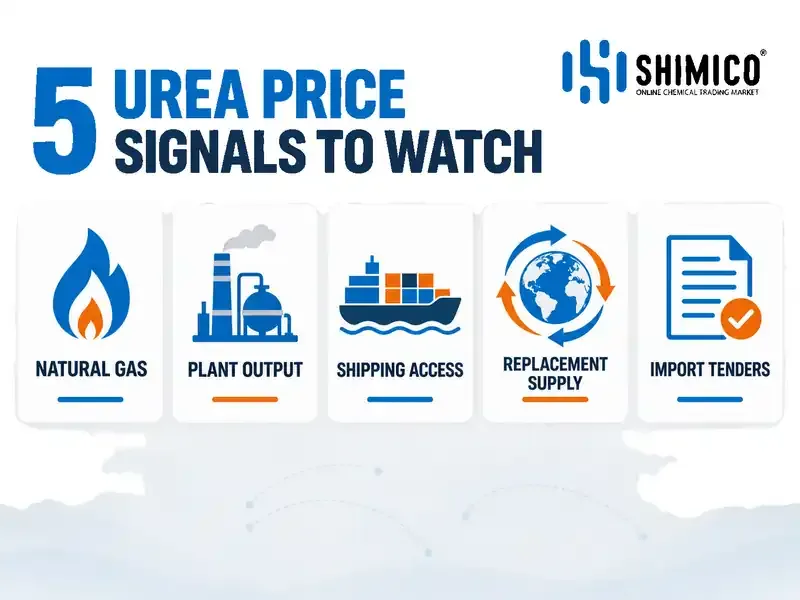
Urea Price Signal 1: Natural Gas and Ammonia Production
Natural gas serves as feedstock and fuel for ammonia, which plants convert into urea. IFA states that gas commonly accounts for 60% to 80% of nitrogen fertilizer production costs.
A gas interruption can cut output even when the urea plant itself has no damage. A price increase can also push high-cost producers in Europe or other regions toward reduced rates.
Watch physical gas allocation as closely as benchmark prices. Governments may protect households and power generation before industrial users. A producer can face lower gas deliveries even when the quoted gas market appears stable.
Urea Price Signal 2: Vessel Movements and Firm Loading Windows
AIS vessel data, port notices and seller documents help separate physical movement from market talk. A rise in ships entering and leaving Gulf terminals can support more supply. Buyers still need to check whether those ships carry fertilizer, energy products or other cargoes.
Firm loading windows matter more than broad claims that a port is open. Request the named port, loading range, product status and evidence that a suitable vessel is nominated. Include contract language for delay, storage and demurrage.
Urea Price Signal 3: Alternative Exporters Replacing Gulf Cargoes
Replacement exporters have become the main reason the shortage eased. Yet their ability to keep filling the gap depends on plant reliability, domestic allocation, export policy and freight to each destination.
Egypt may serve Europe and Turkey well, while Nigeria may compete strongly into Atlantic markets. Russian and Chinese availability depends on policy, commercial terms and destination access.
Buyers should track completed sales rather than offers alone. A supplier can publish a competitive indication and later withdraw because gas, policy or freight changes. Tender awards reveal where tonnes are truly available and which origins can meet destination requirements.
Urea Price Signal 4: India, Brazil and Seasonal Import Demand
Large tenders can tighten prompt availability even when annual supply appears adequate. India influences price discovery because its tenders attract bids from many origins at once.
Brazil can pull cargoes toward the Atlantic during its buying seasons. When large import programs overlap, sellers gain more destination choices and freight demand rises.
Crop economics also matter. Nitrogen demand is less responsive to weak affordability than phosphate or potash because crops need nitrogen each season. Farmers may still reduce application, delay purchases or choose smaller doses if crop revenue cannot cover fertilizer expense.
Urea Price Signal 5: Export Rules and Payment Access
Export controls can remove supply without shutting a plant. Governments may reserve fertilizer for domestic agriculture, slow licenses or adjust customs rules.
Banking restrictions and compliance reviews can delay payment and documents for certain origins. These barriers may redirect trade toward buyers with acceptable payment channels rather than buyers offering the highest nominal price.
Monitor official export announcements, customs data and completed shipments. Rumors can change offers for a few days. A policy notice or verified cargo movement has greater purchasing value.
Global Urea Shortage 2026: Which Import Markets Face More Risk?
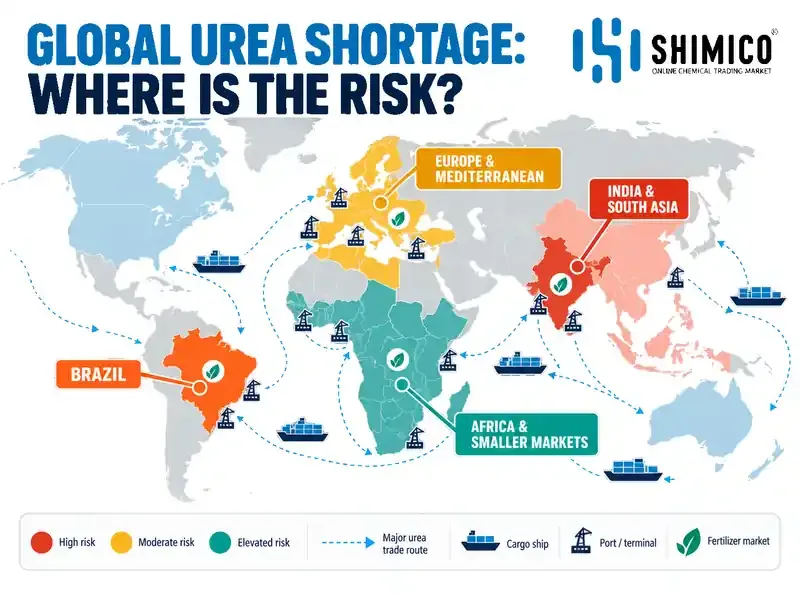
Country exposure depends on more than total import volume. Inventory, crop timing, subsidy policy, port access and approved origins decide whether a global disruption becomes a local shortage. Buyers in markets with narrow supplier lists or short purchasing windows face higher risk.
Urea Shortage Risk in India and South Asia
India combines large consumption, large tenders and domestic production that depends partly on imported energy. Lower import prices and higher stocks improved the position by late summer 2026. The market still watches India because one large tender can absorb prompt cargoes from several origins.
Pakistan and Bangladesh also face gas and import exposure. Higher LNG costs can reduce local output, while tight public budgets restrict the price governments can accept for imports. Delivery timing may matter more than the yearly average price because fertilizer must reach farms before application windows close.
Urea Shortage Risk in Europe and the Mediterranean
Europe can buy from North Africa, the Baltic, the United States and other origins, but high regional gas prices can weaken domestic nitrogen production.
More import dependence then places added pressure on ports, storage and shipping. Carbon costs and product rules can also affect which cargoes remain commercially attractive.
Egypt holds an important role as an accessible Mediterranean exporter. Its producers still depend on adequate gas. Any cut to industrial gas can remove replacement supply that European and Turkish buyers have used during the Gulf disruption.
Urea Shortage Risk in Brazil, Africa and Smaller Import Markets
Brazil can attract cargoes through scale, but long voyages increase freight sensitivity. African buyers often face greater affordability and finance pressure. Smaller importers may struggle when large tenders capture available vessels and sellers prefer high-volume destinations.
The global market may report enough total supply while smaller destinations receive fewer offers. Buyers should measure availability at their own port and shipment size rather than assuming that a global surplus reaches every market equally.
Granular Urea Prices and Prilled Urea Prices During the Iran War
Granular and prilled urea usually contain 46% nitrogen, but buyers cannot treat them as identical cargoes. Granular urea has larger, harder particles and often suits bulk blending and mechanized spreading. Prilled urea has smaller particles and serves established agricultural and industrial markets.
The war can widen or narrow the spread between the two forms. The direction depends on which plants operate, where inventories sit and which destinations enter the market.
Switching form may solve an availability problem, but only after the buyer confirms equipment, agronomic and specification requirements.
Urea Buying Strategy During the Iran War: Three Market Scenarios
Scenario planning gives purchasing teams a better tool than one unsupported price target. The cases below connect observable market conditions with purchasing choices. They do not promise a price direction.
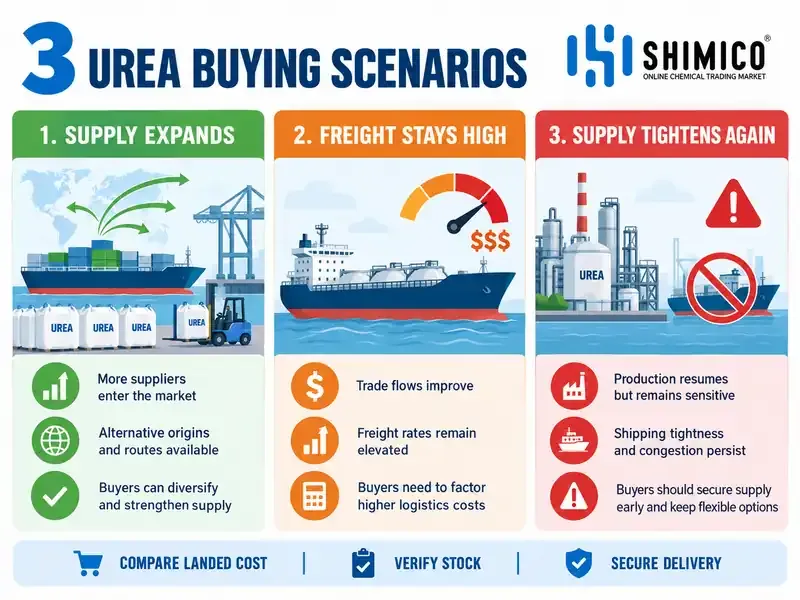
Urea Buying Scenario 1: Alternative Supply Keeps Expanding
More cargoes from outside the Gulf, normal plant operations and calmer tenders would place further pressure on prompt prices. Freight may also ease if more vessels accept regional business. Buyers with comfortable inventory can seek shorter price validity, compare more origins and avoid paying a large premium for distant delivery.
Do not assume that every low-priced cargo meets the same specification or document standard. Confirm nitrogen, biuret, moisture, particle size, origin, inspection, packaging and shipping records.
Urea Buying Scenario 2: Trade Flows Improve but Freight Stays Expensive
This mixed case can produce weaker FOB prices and sticky delivered prices. Oil, insurance and vessel availability keep logistics costly while alternative suppliers offer more product. Buyers should compare CFR or landed offers with an itemized estimate for FOB purchases. The cheapest factory price may lose its advantage after transport.
Staged purchasing can reduce timing risk. A buyer can cover immediate operational needs first, then review later volumes when freight becomes clearer. Contract terms should state who pays new war-risk premiums or route-related costs after signing.
Urea Buying Scenario 3: Production and Shipping Tighten Again
The strongest upward-risk case combines plant outages, weaker replacement exports, active tenders and renewed shipping restrictions. Sellers may shorten price validity or withdraw offers. Buyers with rigid specifications and near-term delivery dates face the greatest exposure.
Supplier verification becomes more important than a low headline quote. Ask for evidence of stock, allocation, port, laycan and vessel. Avoid full reliance on one cargo when missing the delivery date would stop a production line or leave a seasonal fertilizer program uncovered.
Urea Supplier Checklist for Iran War Price and Shipment Risk
A complete RFQ allows buyers to compare like with like. It also reduces the chance that a low quote hides weaker specifications, uncertain stock or missing logistics costs. Include the following points in every bulk urea request.
- Product: agricultural or industrial urea, granular or prilled.
- Specification: nitrogen, biuret, moisture, particle-size range, fines and crushing strength.
- Quantity: total tonnes, acceptable tolerance and shipment lots.
- Packaging: bulk, 25 kg, 50 kg or jumbo bags with marking requirements.
- Origin: producing plant and country, not only trader location.
- Availability: produced stock, allocated stock or future production.
- Shipment: port, laycan, vessel status and estimated arrival.
- Commercial basis: Incoterm, currency, payment, price validity and taxes.
- Documents: COA, TDS, SDS, certificate of origin, inspection and shipping documents.
- Delay terms: storage, demurrage, insurance changes and cancellation rights.
Buyers can compare current listings from urea suppliers and bulk prices.
A proposed switch to ammonium sulfate as an alternative nitrogen source requires agronomic review because the products supply different nitrogen concentrations and ammonium sulfate also supplies sulfur.
Urea Prices Iran War FAQ for Global Buyers
Compare Urea Suppliers or Post a Free Chemical Listing
SHIMICO connects chemical and fertilizer buyers with suppliers. Review urea listings, compare commercial terms or publish a free product advertisement.
Include grade, quantity, origin, packaging, destination and delivery window to receive more comparable responses.
Urea Prices Iran War Sources and Publication Record
Last Seen


Users Comment
Strait of Hormuz Disruption: Which Chemical Prices Could Rise First?
Aramco loan $2 billion to Petro Rabigh to cover cash shortfall
Moldova exports gas to Ukraine for storage injections