


Sulfur WDG: Water Dispersible Granules, Uses & Bulk Supply
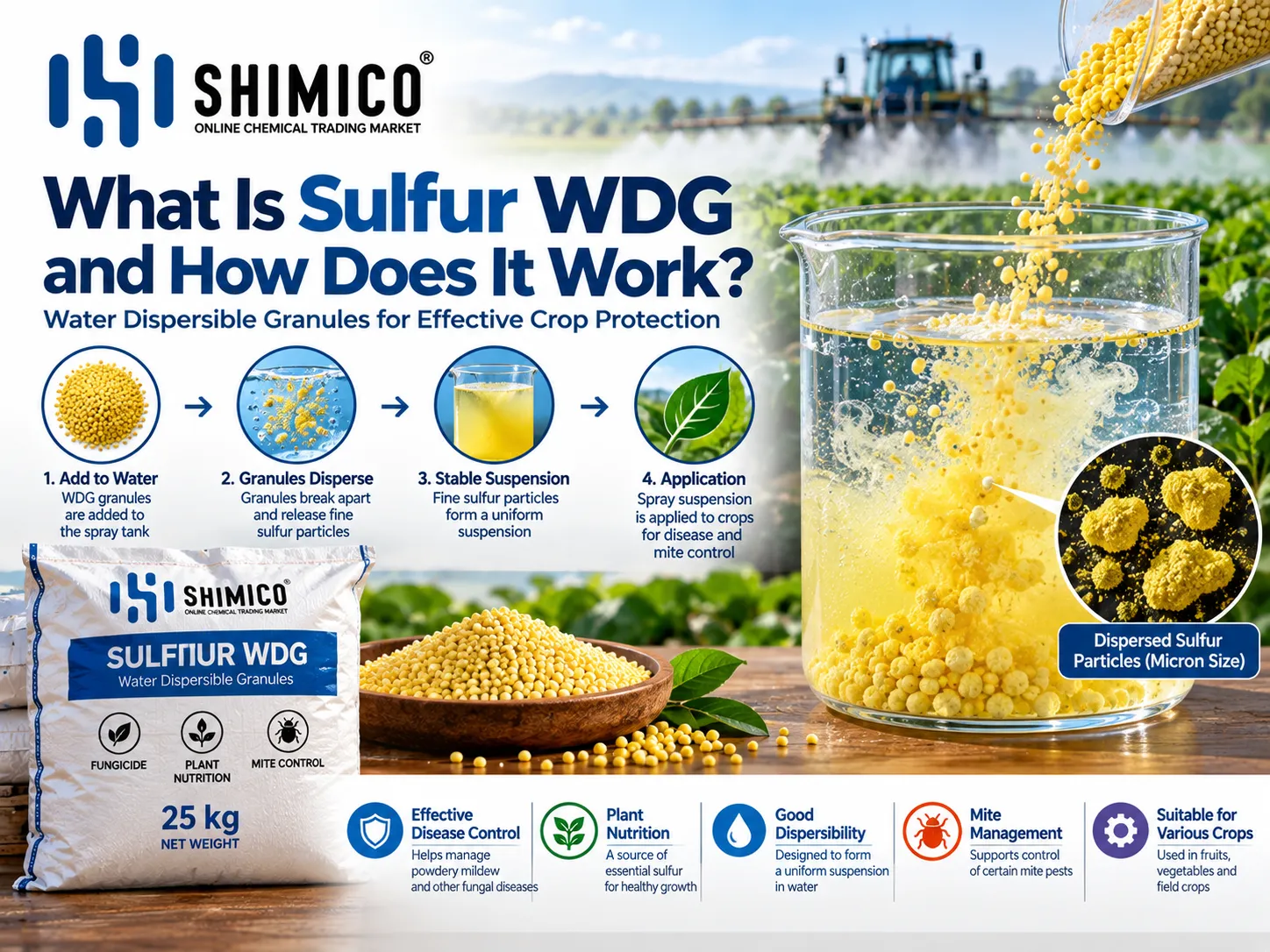
Sulfur WDG is more than yellow granules sold for agricultural spraying. For a wholesale buyer, the difference between a successful shipment and an expensive dispute often lies in how those granules disperse, how the batch is tested, which registration covers the product, and what the quotation actually includes.Two suppliers may quote the same active sulfur percentage while offering products with different physical behaviour, documentation and delivery terms.
Sulfur water dispersible granules (also written Sulphur WDG, Sulfur WG, or sometimes sulfur dry flowable) are formulated to break apart in water and produce a suspension of fine sulfur particles. They do not chemically dissolve into a clear solution. That distinction explains why wetting, dispersion, suspensibility and sieve residue deserve attention alongside the sulfur content printed on a bag.
This global guide is written for agrochemical importers, procurement teams, agricultural distributors and wholesale buyers. It covers the properties, grades, manufacturing methods, uses, documents, packaging, suppliers and cost calculations that support a technically sound purchase. Product availability, approved applications and supplier capabilities must be confirmed for the specific country and proposed shipment.
Buyer snapshot: Before requesting a sulfur WDG quotation, define your target grade, destination country, intended regulatory market, metric tonnage, packaging, Incoterm and required certificate of analysis (COA). If you need related elemental sulfur rather than spray-grade granules, explore Shimico sulfur product listings.
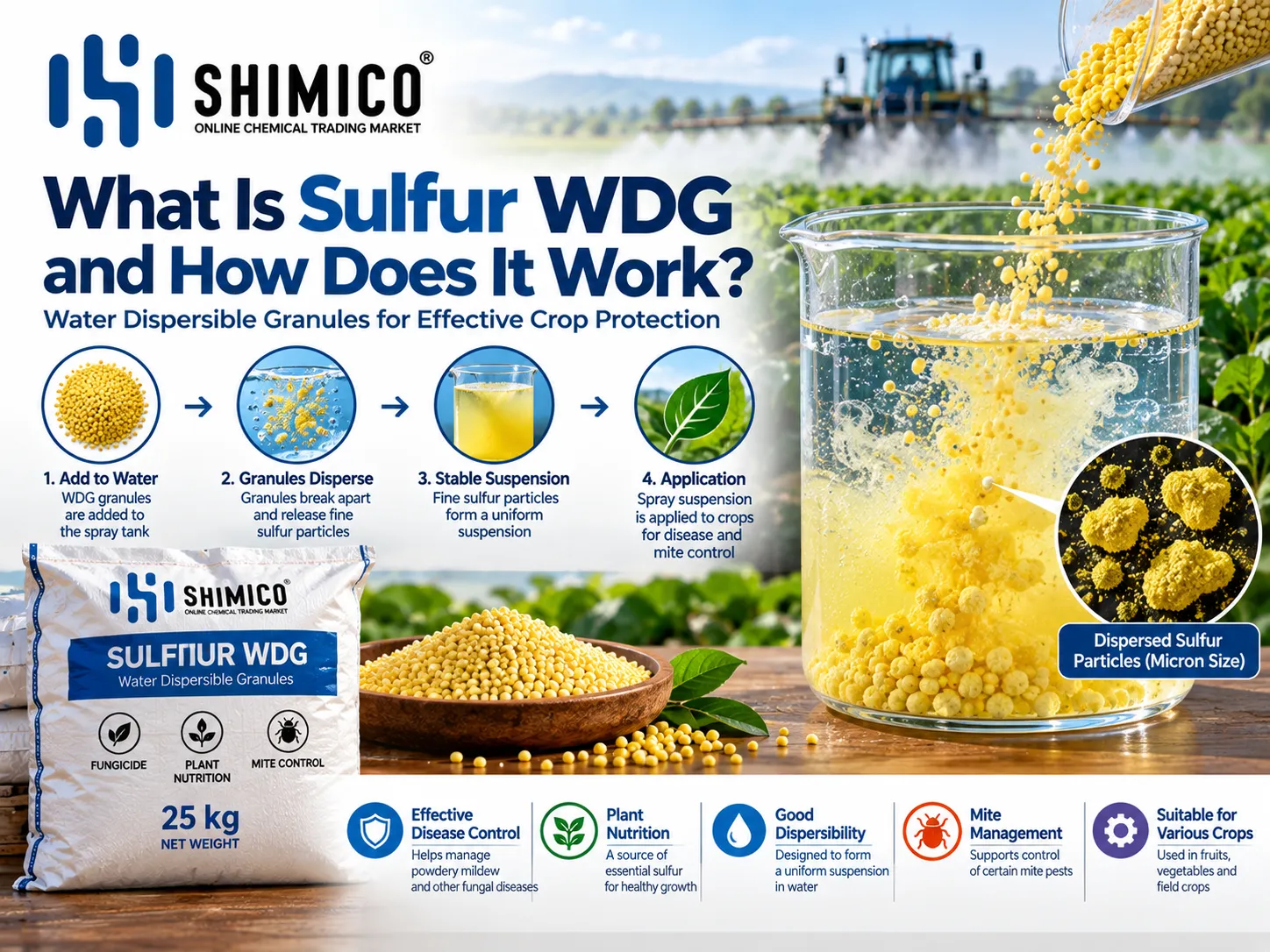
What Is Sulfur WDG and How Does It Work?
Sulfur WDG is a dry agricultural formulation containing elemental sulfur and supporting formulation ingredients. When mixed according to its instructions, the granules disintegrate, wet and distribute fine sulfur particles through water. The result is a spray suspension rather than a solution. In practical terms, the quality of that suspension helps determine whether the product can move through ordinary application equipment without troublesome sediment or coarse residue.
Sulfur WDG, WG and DF: What Do the Names Mean?
WG is the established formulation code for water dispersible granules. WDG is a common descriptive abbreviation. DF, or dry flowable, is used commercially for products with similar dry-dispersible characteristics. These terms do not independently identify an exact product, percentage, manufacturer or registration. A distributor must confirm the code on the approved label and the manufacturer’s technical data sheet (TDS).
Does Sulfur WDG Dissolve in Water?
No. Elemental sulfur has very low water solubility. Properly formulated WDG granules break into much smaller dispersed particles when added to water; these particles form a suspension and need suitable mixing and agitation. A buyer should not interpret a cloudy test beaker as evidence of impurity or failed dissolution. The meaningful questions are whether the granules disperse under a stated test method, whether the suspension remains sufficiently uniform and whether coarse material is limited.
Sulfur WDG vs Ordinary Sulfur Prills
Industrial sulfur prills or bulk granules may be suitable for industrial processing or fertilizer manufacturing, but they are not automatically appropriate for foliar spraying. A spray-grade WDG formulation has been specifically developed to disperse in the application tank. Switching an agricultural WDG with ordinary sulfur prills based only on price per ton is a product-substitution error, not a saving.
Sulfur WDG Physical and Chemical Properties
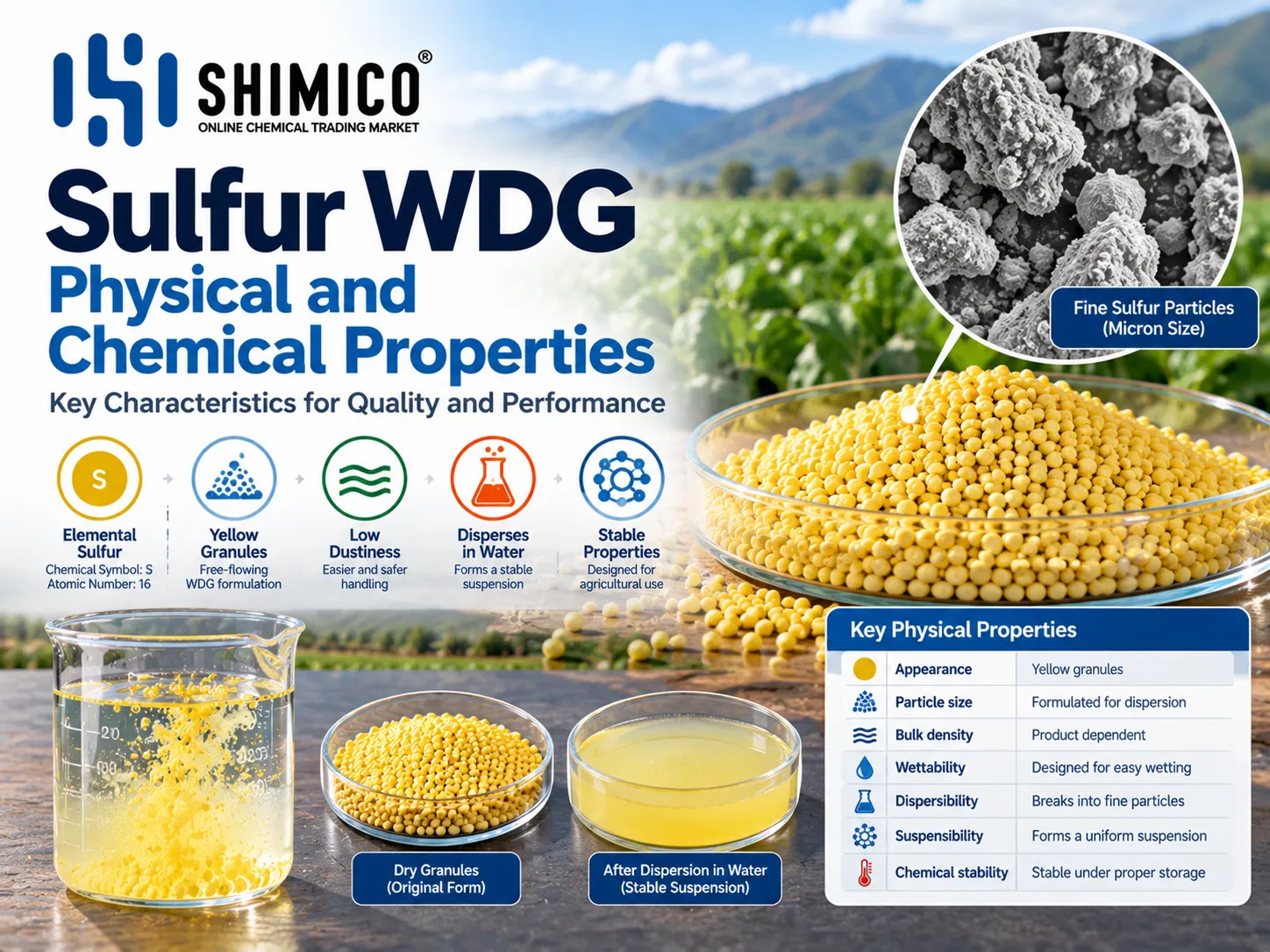
Elemental sulfur is a yellow chemical element with the symbol S. A sulfur WDG product typically appears as dry granules, with the precise size, shade, flow behaviour and bulk density dependent on the manufacturer. It can contain formulation ingredients designed to support wetting, binding, dispersion and storage. Declared active sulfur content should be expressed by weight and tied to the exact grade.
Sulfur WDG Appearance, Granule Size and Dustiness
A commercial batch should conform to its agreed description. A dry, free-flowing product with appropriate dust characteristics is easier to measure and handle than material that arrives caked, broken into fine dust or contaminated. Granule size can affect pouring and mixing, but visible granule size is not the same as the size of the sulfur particles ultimately dispersed in water. Buyers should ask for specifications rather than infer performance from a photograph.
Sulfur WDG Wetting, Dispersion and Suspensibility
Wettability describes how readily water wets a sample. Dispersibility concerns how a granule breaks apart and distributes its particles. Suspensibility describes the proportion remaining in suspension under the prescribed test conditions. A product can be high in sulfur yet perform poorly in these tests. That is why procurement teams should request methods, limits and actual batch results rather than a vague statement such as ‘premium dispersibility’.
Sulfur WDG Technical Specifications, COA and Testing
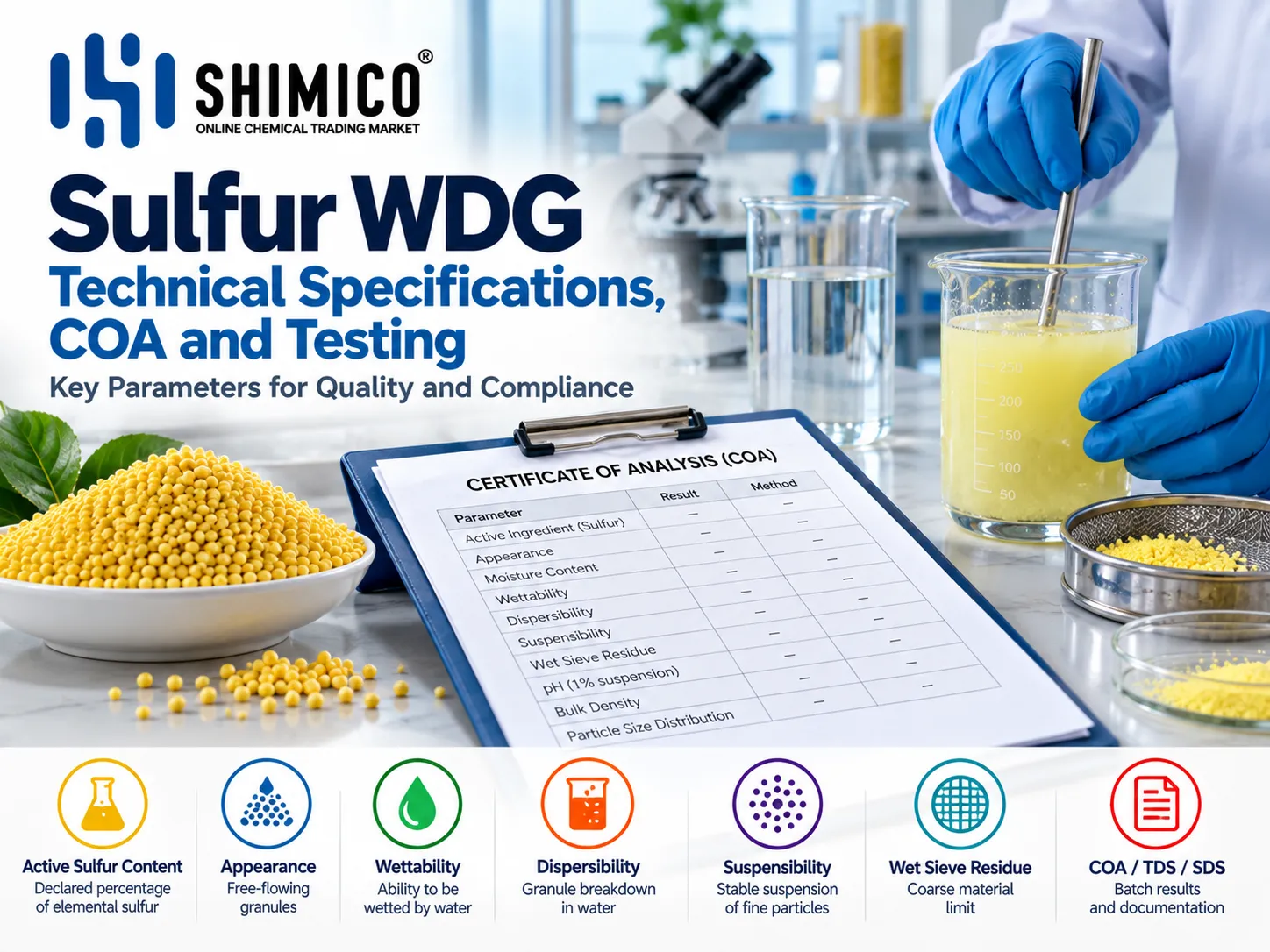
International sulfur WDG procurement depends on a written specification that can be tested. The joint FAO/WHO pesticide specification manual describes relevant WG characteristics, including water dispersion, flow and dust properties. It also stresses representative sampling. These are useful principles for the purchasing contract, not proof that every product listed online automatically meets a particular standard.
The following table identifies the information a buyer should request. It deliberately avoids invented numerical acceptance limits. Actual limits depend on the approved formulation, its reference specification and the agreed analytical methods.
| Sulfur WDG parameter | Why it matters | Evidence to request |
|---|---|---|
| Active sulfur (% w/w) | Confirms the grade ordered | Batch COA, label and TDS |
| Formulation classification | Distinguishes WG/WDG from WP or SC | Registered label, TDS |
| Wettability | Indicates water wetting behaviour | Method and batch result |
| Degree of dispersion | Assesses granule breakdown | Method and acceptance range |
| Suspensibility | Checks uniformity under defined conditions | Tested percentage with method |
| Wet sieve residue | Detects coarse residual particles | Sieve method and measured result |
| Dustiness and flowability | Relates to handling and dosing | Agreed test criteria |
| Moisture and storage stability | Helps assess caking and storage risk | Test report and stability data |
| Packaging, lot and date marks | Supports traceability | Bag sample and packing list |
Sulfur WDG Certificate of Analysis (COA)
The COA should refer to an identifiable manufactured lot and report the values relevant to the contract. A generic template cannot establish that the actual shipment passed testing. Prefer a certificate showing batch number, date, method references and test results. When pre-shipment inspection is planned, establish how the sample will be drawn, sealed and tested before the goods leave the manufacturing site.
Sulfur WDG TDS and Safety Data Sheet (SDS)
The TDS states the declared composition, physical form, relevant technical properties and intended product identity. The SDS addresses hazardous characteristics, protective measures, storage, accidental release, first aid and transport information. The registered pesticide label has another role: it defines the approved use directions and limitations in the relevant market. Each document answers a different question. None should be presented as a substitute for the other two.
Representative Sulfur WDG Samples and Batch Consistency
A small sales sample can demonstrate appearance and mixing behaviour, but it may not represent a later container of product. Request a sample traceable to its manufacturer and batch, and ensure that the commercial shipment is subject to the agreed inspection procedure. For repeat orders, compare multiple batch reports over time. Stable lot-to-lot quality is often more valuable than a single attractive sample.
Sulfur WDG Grades: 80%, 90% and Other Formulations
An active ingredient percentage identifies concentration, not the whole purchasing specification. Sulfur 80 WDG contains 80% sulfur by weight in a water dispersible granule formulation. Sulfur 90 WDG is a different declared concentration where marketed. Neither number alone establishes identical particle size, compatibility, approved crops or performance. The remaining components in a formulated product also contribute to handling and dispersion.
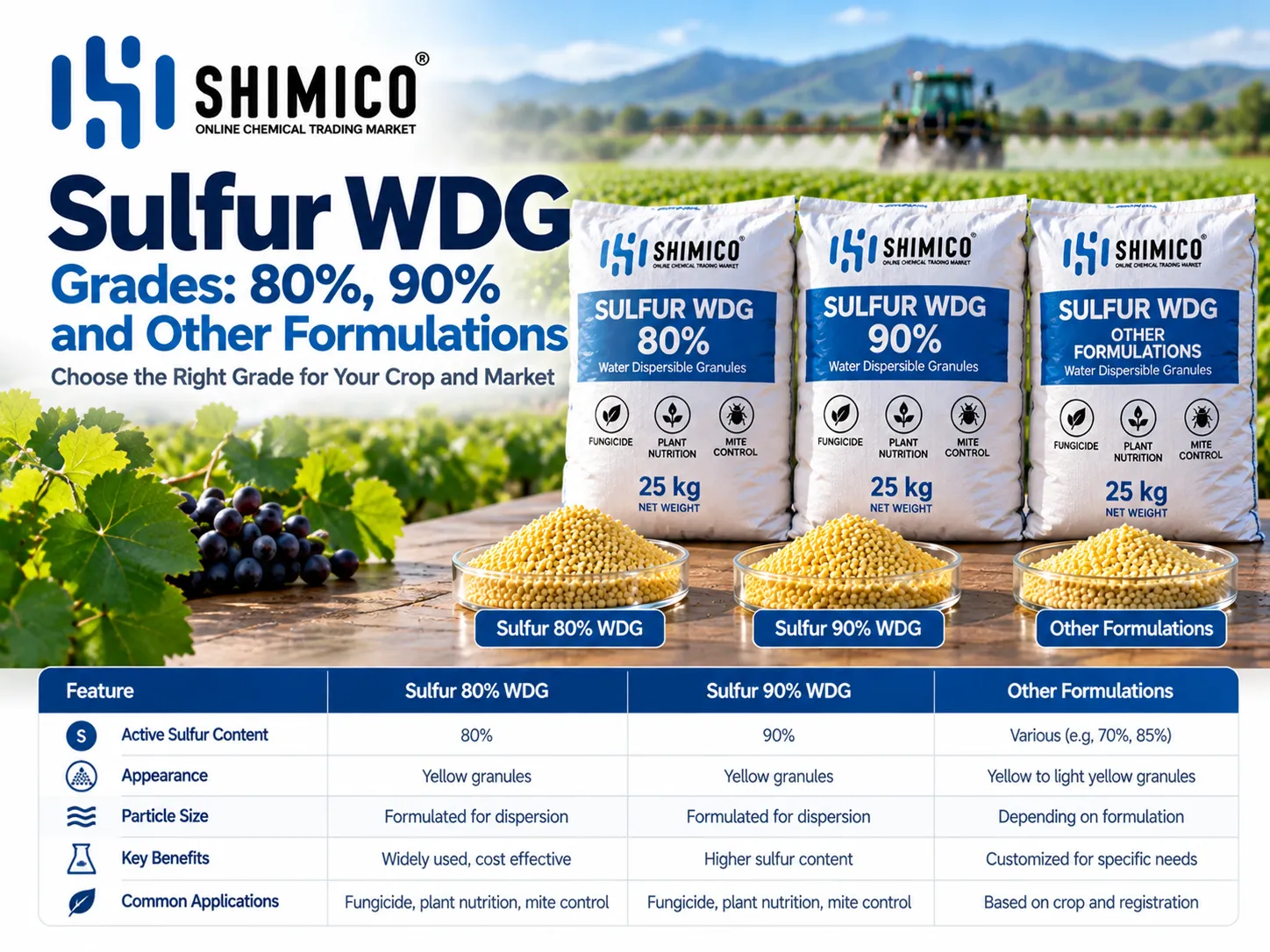
Sulfur 80 WDG for Crop Protection
The 80% formulation is a documented crop-protection category. Drexel Chemical’s Sulfur 80 WDG is one example of an 80% product with registered label information in its own market. Its documentation cannot be used to claim that another brand is authorized for the same crop, pest, rate or country. Procurement contracts should name the exact formulation and intended regulatory destination.
Sulfur 90 WDG and Higher-Concentration Options
Products described as 90% sulfur water dispersible granules also appear in some agricultural markets. Such products may be positioned differently for crop protection or plant-nutrition applications. Do not assume that an additional ten percentage points means better results, a lower application cost or local registration. Compare product-specific specifications, approved claims and cost per usable quantity rather than concentrate percentage alone.
Choosing a Sulfur WDG Grade for Export
Begin with the destination country’s regulatory requirements and target application. Confirm the registered formulation, named manufacturer, active ingredient declaration and proposed labeling. Only then evaluate documents, laboratory properties, loading formats and quotations. Grades that have not been verified should be described as subject to supplier confirmation, not as guaranteed available inventory.
How Is Sulfur WDG Manufactured?
Sulfur WDG production converts sulfur feedstock into a dry formulated granule with predictable handling and water-dispersion characteristics. Manufacturers may follow different processes and use different equipment. A typical sequence involves feedstock assessment, particle size reduction or dispersion preparation, addition of formulation ingredients, granule formation, drying, classification and final testing. No single method should be portrayed as universal.
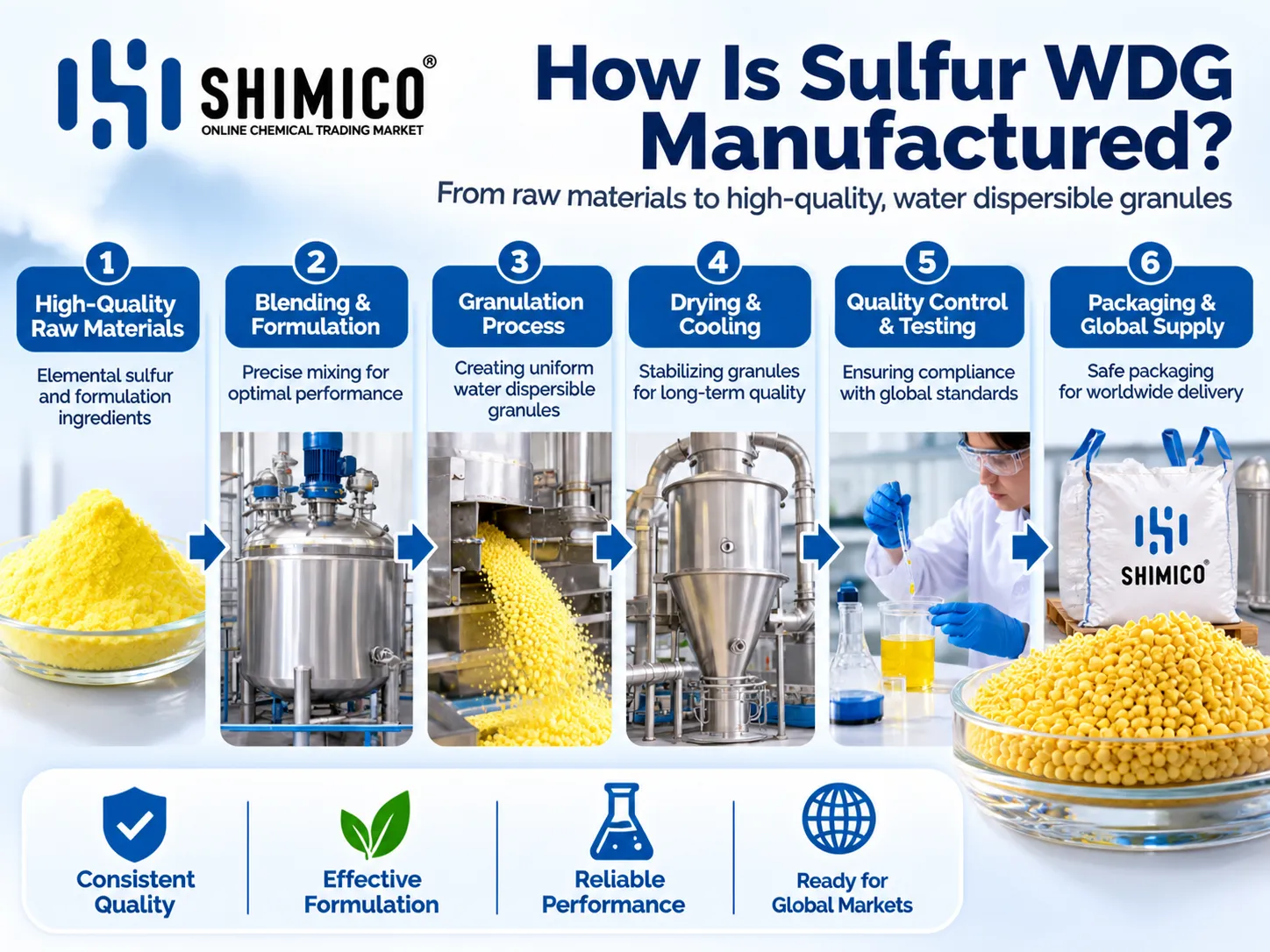
Sulfur Micronization and Formulation Ingredients
Finely divided sulfur is prepared to achieve the desired particle characteristics in the spray suspension. The manufacturer then chooses formulation ingredients that support wetting, distribution, binding and handling. Particle reduction and powder handling require engineering controls because combustible sulfur dust can present industrial safety hazards. These production activities belong in properly designed facilities, not improvised farm mixing operations.
Granulation, Drying and Screening
Granulation changes a formulated mixture into granules intended for transport and dosing. Drying, where used, brings the product toward an acceptable moisture level, while screening helps remove unwanted oversized or undersized material. The relationship between process settings, granule hardness, water dispersion and storage characteristics needs validation for the particular formulation.
Finished Sulfur WDG Quality Tests
Before release, manufacturers should measure the contractually required parameters and identify the final batch. A comprehensive production claim should be supported by traceable testing, not just product photographs or a certificate without numerical results. For buyers, independent verification becomes especially useful when working with a new factory, large order or unfamiliar export jurisdiction.
Sulfur WDG Uses in Agriculture and Crop Protection
Agricultural sulfur formulations are widely associated with fungicidal applications, and particular registered products also carry miticidal or other claims. Sulfur is generally described as a contact or protectant fungicide rather than a systemic material. The actual permitted uses depend on the registered product label. The buyer must avoid treating a worldwide marketing description as legal permission for local application.
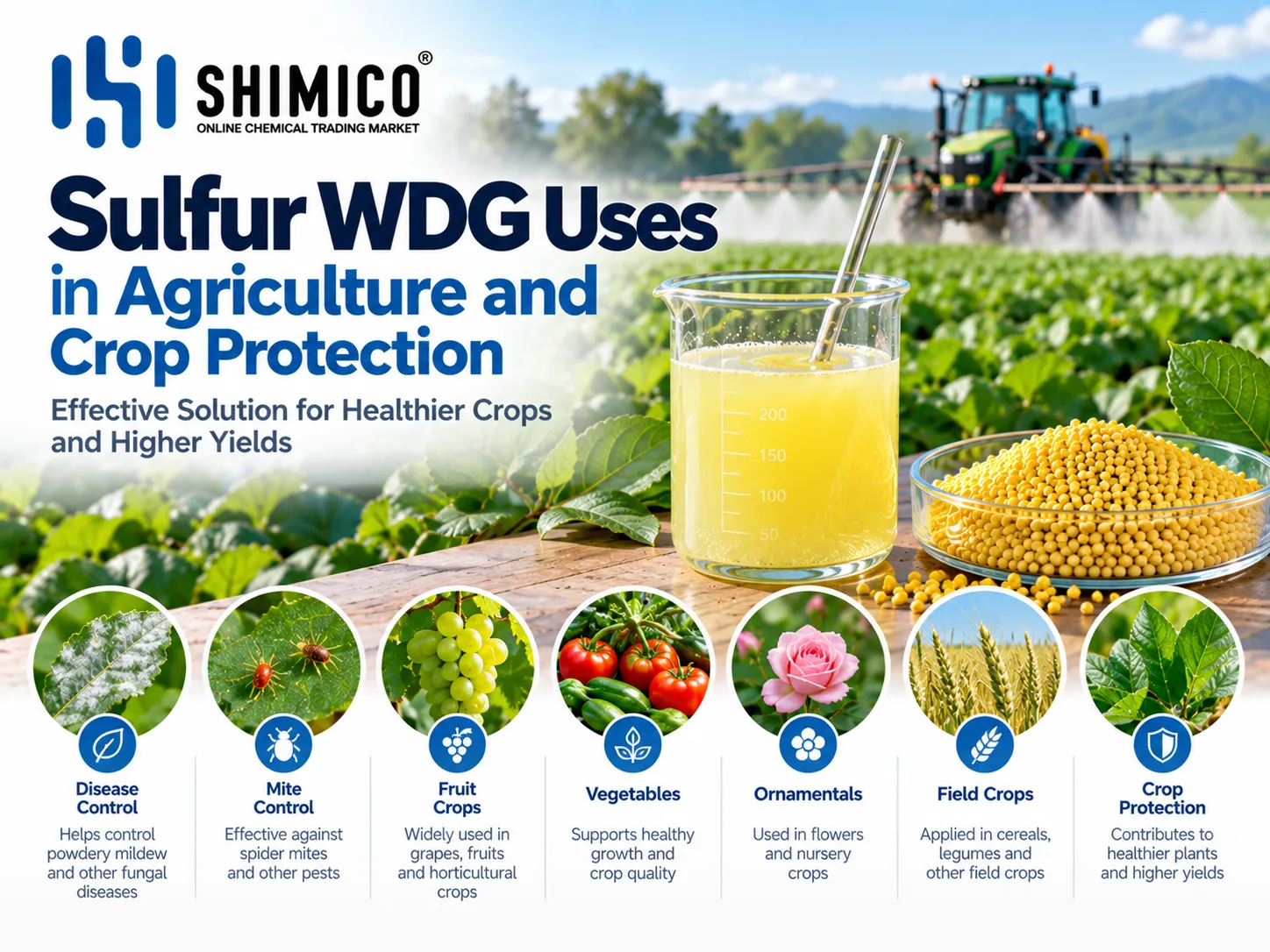
Sulfur WDG Fungicide Uses and Powdery Mildew
Powdery mildew is an important disease group across numerous crop systems. Some registered sulfur WDG fungicides are labelled for specified crops and disease situations. Spray coverage, application timing and label restrictions affect performance. The crop list and dosage appearing on a US label, for example, cannot be transferred automatically to a product sold in Pakistan, Africa or another market.
Sulfur WDG for Mites and Other Labelled Uses
Certain sulfur formulations have miticidal uses listed on their labels. Activity depends on the target mite, crop and approved product. Buyers serving local dealer networks should request the market-specific label before developing claims, promotional material or field recommendations. Product identity and registered uses matter more than broad claims such as ‘controls all pests’.
Sulfur Nutrition Is Not the Same as Pesticide Registration
Plants require sulfur for normal metabolism, including synthesis of sulfur-containing amino acids. That does not mean every sulfur WDG pesticide formulation is automatically intended or registered as a soil fertilizer. Procurement departments should distinguish crop-protection products from fertilizer-grade sulfur and ordinary elemental sulfur. Each category can have separate specifications, documentation, rules and application instructions.
Sulfur WDG Temperature and Crop-Safety Precautions
Sulfur may injure sensitive crops under hot conditions or in proximity to certain horticultural oil treatments. Requirements differ among labels. Drexel’s product information, for instance, cautions about high-temperature applications for its specific formulation. Always follow the locally applicable label, crop restrictions and spray intervals rather than adopting a generic global rate or temperature threshold.
Sulfur WDG vs WP, SC and Conventional Sulfur Granules
The formulation type changes how a product is shipped, stored, mixed and applied. A WDG is a dry granule prepared for dispersion in spray water. A wettable powder (WP) is a dry powder intended to form a spray suspension. A suspension concentrate (SC) is supplied in liquid form with dispersed solid particles. Ordinary sulfur granules and prills are not necessarily spray formulations at all.
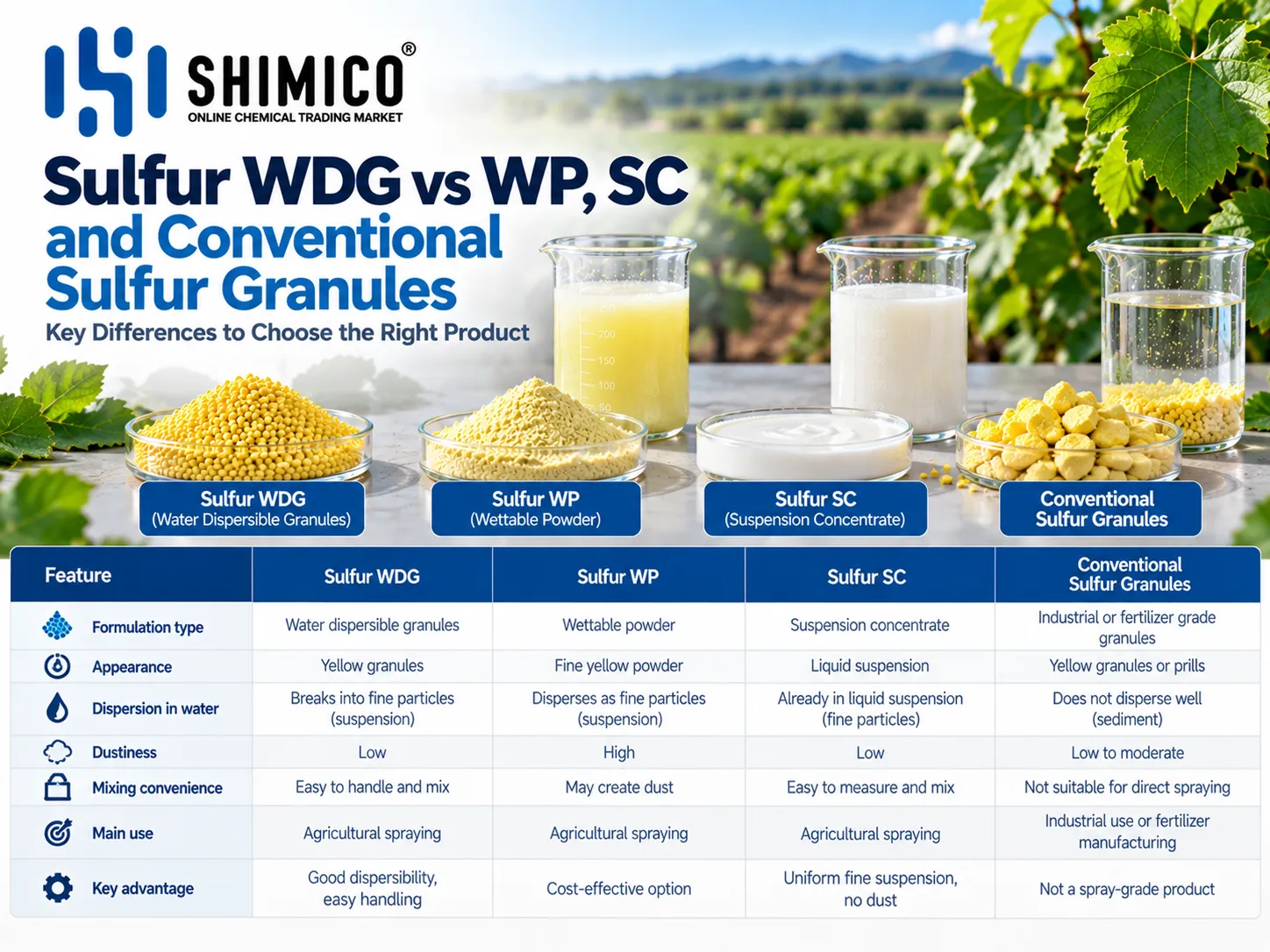
| Material | Supplied form | Main purchasing consideration |
|---|---|---|
| Sulfur WDG / WG | Dry dispersible granules | Dispersibility, suspensibility, handling, registration |
| Sulfur DF | Dry-flowable commercial designation | Confirm exact formulation and label |
| Sulfur WP | Wettable powder | Dust, mixing, residue, registration |
| Sulfur SC | Liquid suspension concentrate | Liquid stability, containers, handling |
| Sulfur prills / industrial granules | Bulk elemental solid | Industrial/fertilizer use, not automatic spray substitution |
A distributor choosing among these formats must compare the approved application, equipment, transport economics, packaging and product characteristics. A lower price per kilogram may offer no advantage if a cheaper material is the wrong formulation for the intended application.
Sulfur WDG Packaging, Storage and Shelf Life
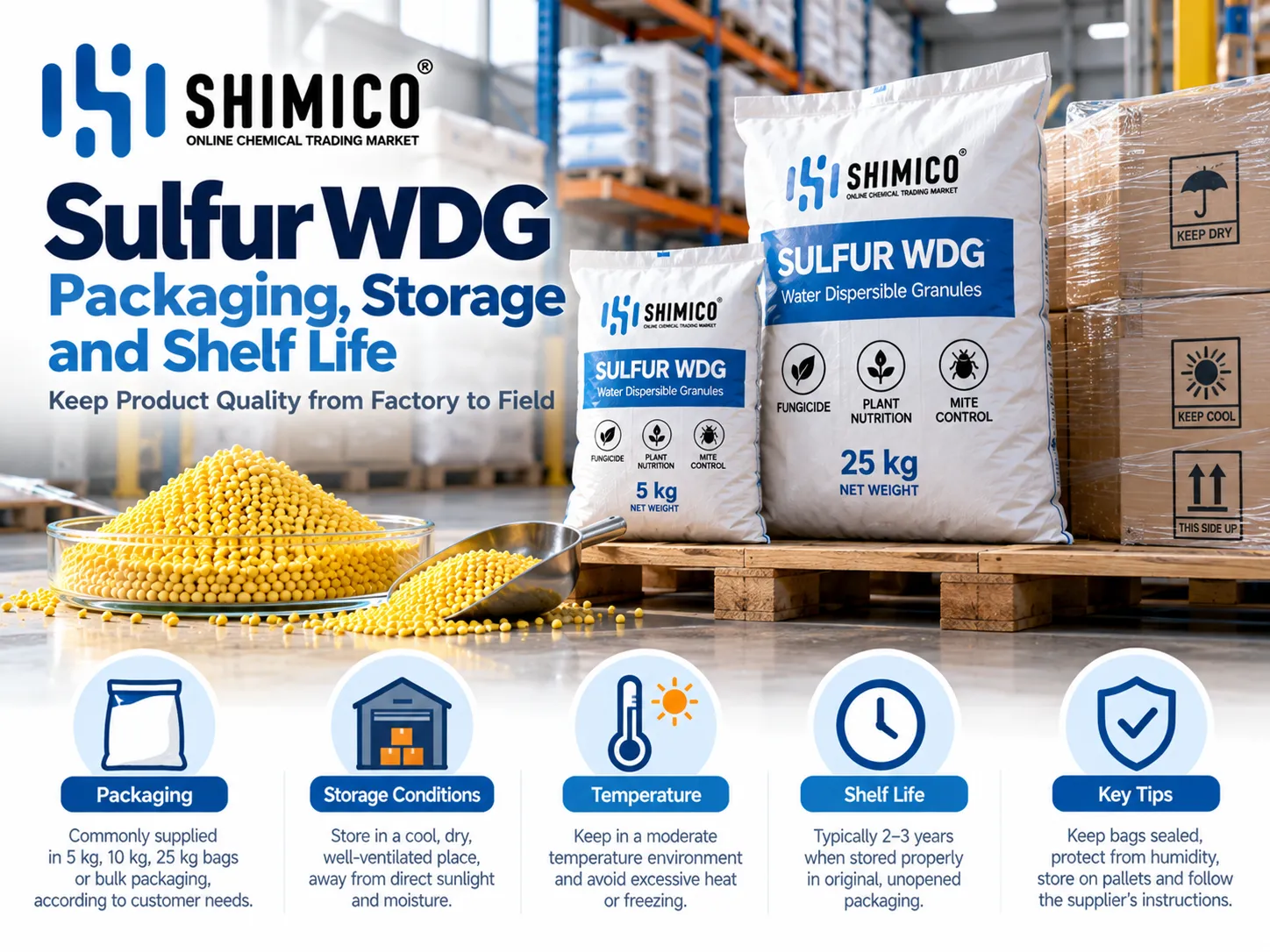
The value of a good formulation can be lost if it arrives wet, caked or incorrectly marked. Bag design, liner material and storage precautions matter in full-container exports. Some markets use 25 kg sacks, while others need smaller packs or authorized repacking. Packaging and labels must follow the applicable product approvals and commercial agreement.
Sulfur WDG 25kg Bags and Bulk Export Packaging
A 25 kg bag is a common wholesale reference size, but it is not a universal available format for every brand. Confirm net weight, inner liner, outer bag, pallet arrangement, container loading method and bag marking. As an illustrative calculation, 24 metric tons in 25 kg bags equals 960 bags. Actual container payload depends on carrier restrictions, tare weight, equipment, stowage and destination rules.
Sulfur WDG Storage and Moisture Protection
Water dispersible granules should be protected from damaging moisture under the conditions specified by the manufacturer. Check the actual SDS, packaging instructions and storage temperature requirements. Inspect bags for torn seams, signs of wetting, contamination or caking, and keep damaged or suspect lots separate until assessed.
Sulfur WDG Shelf Life and Traceability
Do not publish one fixed shelf-life claim for all sulfur WDG grades. Ask the supplier for the product’s documented stability period and storage conditions, and verify manufacturing date, lot number and any expiration information required by the importing jurisdiction. A batch-specific identity links the delivered goods to the COA and helps resolve later complaints.
Sulfur WDG Manufacturers, Suppliers and Global Sourcing
A manufacturer, authorized distributor, exporter and trading marketplace serve different roles in the supply chain. Choosing between them requires more than comparing labels on their websites. The purchaser needs to know who actually formulates the goods, who signs the sales contract, who supplies the technical documents and who is accountable if a shipment fails inspection.
How to Verify a Sulfur WDG Manufacturer
Ask for the legal company identity, manufacturing site, product data sheets, quality-testing capability, sample records and relevant registration information. Depending on the market, manufacturer authorizations and country-specific product documentation may be required. A real factory should be willing to identify the batch offered and explain how it confirms conformity to the agreed specification.
How to Compare Sulfur WDG Suppliers
A good comparison evaluates the same grade under the same commercial terms. Review COA availability, representative samples, bag construction, origin, shipment lead time, loading quantity and inspection arrangements. A lower quote can become more expensive when missing paperwork, damaged packaging or a mismatched formulation delays clearance. Require written answers where practical.
Global Sourcing Through Shimico
Shimico’s product marketplace helps buyers discover chemical product and supplier listings. Buyers can also review the sulfur product category to distinguish elemental sulfur listings from formulated crop-protection options. Marketplace discovery is an initial sourcing step; availability, product registration and the specific seller’s contractual responsibilities must be checked independently.
Sulfur WDG Wholesale Price per Ton and Landed Cost
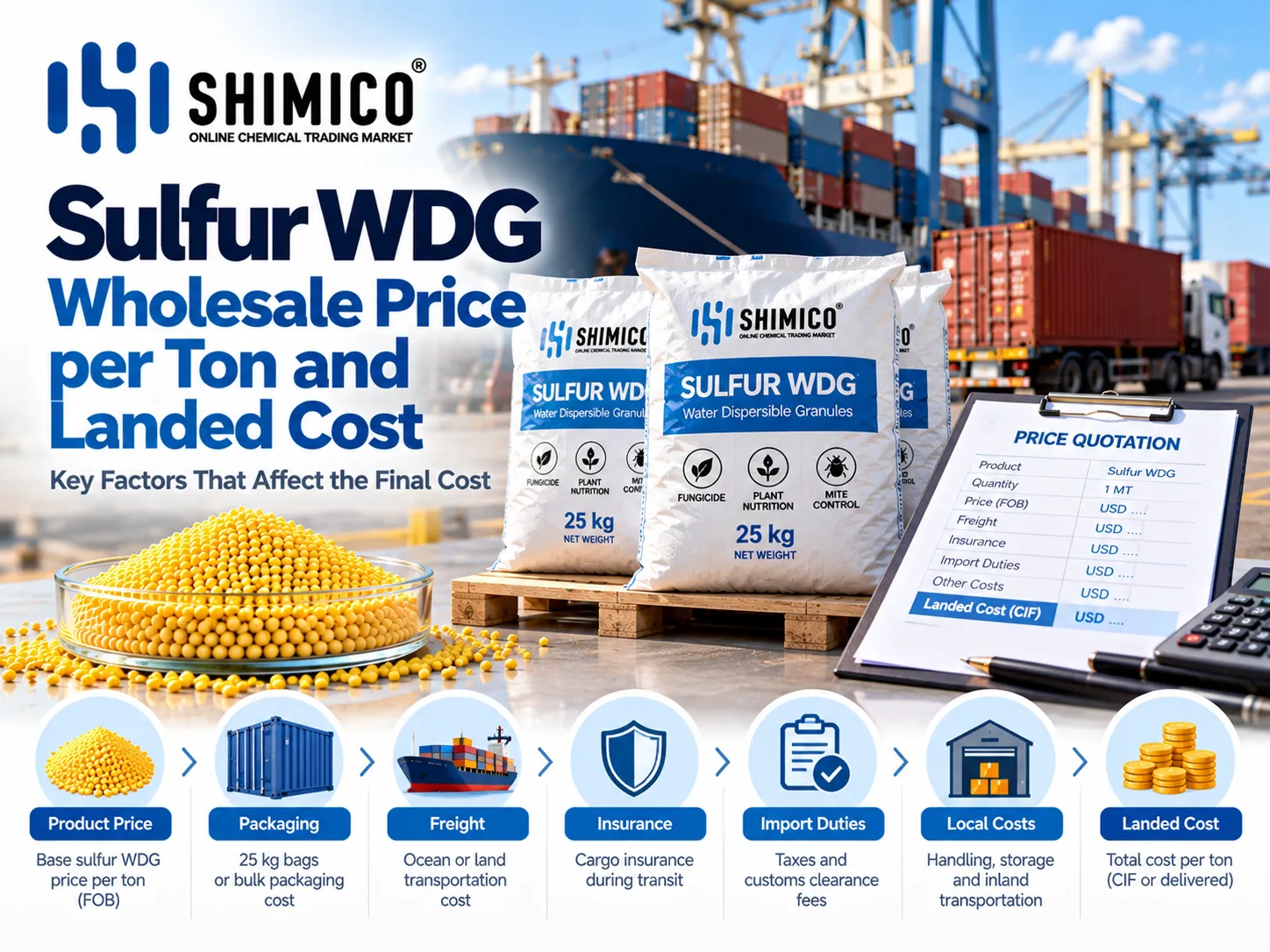
There is no single meaningful worldwide ‘today’s Sulfur WDG price’ covering every grade, origin and destination. A valid quotation has to name the formulation, packaging, quantity, currency, loading point and shipment terms. Feedstock costs, formulation processing, bag material, shipment size, exchange rates and freight may influence the price, but they do not replace a dated supplier quote.
Ex-Works, FOB, CFR and CIF Sulfur WDG Quotes
An ex-works quotation is not directly comparable with a CFR destination-port offer. Under FOB, CFR and CIF the allocation of carriage, cost and risk differs. Specify the current Incoterms version and the named place in the purchase agreement. Buyers should ask for detailed inclusions and exclusions, not just a short price message.
How to Calculate Sulfur WDG Landed Cost
Estimate the final delivered cost by adding every applicable element not already included in the supplier’s quotation: goods, packing, origin handling, international freight, insurance, destination port charges, import duties, taxes, customs clearance, inland delivery and finance-related expenses. Avoid double-counting freight where the selected Incoterm includes it. Then divide the total landed cost by the net metric tons shipped. This gives a comparison basis for offers covering the same approved formulation.
Bulk RFQ Example for Sulfur WDG
A useful illustrative enquiry is: ‘Sulfur 80% WG, 24 MT, 25 kg lined bags, proposed delivery CFR named destination port, batch COA, TDS, SDS, manufacturer identity, production lead time and registration documents requested.’ This is an example of the information a buyer may supply, not a claim that Shimico currently stocks or quotes a 24 MT lot. Always include the destination country and registration status.
Buy Sulfur WDG in Bulk Through Shimico
For procurement teams, buying sulfur WDG in bulk starts with a clear specification. Specify the active sulfur percentage, WG/WDG formulation, expected tonnage, preferred bag size, destination, Incoterm and documents required. For repeat orders, agree on the batch test procedure and a process for handling product discrepancies before dispatch.
If you are sourcing specifically for Pakistan, consult the dedicated Sulphur WDG Pakistan buying guide for the local market’s import and distribution questions; verify this destination URL after publication. For broader products, browse Shimico sulfur listings and find chemical suppliers. Provide an RFQ that allows sellers to assess the same purchasing specification. Stock, quoted prices, registration and delivery terms are subject to confirmation with the relevant seller.
Request a Bulk Sulfur WDG Quote
Specify the required formulation, metric tonnage, destination and technical documents to compare sourcing options.
Frequently Asked Questions About Sulfur WDG
What is sulfur WDG?
Sulfur WDG is a dry water dispersible granule formulation containing elemental sulfur. The granules are formulated to break apart in water, releasing fine suspended particles for uses allowed by the product’s registered label.
Is sulfur WDG the same as sulfur WG?
WG and WDG describe water dispersible granule formulations. The abbreviations do not identify a specific concentration, product registration or manufacturer.
Is sulfur WDG soluble in water?
No. The granules disperse, but elemental sulfur does not dissolve into a clear aqueous solution. The intended result is a suspension of fine sulfur particles.
What is the difference between sulfur 80 WDG and sulfur 90 WDG?
They refer to different declared sulfur concentrations, usually 80% and 90% by weight. Their formulation characteristics and approved uses may also differ. A higher concentration alone does not determine suitability.
How much does sulfur WDG cost per ton?
Wholesale price depends on the exact grade, quantity, origin, packaging, Incoterm and destination. Request a dated quote and calculate landed cost for comparable products.
What is sulfur WDG used for?
Some registered sulfur WDG products are used as agricultural fungicides, including for labelled powdery mildew applications, and some have specific mite-related uses. Follow the exact approved label for the country and crop.
What are the most important sulfur WDG technical specifications?
Buyers should assess active ingredient content, formulation type, wettability, dispersion, suspensibility, wet sieve residue, storage stability and traceability according to the applicable specification.
What documents should a sulfur WDG supplier provide?
Common requests include a technical data sheet, safety data sheet, batch certificate of analysis and applicable product registration or manufacturer authorization documents, along with shipping paperwork.
Can sulfur WDG be used in hot weather?
Sulfur may cause plant injury under some high-temperature conditions. Limits and warnings depend on the exact formulation and registered crop label; growers must follow those directions.
How do I order sulfur WDG in bulk?
Send an RFQ stating the formulation, concentration, tonnage, destination, bag size, Incoterm, regulatory status and desired technical documents. Confirm the actual seller, availability and quality acceptance procedure before contracting.
Sulfur WDG Technical and Regulatory Sources
For technical decisions, refer to the original formulation specification, registered label and relevant regulators. Useful references include the FAO/WHO pesticide specification manual, the FAO pesticide specifications programme, Drexel Chemical’s Sulfur 80 WDG product page, and the US EPA sulfur product label record. Product labels and regulatory status can differ by market and change over time.
Last Seen


Users Comment
Sulfur Fungicide: How It Works, Uses and Safety Precautions
Types of Sulfur Fertilizers: Powder, Granular, Liquid & Sulfate Forms
Sulfur for Soil: Benefits, Uses and How to Apply It
Sulphur 80 WDG: Technical Specifications, Uses & Bulk Supply
Sulphur WDG Pakistan: Bulk Supply, Prices & Import Guide
Sulfuric Acid Supply to Turkey: Price, Transport and Import Guide
Sodium Bicarbonate for Dairy Cows: Rumen Buffer, Dosage, Milk Fat
Why Sulfuric Acid Is King and Benzene Is Called Queen
Buy Basic Chromium Sulfate in Pakistan: BCS Price, Wholesale Supply
How Urea Can Hydrate and Exfoliate Your Skin
Sodium carbonate| Soda ash; features and applications
Copper Sulfate; Features and applications