


Sulfur for Soil: Benefits, Uses and How to Apply It
Sulfur for Soil: What Does It Do?
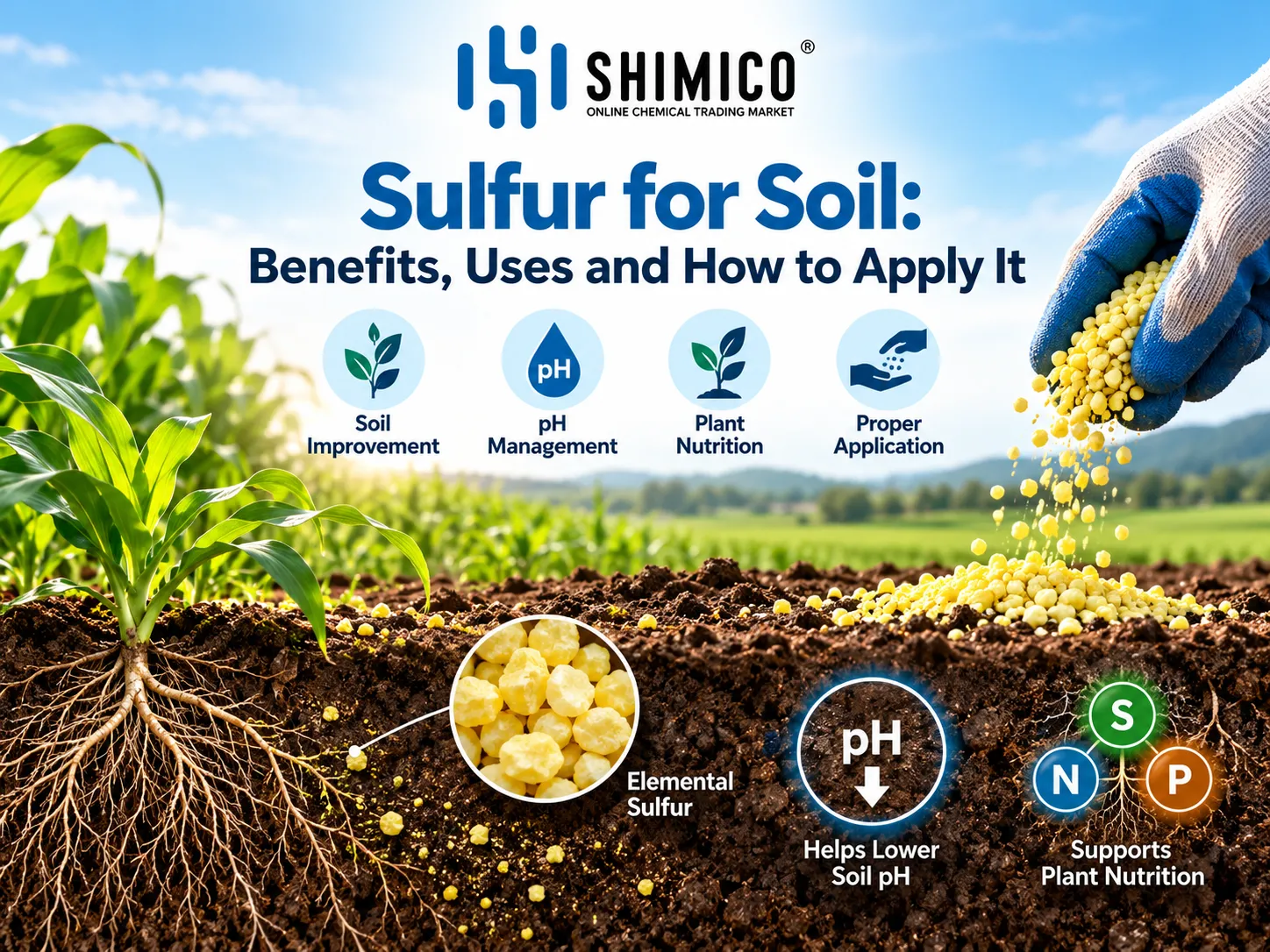
Sulfur for soil is used primarily to manage sulfur nutrition and, under the right conditions, reduce soil pH. The two outcomes are related through soil chemistry but should not be treated as identical. A field may need sulfate nutrition without needing any reduction in pH. Another field may contain enough total sulfur while still having a pH that limits access to iron or manganese for sensitive crops.
How elemental sulfur for soil becomes sulfate
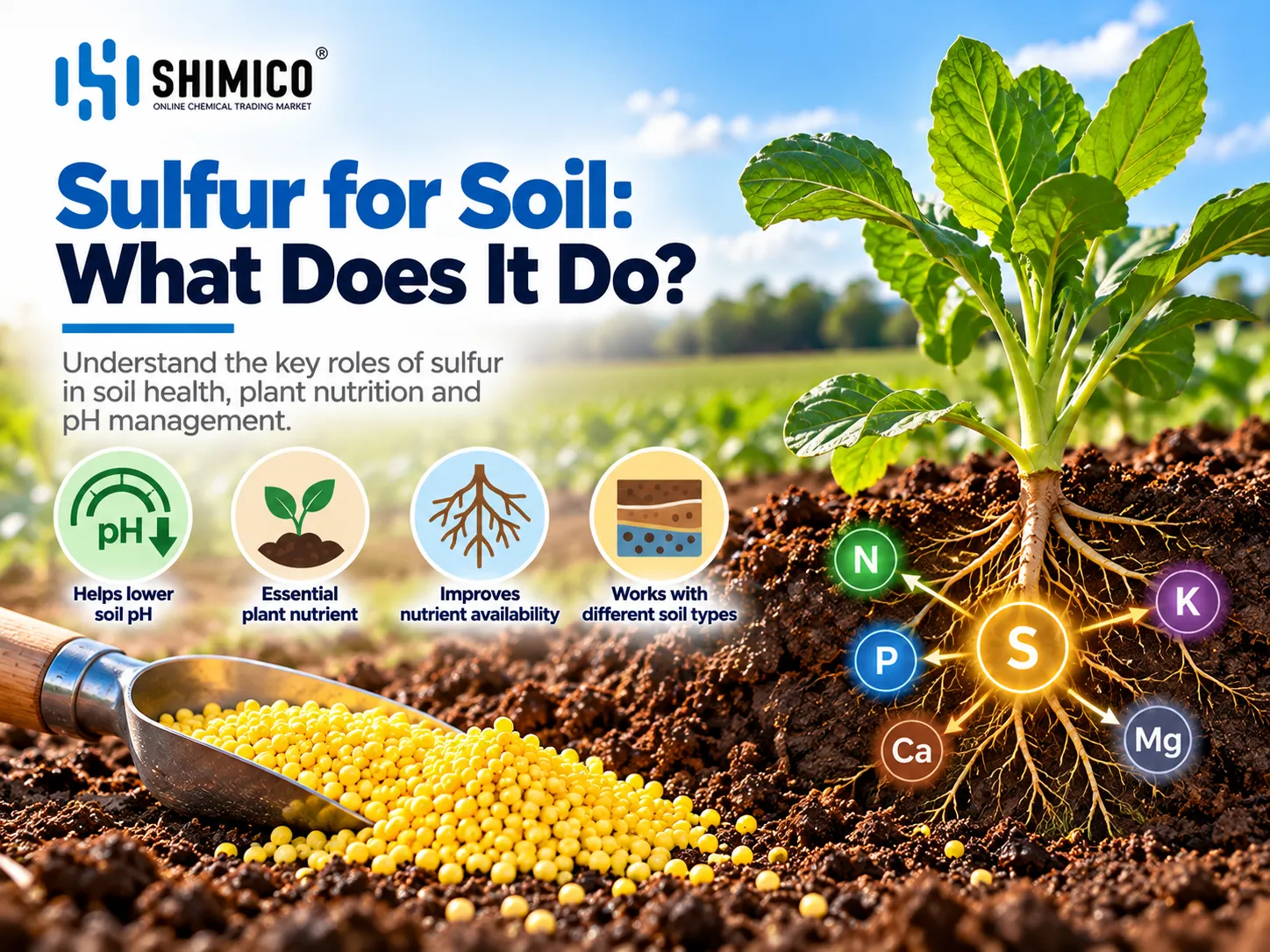
Elemental sulfur is the yellow solid often labeled S or sulfur 90% and higher, depending on the material. When incorporated into biologically active soil, sulfur-oxidizing microorganisms convert it toward sulfate. The process produces acidity, which can lower pH in soil with suitable buffering conditions. Sulfate is the dissolved form most plants take up through their roots.
This is not an instant chemical reaction like mixing an acid into water. Microbes require oxygen, workable moisture and suitable temperature. Fine particles normally offer more contact area than large solid pieces, although actual performance depends on the product and soil environment.
Elemental sulfur is not the same as sulfate fertilizer
Elemental sulfur must oxidize before its sulfur becomes available to roots as sulfate. Ammonium sulfate, potassium sulfate and gypsum already contain sulfur in sulfate form. These products also supply other nutrients or minerals and do not play the same role in a soil-acidification plan.
Can sulfur for soil improve plant growth?
Correcting an actual sulfur deficiency can support the formation of amino acids and proteins and help crops grow normally. If sulfur is already sufficient, adding more does not guarantee a larger harvest. Similarly, lowering pH may improve nutrient availability for acid-preferring crops, but taking an already suitable pH too low can restrict other nutrients and damage roots.
The Iowa State University soil-test guide explains that pH affects nutrient availability and that different crops have different preferred ranges. This is why the crop’s pH requirement must appear next to every soil amendment decision.
How Sulfur for Soil Lowers Soil pH
Sulfur to lower soil pH works only when oxidation produces acidity that is not immediately neutralized by the soil’s existing carbonate reserve. A pH number on its own describes current acidity, not how much acid the soil can absorb before that number changes.
What happens during sulfur oxidation?
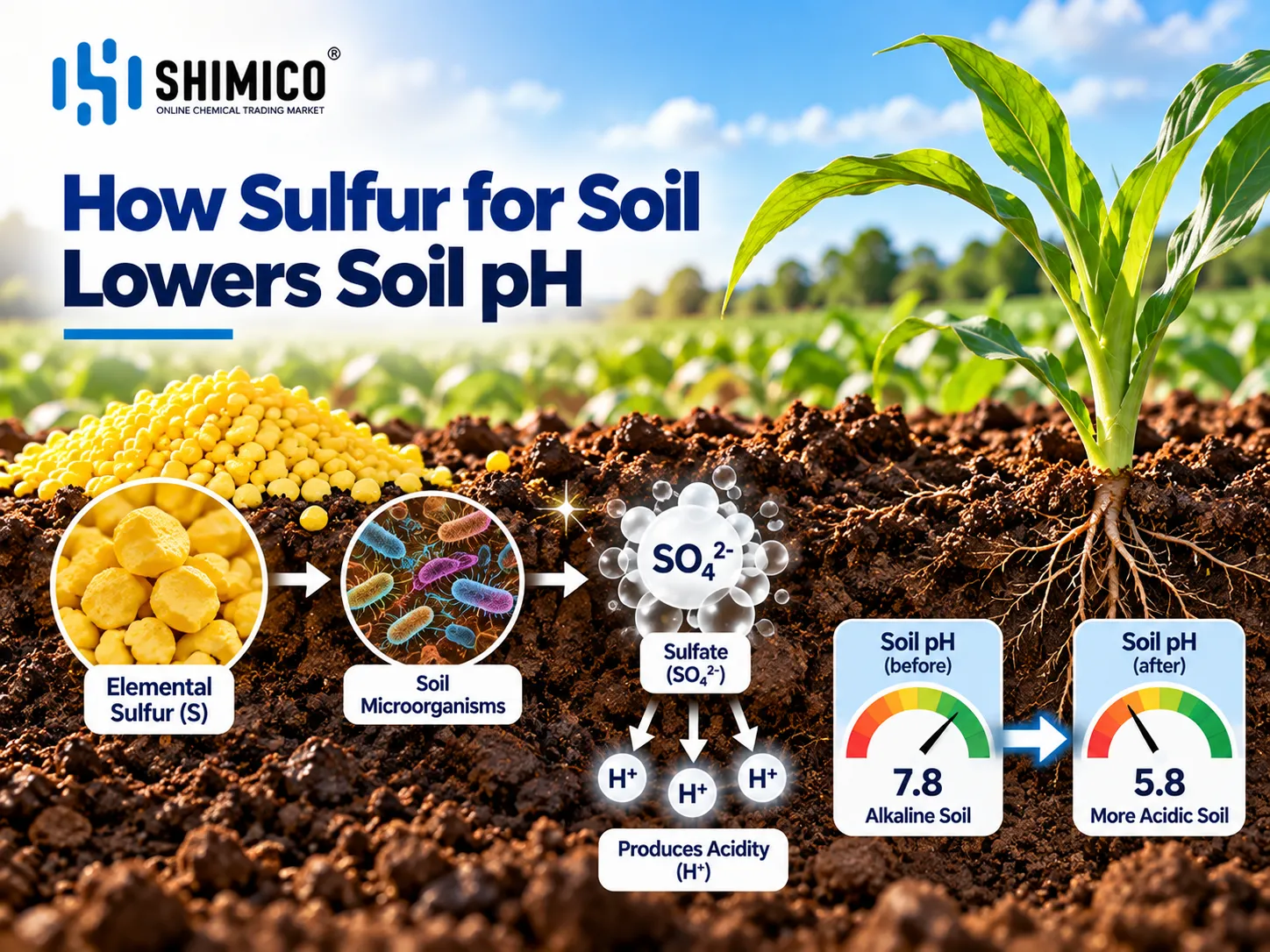
In aerated soil, microorganisms convert elemental sulfur into sulfate and associated acidity. As acidity reacts with soil minerals, the measured pH can decline. This conversion tends to advance faster in warm, moist, biologically active soil than in cold, waterlogged or very dry conditions.
According to Iowa State University Extension’s guidance on changing soil pH, elemental sulfur often needs about three to six months of warm-soil biological activity to produce an appreciable effect. That is an illustrative time frame, not a guaranteed waiting period for all fields.
Why soil texture and buffering change the result
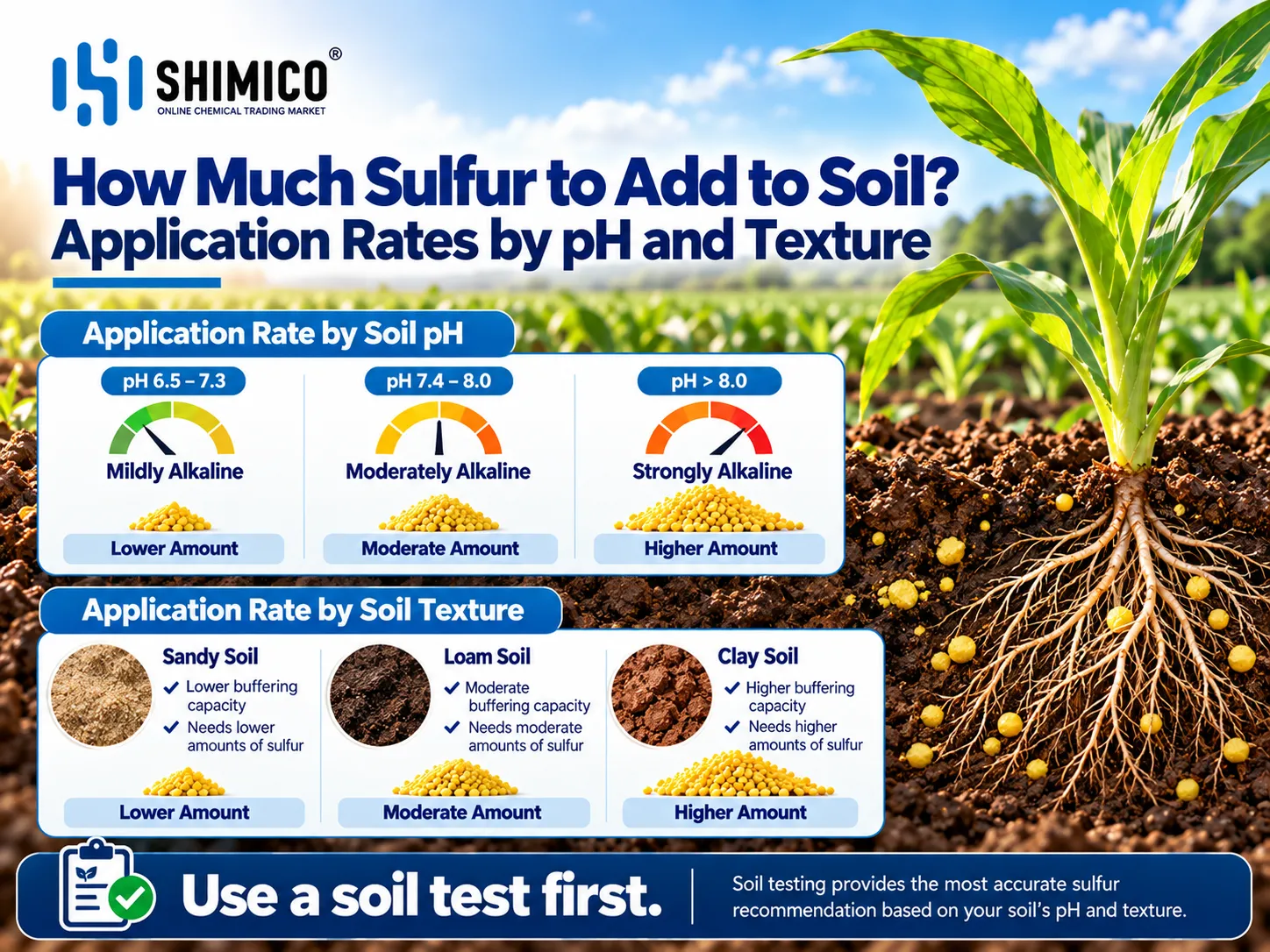
Sandy soils frequently respond to less amendment because they commonly have lower buffering capacity. Clay-rich soils and soils high in organic matter can resist change, even when their starting pH matches that of a sandy soil. A laboratory recommendation should account for soil texture and, where appropriate, other measures of buffering or carbonate content.
Why two soils at pH 7.8 may need different treatment
Imagine a sandy planting bed and a heavy clay field that both read 7.8. A recommendation that uses only pH would treat them as equivalent. In reality, the clay may require much more acidifying material. If the heavy field also contains free calcium carbonate, an entirely different management plan may be preferable.
Sulfur for alkaline soil: when does it fail?
Alkaline soil is soil with pH above 7. Calcareous soil contains appreciable free calcium carbonate, often called free lime. These terms overlap, but they are not interchangeable. In calcareous soil, acidity generated by sulfur reacts with carbonate, forming compounds such as calcium sulfate instead of persistently lowering the pH of the whole rooting zone.
Colorado State University Extension warns that extensive pH reduction in free-lime soils is often impractical. The correct response may be to choose better adapted crops, manage irrigation water and address individual nutrient limitations rather than repeatedly adding elemental sulfur.
How Much Sulfur to Add to Soil? Application Rates by pH and Texture
The right answer to how much sulfur to add to soil begins with a soil test, not a universal rate. A defensible recommendation uses the present pH, desired pH, soil texture, treatment depth and the amendment’s elemental sulfur concentration. The amount needed for a container, a raised bed and a hectare of field soil will differ greatly.
What information do you need before calculating a sulfur rate?
Record the sampling depth and the area you intend to treat. Ask for current pH, soil texture, an appropriate assessment of carbonate or free lime, and a laboratory recommendation suitable for the crop. For irrigated production, water alkalinity may also matter because repeated irrigation can counteract attempts to acidify the root zone.
The Iowa State guide identifies the current pH, target pH and soil type as the three starting variables for its published sulfur table. Its figures assume a defined incorporation depth and pure elemental sulfur, conditions that must be preserved when using those numbers.
How to read a published sulfur application-rate table
The following values are illustrative examples from a published Iowa State table for lowering pH to 6.0 in soil to a six-inch depth. The figures are in pounds of pure elemental sulfur per 1,000 square feet; they are not blanket recommendations for a specific farm, crop, country or product. They should not be used for soils containing appreciable free lime.
| Starting pH | Target pH | Sandy loam | Loam | Clay loam |
|---|---|---|---|---|
| 7.0 | 6.0 | 8 lb | 15 lb | 18 lb |
| 7.5 | 6.0 | 16 lb | 27 lb | 31 lb |
| 8.0 | 6.0 | 31 lb | 44 lb | 53 lb |
Read across the table rather than selecting a single number without context. For a starting pH of 7.0 and a target of 6.0, the example sandy loam amount is 8 lb per 1,000 sq ft, compared with 18 lb for clay loam. For a starting pH of 8.0, the illustrative amounts rise to 31 and 53 lb respectively. These differences show why soil texture matters as much as the pH number.
Example: converting an area-based recommendation
If an appropriate laboratory or extension recommendation calls for 8 lb of pure sulfur per 1,000 sq ft, a 500 sq ft plot would mathematically require 4 lb under the same stated conditions. If the product contains 90% elemental sulfur rather than 100%, the product mass is 4 ÷ 0.90, or about 4.44 lb. This calculation adjusts concentration only. It does not validate the original rate for another soil, application method or crop.
Why a sulfur-per-acre calculator needs soil-specific inputs
An online sulfur rate calculator is only as trustworthy as its underlying assumptions. Input fields should include area, depth, initial and target pH, texture, elemental sulfur fraction and any site-specific laboratory recommendation. Multiplying area by a published rate is straightforward; determining whether the rate applies to your soil is the difficult part.
How to Apply Sulfur to Soil Safely and Effectively
How to add sulfur to soil depends on whether you are preparing an unplanted field, maintaining an existing orchard or correcting a smaller growing bed. Application equipment, root location and soil conditions all affect where the amendment should go. Pre-plant incorporation is often easier to manage than treating a mature crop’s established root zone.
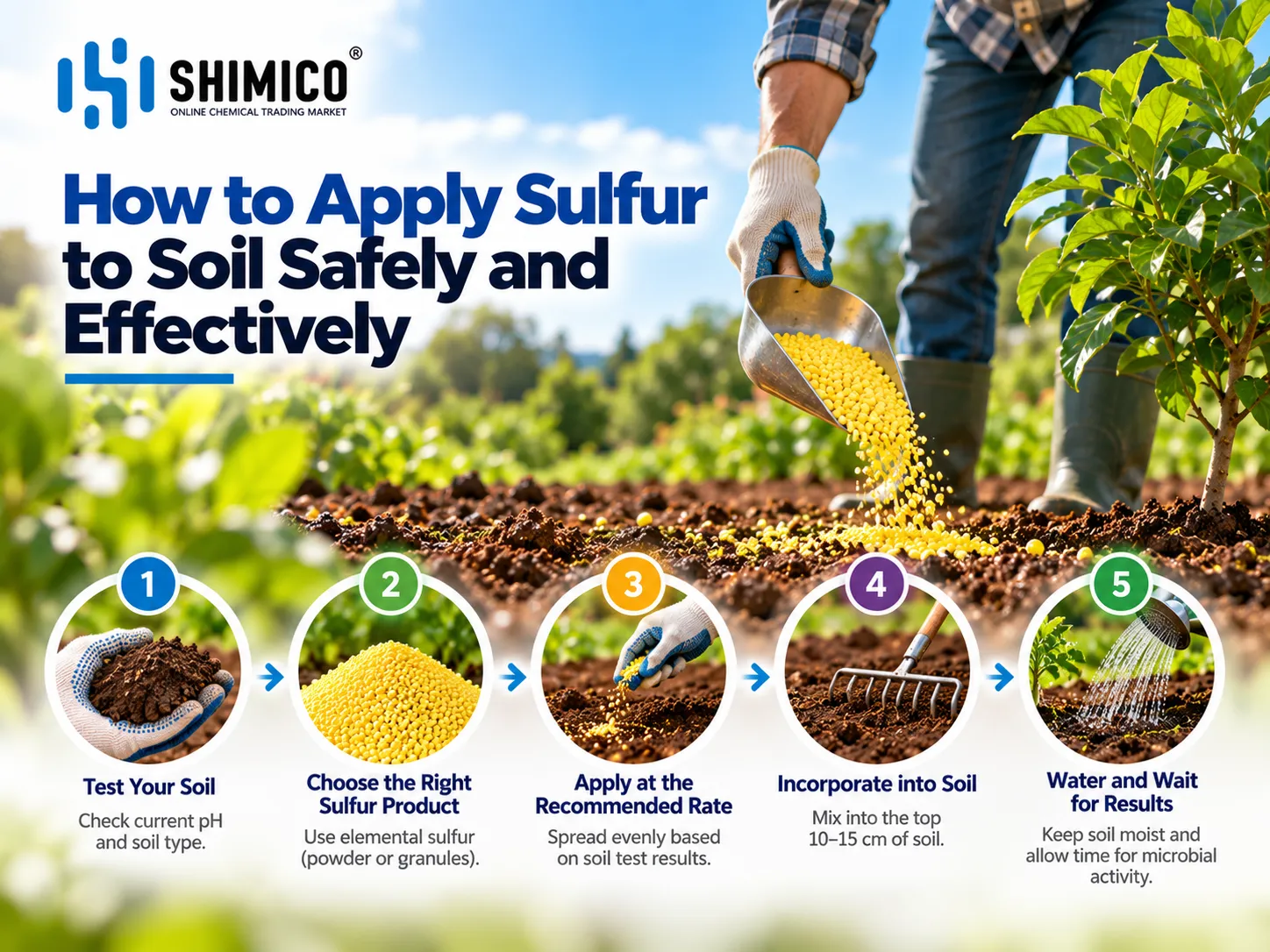
Step 1: Test soil before sulfur application
Collect representative samples from the area to be treated and keep unlike zones separate. A single sample should not combine a sandy ridge, a poorly drained clay depression and a recently fertilized planting bed. Record sampling depth and date, and submit samples to a laboratory experienced with your region’s soils.
Step 2: Choose a suitable elemental sulfur formulation
Check whether the product is intended for soil amendment, whether its sulfur content is declared and whether its particle size and granule structure suit the application equipment. Finely divided sulfur can oxidize faster under suitable soil conditions, while some formed granules offer easier distribution. Granules differ among manufacturers, and the label must guide their use.
Step 3: Distribute sulfur evenly
Uneven spreading leaves treated and untreated zones within the same field. Calibrate the spreader for the particular bulk density and particle size. Prevent concentrated deposits near roots, stems or irrigation outlets. Use protective measures specified by the supplier’s safety data sheet and avoid making airborne dust during handling.
Step 4: Incorporate sulfur where appropriate
Where pre-plant preparation and the product instructions permit it, mixing sulfur into the relevant soil layer places particles closer to active microorganisms and moisture. The Iowa State rate table discussed earlier assumes incorporation to six inches. Surface-only treatment has different conditions and should not be assigned the same outcome without local guidance.
How to apply sulfur near established plants
Avoid aggressive cultivation through mature roots. Existing trees and shrubs may need smaller surface applications or a longer corrective programme designed by an agronomist. Follow locally validated guidance for application distance, amount and timing. Do not place unapproved rates directly against tree trunks.
Step 5: Retest soil before repeating treatment
A follow-up measurement is the only reliable way to know whether the amendment changed soil pH. Colorado State recommends retesting after approximately three to four months for relevant sulfur treatments. Keep records of treatment date, weather, product concentration, area and lab results, then decide whether additional treatment is warranted.
When to Apply Sulfur to Soil: Spring, Fall or Before Planting?
There is no single season that always produces the best response. The decision depends on how much time is available before planting, regional soil temperature, moisture and crop sensitivity. A fall application may allow several months for reaction before spring planting in some climates, while cold winter soil can greatly slow oxidation.
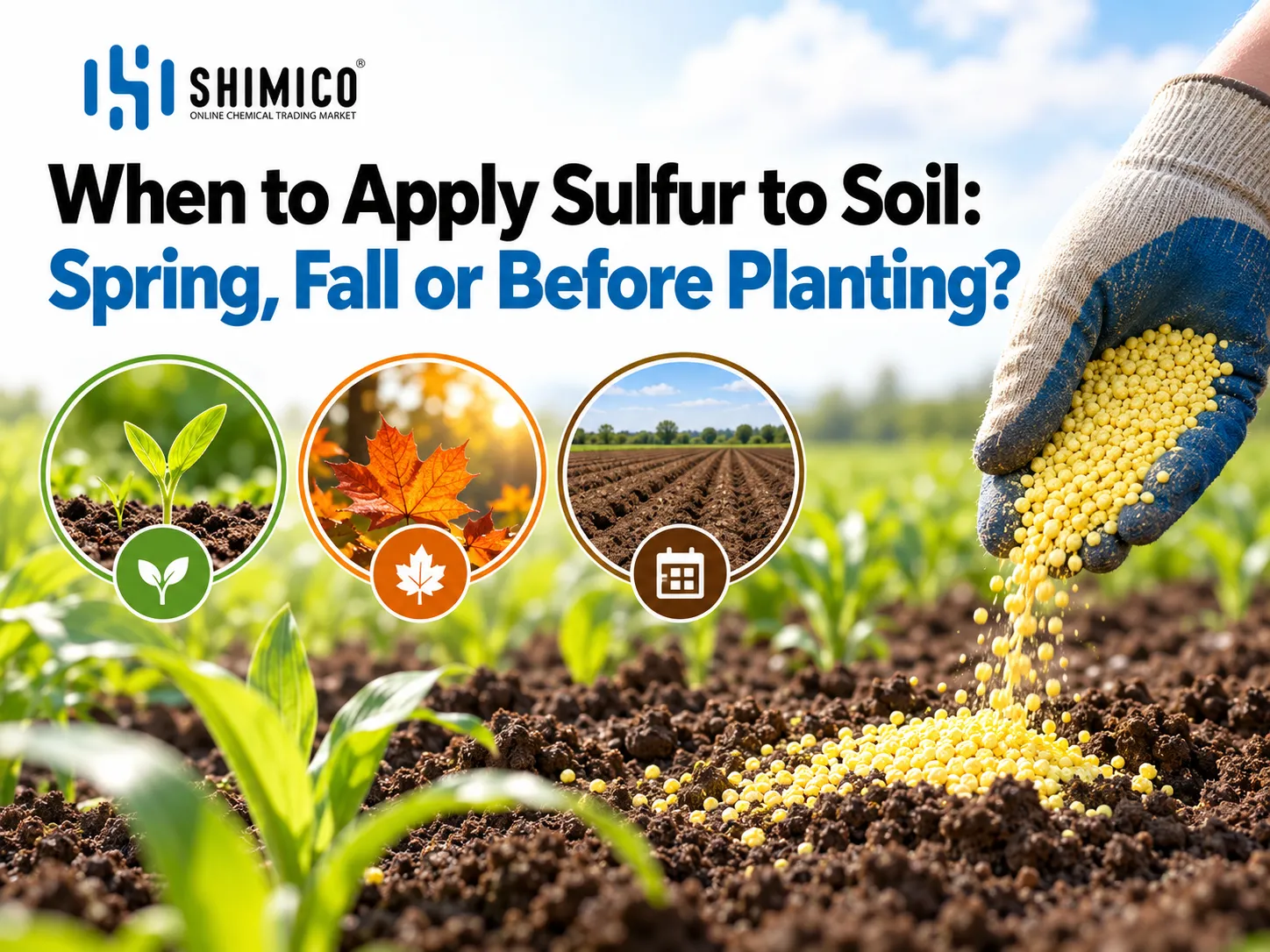
Benefits and limits of fall sulfur applications
Fall can provide a practical window for preparing beds after harvest, especially when cultivation is allowed and equipment is available. Soil biology still needs suitable conditions. Applying sulfur before a cold, saturated winter should not be assumed to deliver a fixed pH reduction by spring.
When spring applications make sense
Spring application may coincide with warmer soil and increasing microbial activity. For crops that need a substantial pH correction at planting, that timing may be too late. Assess the lead time required, particularly for acid-loving perennial crops.
Why pre-plant planning often works better
Pre-plant soil amendments are easier to incorporate uniformly. They also give growers time to retest and correct a treatment before placing sensitive roots into the bed. Oregon State University Extension recommends gradual acidification and ongoing monitoring for acid-loving plantings, rather than expecting an immediate large change.
How Long Does Sulfur Take to Lower Soil pH?
Many growers expect a visible change within days. Elemental sulfur works on a biological timetable. Three to six months of warm, biologically active soil is a useful reference from Iowa State, while other soils may take longer, sometimes a year or more for a desired adjustment.
Temperature, water and aeration
Microbes slow down in cold soil, and dry soils restrict activity. Waterlogged conditions restrict oxygen availability, which can hinder the normal oxidation pathway. Irrigation and drainage management influence sulfur performance, but overwatering to force a reaction can harm roots and soil structure.
Particle size, placement and soil chemistry
Smaller particles usually present more contact surface, but packaging labels and promotional claims should not be treated as laboratory evidence of guaranteed oxidation speed. Incorporation depth and contact with the soil matter. Free lime and buffering can neutralize the produced acidity even when oxidation progresses.
How long does sulfur last in soil?
There is no universal persistence period. Sulfate can be absorbed by plants, immobilized in biomass or move with water, depending on soil and crop conditions. Soil pH can also change again through irrigation, fertilization and other processes. Ongoing monitoring is more meaningful than assuming that one treatment permanently fixes pH.
Sulfur for Alkaline Soil vs Saline or Sodic Soil
The terms alkaline, saline and sodic describe different soil problems. Alkaline refers to pH. Saline describes excessive soluble salts. Sodic describes excessive exchangeable sodium that can weaken soil structure. A soil may have more than one condition, but using the same amendment for all of them can waste money or make conditions worse.
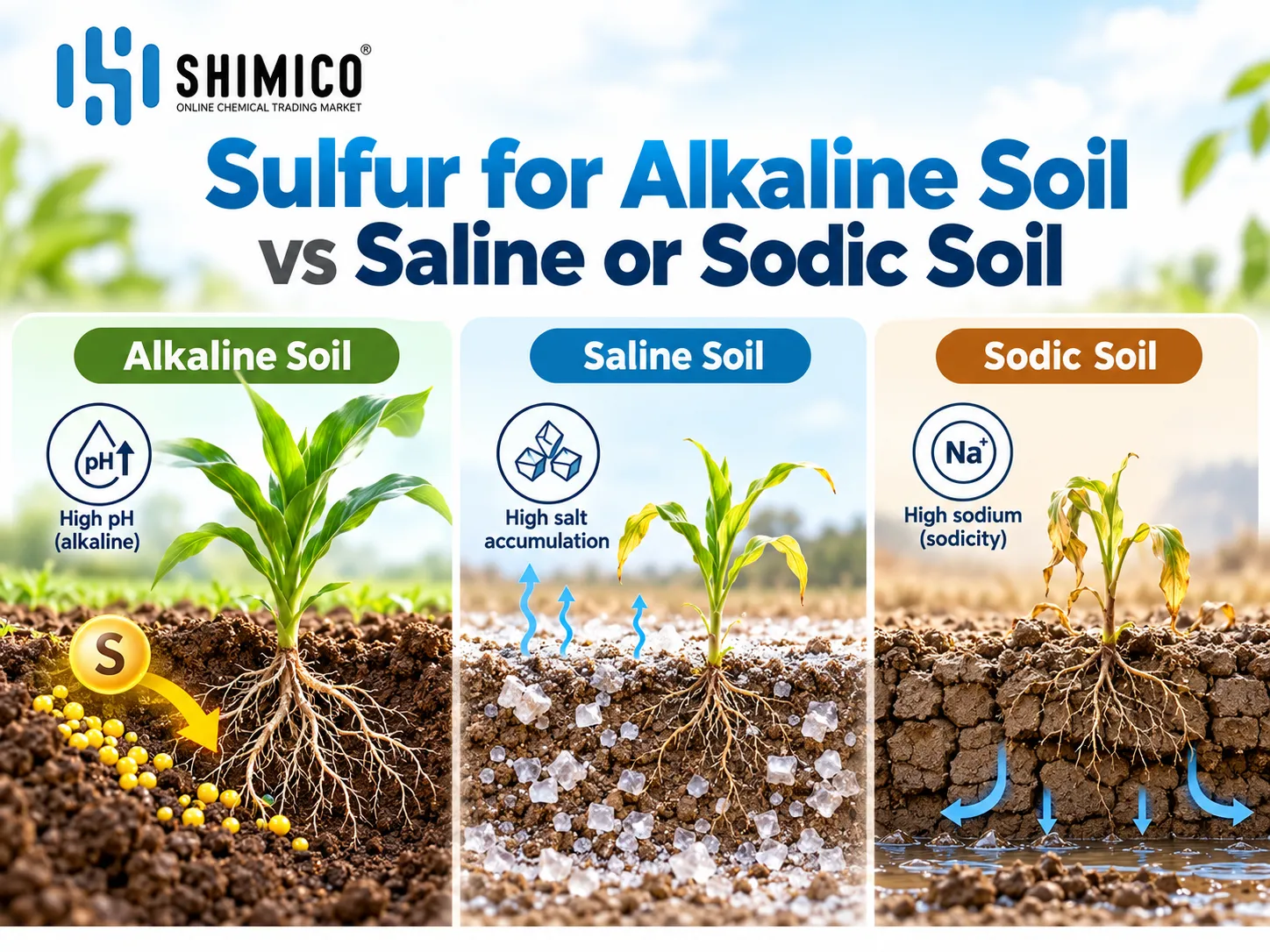
What sulfur can and cannot fix in alkaline soil
Elemental sulfur may acidify a soil that has sufficient biological activity and limited carbonate buffering. Where free calcium carbonate is abundant, acidity is consumed. A visible chemical reaction does not mean the bulk soil pH has been corrected.
Sulfur vs gypsum for soil: different purposes
Gypsum is calcium sulfate. It supplies calcium and sulfate sulfur but is not a standard tool for lowering pH in ordinary soils. Where sodium is the problem, gypsum may help replace exchangeable sodium if drainage and leaching water are adequate. It should not be sold as a universal cure for compacted clay.
The Colorado State Extension soil-compaction guidance distinguishes sodic reclamation from ordinary high-pH or clay problems. This distinction matters when comparing gypsum with elemental sulfur for bulk agricultural orders.
What to investigate if sulfur appears not to work
Check the latest soil test before repeating the treatment. Compare the actual product and application rate with the plan, confirm whether the soil contains free lime, inspect irrigation-water alkalinity, and assess whether enough warm, moist time has elapsed. If the objective is correcting a nutrient deficiency rather than pH, plant-tissue analysis may be more useful than adding another acidifying amendment.
Powdered vs Granular Sulfur for Soil: Which Form Is Better?
Both powdered and granular forms can contain elemental sulfur, but their physical structure affects storage, spreading and reaction. Powdered sulfur has more exposed surface area at a given mass, which may speed oxidation when distributed correctly. Granular products may be easier to handle and spread mechanically. A product sold as granules can disintegrate into smaller particles after wetting, or it may remain relatively coarse, depending on its construction.
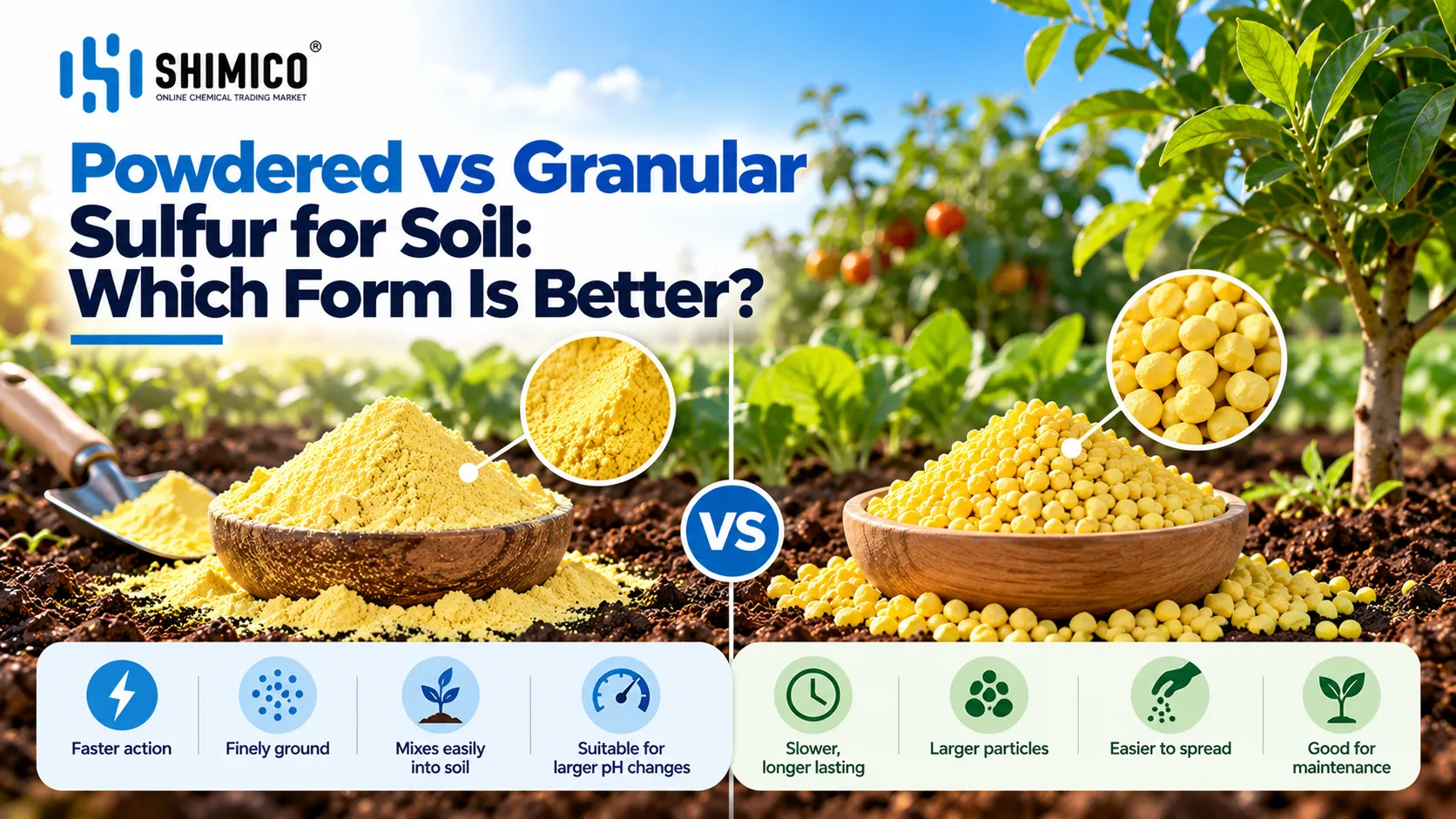
Powdered sulfur for soil
Powder can be suitable for controlled incorporation where the equipment handles fine solids safely. The trade-offs include dust generation, wind drift and potential loss of uniformity. Industrial sulfur powder should not be assumed to be an approved soil amendment simply because it contains sulfur.
Granular and pelletized sulfur for soil
Granules and pellets often make bag handling and bulk distribution easier. Some formulations disperse after contact with moisture; others require more time to break down. Buyers should examine particle size distribution, elemental sulfur declaration, additives, moisture tolerance and product-specific instructions.
Is Sulfur WDG appropriate for soil acidification?
Sulfur WDG means water-dispersible granules formulated to disperse in a spray tank. It is not an automatic replacement for soil-grade granular elemental sulfur. Product registration, application route and approved label determine whether it can be used for any particular soil application. See the Sulfur WDG grades and formulations guide for the separate spray-formulation category.
| Material | Usual purpose | Buyer verification |
|---|---|---|
| Soil-grade elemental sulfur powder | Soil amendment where suitable | Sulfur percentage, dust, application directions |
| Soil-grade elemental sulfur granules | Spreadable soil amendment | Disintegration, particle size, label |
| Sulfur WDG/WG | Formulated agricultural suspension where registered | Exact registration and labelled use |
| Ammonium sulfate | Nitrogen plus sulfate sulfur nutrition | N and S analysis, crop need |
| Gypsum | Calcium and sulfate; selected sodic soil applications | Calcium requirement, sodium status, drainage |
For buyers, the real comparison is not merely the color or size of the particles. It is the combination of declared chemistry, permitted use, spreading method and a documented performance specification.
Sulfur for Blueberries, Fruit Trees and Other Crops
Crop-specific pH targets determine whether an acidifying amendment is warranted. Blueberries are especially sensitive to unsuitable pH, whereas many common vegetables and orchard crops tolerate a wider range. A grower should not treat a whole mixed planting to the blueberry pH target.
Sulfur for blueberries and other acid-loving crops
Blueberries commonly perform best in strongly acidic soil. A 2026 University of Minnesota Extension update identifies an ideal pH around 4.5 to 5.2 for blueberries and discusses testing pH, texture and irrigation-water alkalinity before acidification.
The right time to correct a future blueberry bed is usually before planting. Established bushes require more cautious adjustments to protect roots. Symptoms such as yellowing leaves can also reflect iron availability or water issues, so diagnosis should not rely on appearance alone.
Sulfur for fruit trees and orchards
Fruit trees do not share one soil requirement. The intended crop, rootstock and orchard soil determine whether pH correction is useful. In a calcareous orchard, a grower may obtain better results by treating documented micronutrient limitations than by attempting to acidify the entire soil profile.
Sulfur for lawns and vegetable beds
Lawns and vegetables may need sulfur nutrition without needing acidification. A fertilizer recommendation should reflect soil testing and crop demand. Avoid repeated sulfur applications based solely on the assumption that lower pH always improves growth.
Can Too Much Sulfur Damage Plants or Soil?
Excessive elemental sulfur can acidify suitable soils beyond the crop’s preferred pH range, while repeated amendments in saline or carbonate-rich soil can aggravate salt concerns. Large localized doses can also stress roots. More amendment is not automatically more benefit.
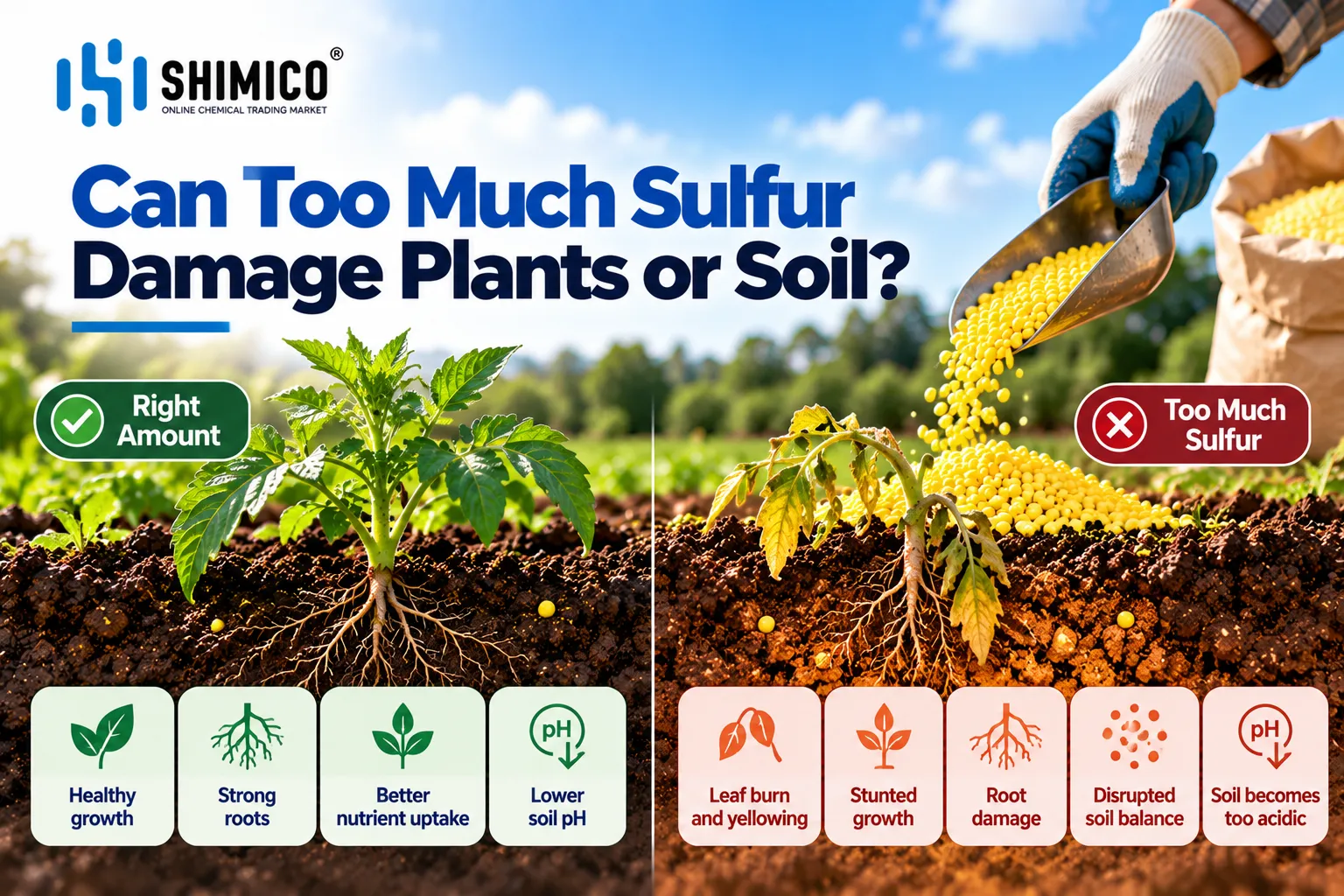
Signs that a soil-amendment plan may be excessive
Unexpected pH decline, new growth problems after treatment or rising electrical conductivity should prompt investigation. Such observations have several possible causes and cannot prove sulfur toxicity by themselves. Retest the soil, examine irrigation water and review the product used before attributing damage.
Handling sulfur products responsibly
Follow the product safety data sheet for respiratory protection, ignition sources and dust handling. Fine sulfur dust can be combustible under certain industrial conditions. Store agricultural products in properly marked, dry packaging, away from incompatible materials and unauthorized access. Only use products approved for the intended agricultural purpose.
Buying Sulfur for Soil: Specifications and Bulk Sourcing
Commercial buyers should distinguish soil-amendment sulfur from sulfur fungicides, industrial prills and sulfate fertilizers before requesting prices. A purchasing specification should say what the product is expected to do and how the buyer intends to use it.
What to request from a sulfur supplier
Ask for the declared elemental sulfur content, product form, particle size or distribution, additives, packaging weights, moisture condition, origin and applicable technical documents. Where required, verify registration, labeling and permitted agricultural claims in the destination market. For repeat orders, batch identity and consistent packaging are as relevant as the price per ton.
Compare sulfur for soil on delivered cost, not price alone
A quote should identify metric tonnage, Incoterms, destination, packaging and freight assumptions. A fine powder requiring special dust controls and a pelletized product designed for spreading may have different handling costs. A low per-ton offer cannot be compared fairly with another without considering usable sulfur fraction and the actual application system.
Where Shimico fits into sulfur sourcing
Shimico is an online chemical trading marketplace where businesses can review sulfur products and identify sourcing opportunities. Buyers can start with Shimico sulfur product listings, then request supplier-specific documents and confirm whether the selected material is intended for soil amendment or another use. If a spray formulation is needed, the separate Sulphur 80 WDG Pakistan guide addresses a market-specific purchasing context.
Source Sulfur Products Through Shimico
Compare sulfur grades, packaging formats and supplier documentation before a bulk purchase. Specify the intended use, quantity, destination and required analysis when contacting sellers.
Frequently Asked Questions About Sulfur for Soil
These questions address the main distinctions that influence sulfur treatment: soil pH, nutrient availability, application time and product choice. Rates and permitted uses must still be checked against local soil recommendations and product labels.
What does sulfur do to soil?
Elemental sulfur can reduce pH after microbial oxidation in suitable soil, while sulfate sulfur serves as a plant nutrient. These are distinct goals. Test soil before deciding which sulfur product is appropriate.
Does sulfur lower soil pH?
Yes, in suitable soils without excessive carbonate buffering. Elemental sulfur oxidizes and releases acidity, which may reduce pH. Soils with abundant free lime often resist meaningful whole-soil acidification.
How much sulfur should I add to soil?
The rate depends on current and target pH, soil texture, incorporation depth and product concentration. Use local laboratory recommendations. A single rate per acre cannot serve every soil.
How long does sulfur take to lower soil pH?
Iowa State University Extension indicates that elemental sulfur often needs three to six months of warm, biologically active soil. Cold temperatures, dryness, particle size and carbonate buffering can extend the process.
Is sulfur good for alkaline soil?
It may help alkaline soils with limited free lime. Highly calcareous soils can neutralize the acidity and make broad pH correction impractical. Identify the soil’s carbonate content before treatment.
Can sulfur be applied in fall?
Fall application can provide time before spring planting, but oxidation slows in cold or waterlogged soil. Apply according to local recommendations and retest rather than assuming a seasonal result.
Is powdered or granular sulfur better for soil?
Powder can present more exposed surface area, while granules may be easier to spread. Performance depends on product formulation, placement and moisture. Choose a material labeled for the intended soil use.
Can gypsum replace elemental sulfur for soil pH reduction?
No. Gypsum supplies calcium and sulfate and is sometimes used for sodic-soil reclamation where drainage allows. It is not an equivalent amendment for lowering ordinary soil pH.
Can too much sulfur harm plants?
Yes. Excessive acidification or localized amendment concentrations may create unfavorable conditions. Soil and irrigation testing should guide treatment amounts and follow-up monitoring.
Is Sulfur 80 WDG the same as soil amendment sulfur?
No. Sulfur 80 WDG is a water-dispersible agricultural formulation. Its registered label determines permitted uses. Do not assume that a spray-grade product can replace a soil-grade elemental sulfur amendment.
Scientific References for Sulfur in Soil
How to Change Your Soil’s pH, Iowa State University Extension, publication date not shown on referenced page.
Soil pH, Colorado State University Extension, publication date not confirmed.
Acidifying Soil for Blueberries and Ornamental Plants, Oregon State University Extension, publication date not confirmed.
Soil Compaction and Gypsum Guidance, Colorado State University Extension, publication date not confirmed.
Fruit Update, August 20, 2026, University of Minnesota Extension, August 20, 2026.
Last Seen


Users Comment
Sulfur Fungicide: How It Works, Uses and Safety Precautions
Types of Sulfur Fertilizers: Powder, Granular, Liquid & Sulfate Forms
Sulphur 80 WDG: Technical Specifications, Uses & Bulk Supply
Sulfur WDG: Water Dispersible Granules, Uses & Bulk Supply
Sulphur WDG Pakistan: Bulk Supply, Prices & Import Guide
Sulfuric Acid Supply to Turkey: Price, Transport and Import Guide
Sodium Bicarbonate for Dairy Cows: Rumen Buffer, Dosage, Milk Fat
Why Sulfuric Acid Is King and Benzene Is Called Queen
Buy Basic Chromium Sulfate in Pakistan: BCS Price, Wholesale Supply
How Urea Can Hydrate and Exfoliate Your Skin
Sodium carbonate| Soda ash; features and applications
Copper Sulfate; Features and applications