


Sulfur Export Price FOB Iran: Bulk Sulfur Price per Ton
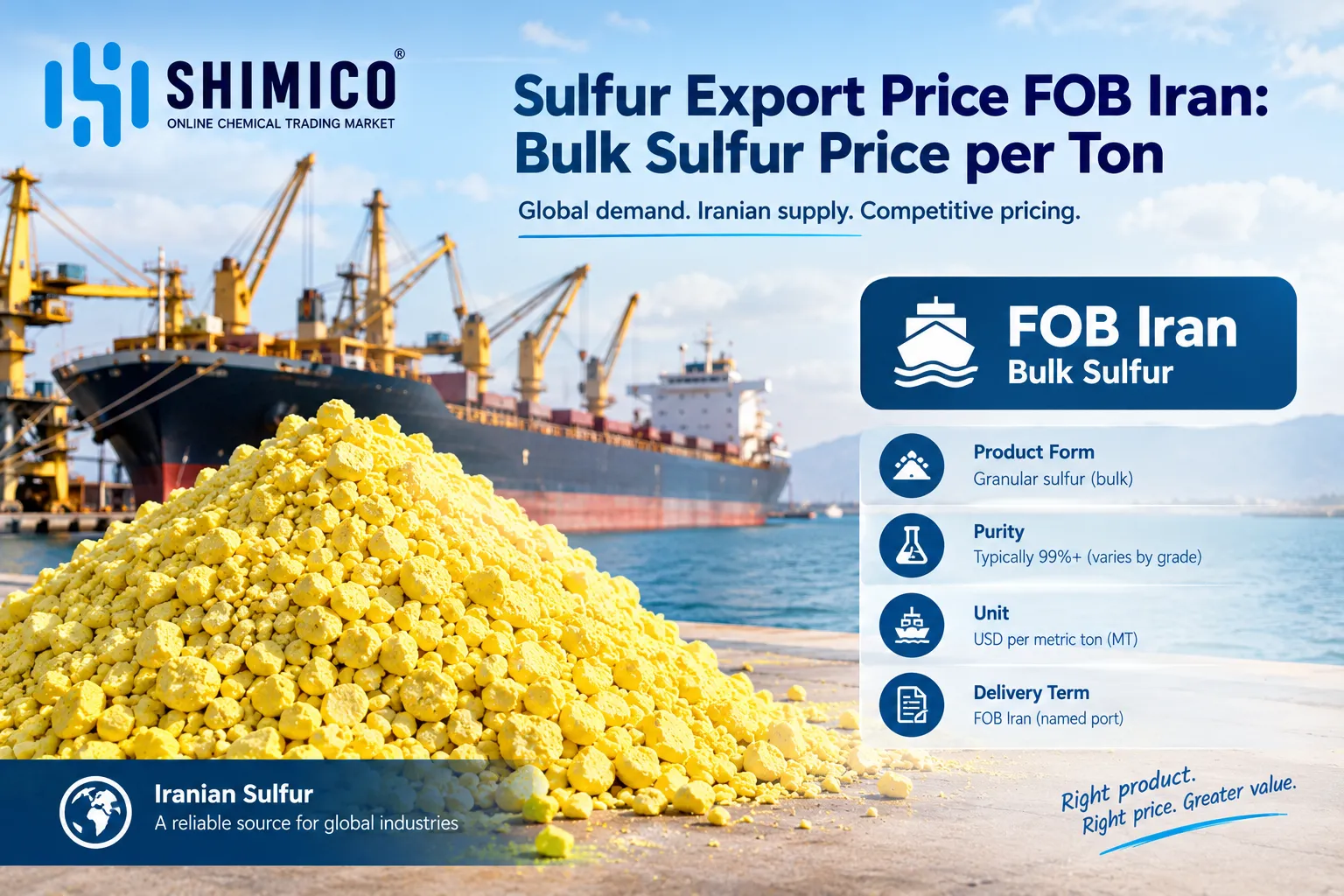
For industrial buyers, the lowest sulfur offer is not always the lowest-cost purchase. A quotation may look attractive until you check the product specification, moisture limits, packing, loading terms, inspection requirements and delivery schedule.
If your company purchases sulfur for fertilizer production, sulfuric acid manufacturing, chemical processing or industrial distribution, you need more than a price per tonne. You need an offer that matches your plant requirements and your shipment plan.
The sulfur export price FOB Iran depends on the product grade, physical form, order quantity, packaging, loading arrangements and agreed trade terms. Buyers searching for the Iran sulfur price per ton, a granular sulfur supplier or a reliable source for bulk sulfur should compare quotations on the same commercial basis before selecting a supplier.
This guide explains how to request a sulfur FOB quotation, which technical documents to review, how FOB differs from CFR and CIF, and what procurement teams should check before confirming an order. It is intended for importers, chemical distributors, fertilizer manufacturers, industrial purchasing departments and companies planning bulk or recurring sulfur purchases.
Shimico is a business-to-business platform where buyers can review chemical product listings and connect with sellers. Buyers can use the platform to identify relevant offers and begin supplier inquiries. Product availability, export capability, technical specifications and final commercial terms must be confirmed directly with the seller.
Buyer note: prepare these details before requesting a sulfur quotation
Specify the sulfur form, required purity, technical limits, quantity in metric tonnes, packing preference, destination, requested Incoterm, loading period and required documents. A complete request helps suppliers prepare an offer that your procurement and logistics teams can compare.
Sulfur Export Price FOB Iran: What Does FOB Mean?
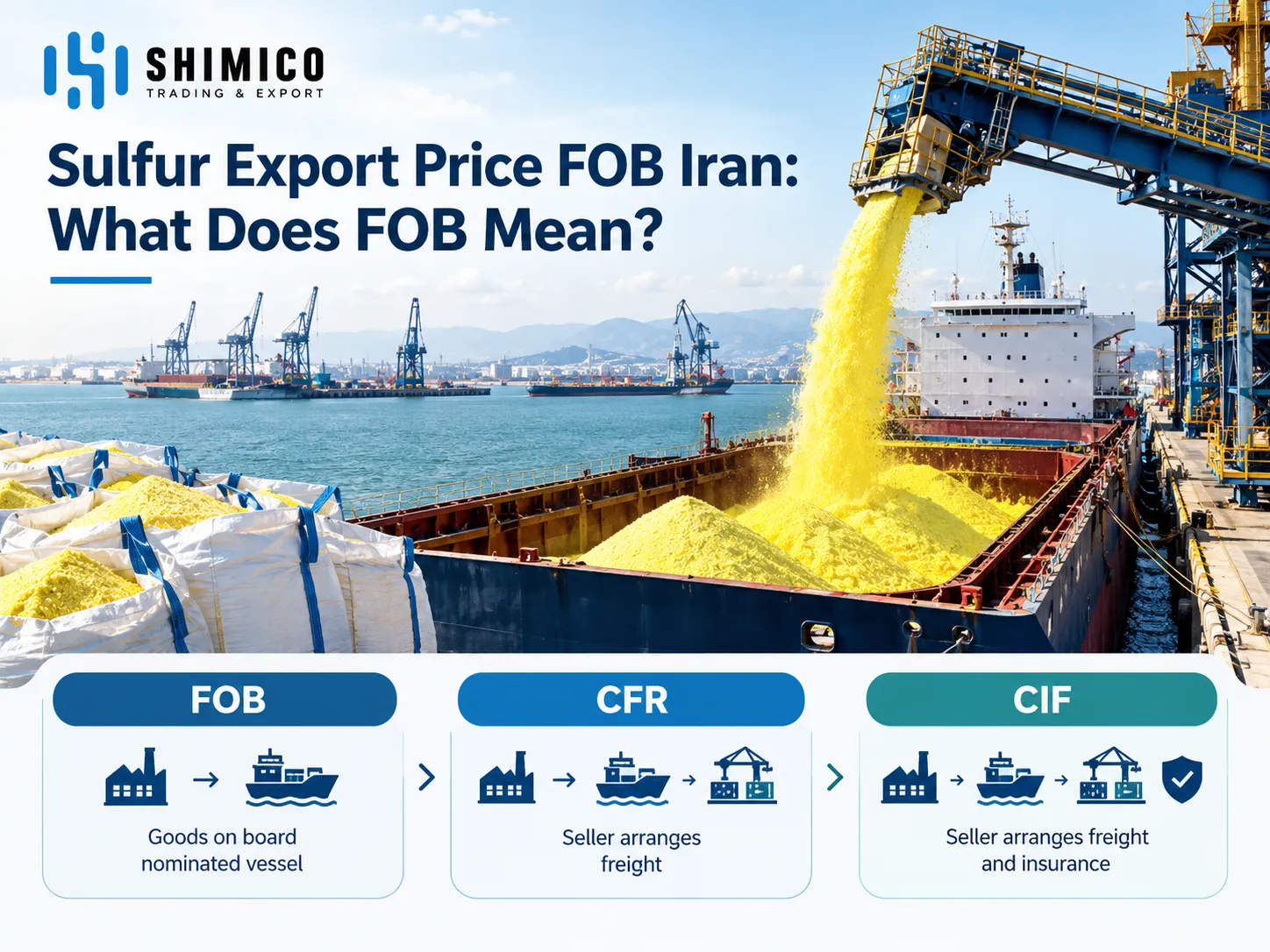
FOB stands for Free On Board. Under the FOB rule in Incoterms® 2020, the seller delivers the goods on board the vessel nominated by the buyer at the named port of shipment. Risk transfers when the goods are on board the vessel. The buyer generally arranges and pays for the main sea carriage after that point.
The words following FOB matter. A quotation should name the agreed port and state which edition of Incoterms applies. “FOB Iran” alone does not identify a precise delivery point or explain every commercial detail. For a bulk sulfur order, the quotation should also specify the grade, quantity, packaging, inspection arrangements, payment terms and expected loading period.
The International Chamber of Commerce explains the responsibilities and risk transfer under the official Incoterms® rules. These rules help buyers and sellers define their obligations, but they do not replace a complete sales contract.
Sulfur FOB Iran vs. CFR and CIF Prices
An FOB price should not be compared directly with a CFR or CIF price without adjusting for the different delivery terms. Under CFR, the seller arranges and pays the freight needed to bring the goods to the named destination port, while risk transfers when the goods are on board at the shipment port. Under CIF, the seller also arranges cargo insurance for the buyer’s risk during carriage, subject to the insurance requirements of the rule.
The difference is practical. A supplier may quote a lower price on an FOB basis because the buyer arranges the main carriage. Another supplier may quote a higher CIF price that includes freight and insurance. The buyer must calculate the full landed cost before deciding which offer is more attractive.
The table is a starting point, not a full contract. Under both CFR and CIF, the transfer of risk occurs at shipment rather than when the goods arrive at the destination port. CIF insurance also does not automatically mean comprehensive cover. Buyers that need wider protection should review the policy and agree on any additional insurance requirements.
When FCA May Be More Suitable Than FOB
FOB is designed for sea or inland waterway transport where delivery takes place on board a vessel. If containerized sulfur is handed over to a carrier at a terminal before it is loaded on board, FCA may better reflect the actual delivery arrangement. The right Incoterm depends on the physical handover, transport method and contract structure.
Warning: avoid incomplete FOB quotations
Do not approve a quote that only states “FOB Iran.” Request the named port, Incoterms edition, product specification, quantity, loading period, packing, inspection terms, payment conditions and offer validity. These details should appear in the quotation and final contract.
Iran Sulfur Price per Ton: Main Factors That Affect the Quote
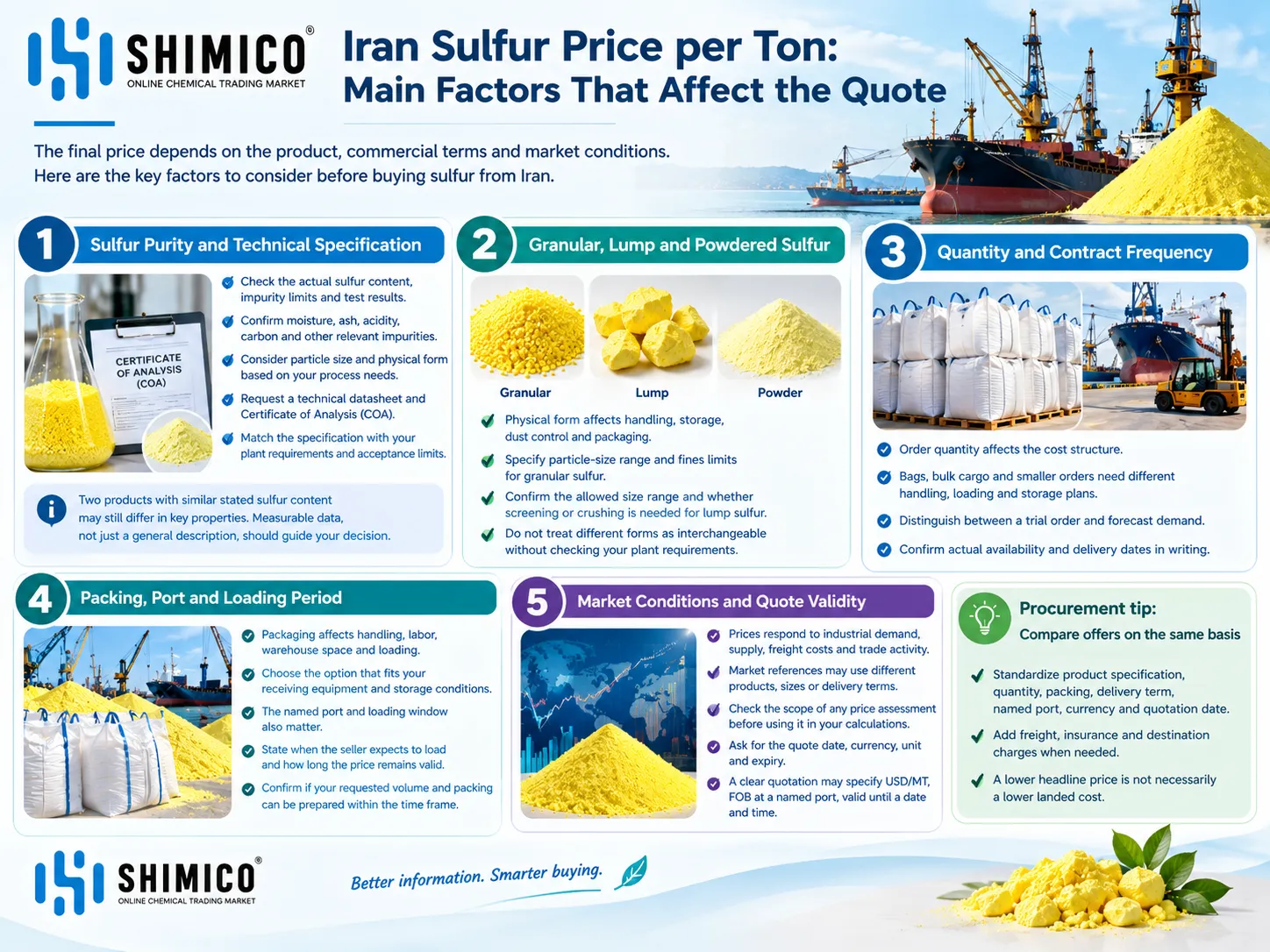
There is no single sulfur price per metric tonne that applies to every grade, shipment and buyer. The final offer depends on the exact product and the commercial terms attached to it. A bulk granular sulfur cargo, a bagged shipment and a smaller trial order may involve different handling, packaging and loading costs.
Price comparisons also depend on the date of the quotation. Sulfur is traded in a market affected by supply, demand, regional trade flows, freight and purchasing activity from industries that consume sulfur or sulfur-derived products. A historical price assessment can help with market context, but it should not be treated as a firm offer for a specific Iranian shipment.
1. Sulfur Purity and Technical Specification
Purity is one of the first details industrial buyers should check. A seller may describe sulfur as high purity, but that phrase does not define the full specification. The buyer should request the actual sulfur content, impurity limits and test results relevant to the intended process.
Depending on the product and application, a purchase specification may include moisture, ash, acidity, carbon or other impurities, particle size and physical form. Not every parameter applies to every contract. The buyer’s plant specification should determine which values matter and which acceptance limits must appear in the sales agreement.
Two products with similar stated sulfur content may still differ in properties that matter to a specific plant. The supplier should therefore provide a technical datasheet and, where available, a Certificate of Analysis (COA) for the offered grade or shipment. A general product description is not a replacement for measurable acceptance criteria.
2. Granular Sulfur, Lump Sulfur and Powdered Sulfur
Physical form can affect handling, storage, dust control, packaging and suitability for a production line. Granular sulfur is supplied as formed particles. Lump sulfur comes in larger pieces and may require size reduction for some applications. Powdered sulfur has finer particles and can create different dust-control and handling requirements.
These forms should not be treated as interchangeable without checking the plant requirements. A buyer who needs granular sulfur should state the particle-size range and any limits on fines. A buyer who can accept lump sulfur should confirm the permitted size range and whether screening or crushing is needed before use.
3. Quantity and Contract Frequency
Order quantity can change the cost structure of a sulfur purchase. A shipment packed into bags requires different handling from cargo loaded in bulk. Large orders may also need a different loading plan, vessel arrangement, storage capacity or inspection schedule.
Buyers should distinguish between the first order and forecast demand. A company may need a trial lot before qualifying a supplier for regular monthly shipments. State both quantities in the inquiry, but ask the supplier to confirm actual availability and delivery dates in writing.
4. Packing, Port and Loading Period
Packaging affects material handling, labor, warehouse space and loading arrangements. Bulk sulfur, jumbo bags and smaller bags may have different costs and operational requirements. The correct option depends on the buyer’s receiving equipment, storage conditions and local transport arrangements.
The named shipment port and loading window also matter. A quotation should state when the seller expects to load the goods and how long the price remains valid. If the buyer requires a narrow shipment window, the seller should confirm that the requested volume and packing can be prepared within that period.
5. Market Conditions and Quote Validity
Sulfur pricing can respond to changes in industrial demand, regional supply, freight costs and trade activity. Market references may use different products, loading locations, shipment sizes or delivery terms. Buyers should check the scope of any price assessment before using it in procurement calculations.
Ask each seller to state the quote date, currency, unit and expiry. A clear quotation might specify a price in USD per metric tonne on an FOB basis at a named port, valid until a stated date and time. If any detail changes, request a revised quotation rather than assuming the original price still applies.
Procurement tip: compare offers on the same basis
Before ranking sulfur quotations, standardize the product specification, quantity, packing, delivery term, named port, currency and quotation date. Add freight, insurance and destination charges when needed. A lower headline price is not necessarily a lower landed cost.
Types of Sulfur for Industrial Buyers
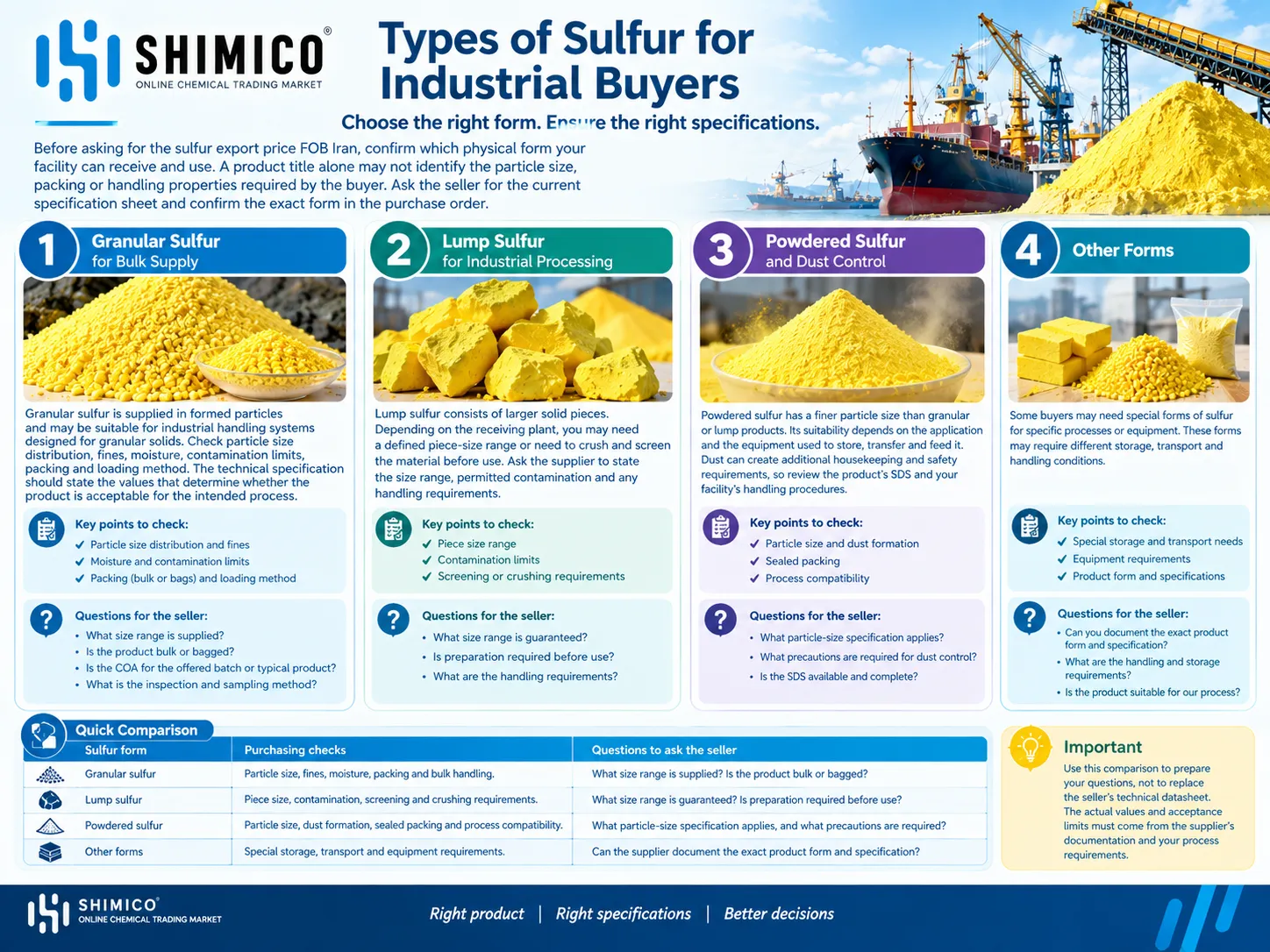
Before asking for the sulfur export price FOB Iran, confirm which physical form your facility can receive and use. A product title alone may not identify the particle size, packing or handling properties required by the buyer. Ask the seller for the current specification sheet and confirm the exact form in the purchase order.
Granular Sulfur for Bulk Supply
Granular sulfur is supplied in formed particles and may be suitable for industrial handling systems designed for granular solids. Buyers should check particle-size distribution, fines, moisture, contamination limits, packing and loading method. The technical specification should state the values that determine whether the product is acceptable for the intended process.
When evaluating a granular sulfur supplier, ask whether the quoted product is available in bulk or packed form. Confirm whether the COA relates to the offered batch or only describes typical product properties. If inspection is part of the contract, agree on the sampling method and inspection point before loading.
Lump Sulfur for Industrial Processing
Lump sulfur consists of larger solid pieces. Depending on the receiving plant, the buyer may need a defined piece-size range or may need to crush and screen the material before use. Ask the supplier to state the size range, permitted contamination and any handling requirements.
Price alone does not show whether lump sulfur suits a plant. If the buyer needs extra processing before use, the purchase evaluation should include the associated handling and preparation costs. Confirm these requirements before approving a large shipment.
Powdered Sulfur and Dust Control
Powdered sulfur has a finer particle size than granular or lump products. Its suitability depends on the application and the equipment used to store, transfer and feed it. Dust can create additional housekeeping and safety requirements, so buyers should review the product’s SDS and their facility’s handling procedures.
Do not accept a substitution between powder and granular sulfur without technical approval. The physical form can change how the material behaves during transport and use. The agreed product form should be written into the contract.
Use this comparison to prepare questions, not to replace the seller’s technical datasheet. The actual values and acceptance limits must come from the supplier’s documentation and the buyer’s process requirements.
Sulfur Technical Specifications and Certificate of Analysis (COA)
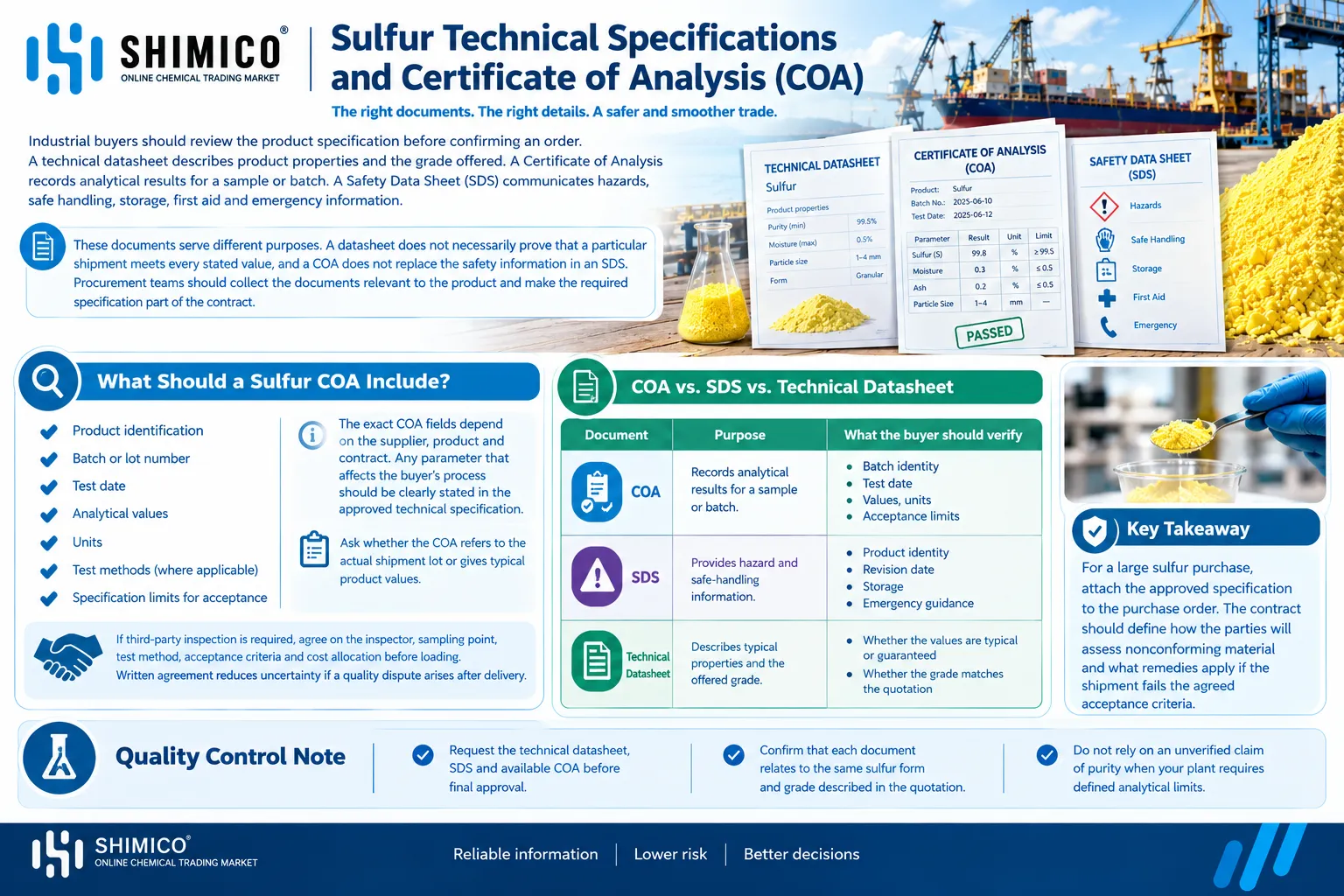
Industrial buyers should review the product specification before confirming an order. A technical datasheet describes product properties and the grade offered. A Certificate of Analysis records analytical results for a sample or batch. A Safety Data Sheet (SDS) communicates hazards, safe handling, storage, first aid and emergency information.
These documents serve different purposes. A datasheet does not necessarily prove that a particular shipment meets every stated value, and a COA does not replace the safety information in an SDS. Procurement teams should collect the documents relevant to the product and make the required specification part of the contract.
What Should a Sulfur COA Include?
The exact COA fields depend on the supplier, product and contract. Buyers may request product identification, batch or lot number, test date, analytical values, units, test methods where applicable and the specification limits used for acceptance. Any parameter that affects the buyer’s process should be clearly stated in the approved technical specification.
Ask whether the COA refers to the actual shipment lot or gives typical product values. If the contract requires third-party inspection, agree on the inspector, sampling point, test method, acceptance criteria and cost allocation before loading. Written agreement reduces uncertainty if a quality dispute arises after delivery.
COA vs. SDS vs. Technical Datasheet
| Document | Purpose | What the buyer should verify |
|---|---|---|
| COA | Records analytical results for a sample or batch. | Batch identity, test date, values, units and acceptance limits. |
| SDS | Provides hazard and safe-handling information. | Product identity, revision date, storage and emergency guidance. |
| Technical datasheet | Describes typical properties and the offered grade. | Whether the values are typical or guaranteed and whether the grade matches the quotation. |
For a large sulfur purchase, attach the approved specification to the purchase order. The contract should define how the parties will assess nonconforming material and what remedies apply if the shipment fails the agreed acceptance criteria.
Quality control note
Request the technical datasheet, SDS and available COA before final approval. Confirm that each document relates to the same sulfur form and grade described in the quotation. Do not rely on an unverified claim of purity when your plant requires defined analytical limits.
Industrial Applications of Sulfur and Buyer Requirements
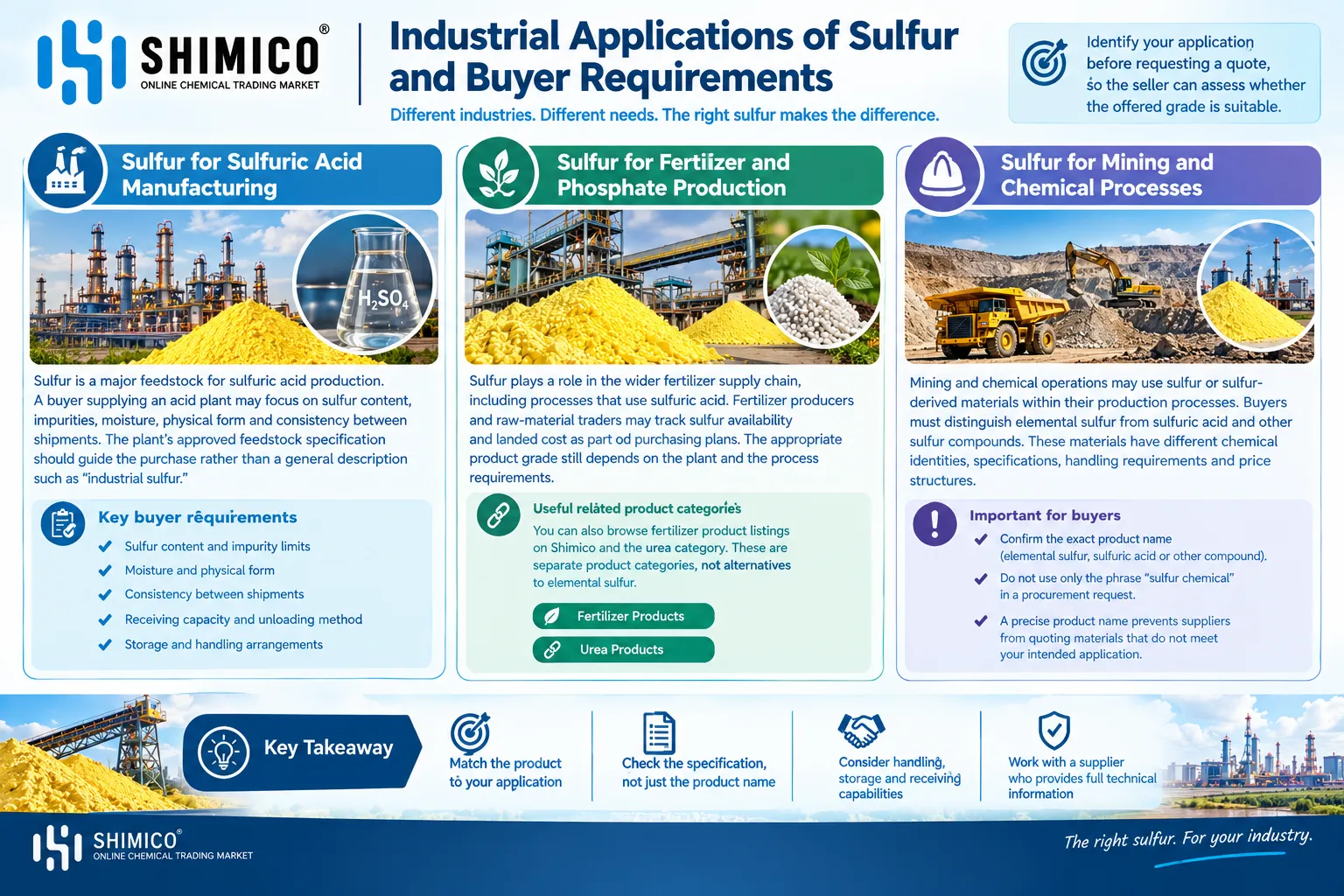
Sulfur is used as a raw material or process input in several industrial sectors. The required form and specification depend on the plant design, production route and quality requirements. Buyers should identify the intended application when requesting a quote so the seller can assess whether the offered grade is suitable.
Sulfur for Sulfuric Acid Manufacturing
Sulfur is a major feedstock for sulfuric acid production. A buyer supplying an acid plant may focus on sulfur content, impurities, moisture, physical form and consistency between shipments. The plant’s approved feedstock specification should guide the purchase rather than a general description such as “industrial sulfur.”
Procurement teams should also confirm receiving capacity, unloading method and storage arrangements. A technically suitable product still needs to arrive in a form that the facility can handle safely and feed into its process.
Sulfur for Fertilizer and Phosphate Production
Sulfur plays a role in the wider fertilizer supply chain, including processes that use sulfuric acid. Fertilizer producers and raw-material traders may therefore track sulfur availability and landed cost as part of purchasing plans. The appropriate product grade still depends on the plant and the process requirements.
Companies purchasing other fertilizer inputs can also browse fertilizer product listings on Shimico and the urea category. These are separate product categories, not alternatives to elemental sulfur.
Sulfur for Mining and Chemical Processes
Mining and chemical operations may use sulfur or sulfur-derived materials within their production processes. Buyers must distinguish elemental sulfur from sulfuric acid and other sulfur compounds. These materials have different chemical identities, specifications, handling requirements and price structures.
If a procurement request uses only the phrase “sulfur chemical,” clarify the exact product before requesting quotations. A precise product name prevents suppliers from quoting materials that do not meet the intended application.
Sulfur Safety, Storage and Handling
Sulfur is a chemical element with the symbol S and atomic number 16. PubChem describes sulfur as a nonmetal and a solid at ordinary room temperature. Its physical properties vary with its form, and the handling requirements for bulk granular sulfur may differ from those for a fine powder. See the reference record from PubChem: Sulfur.
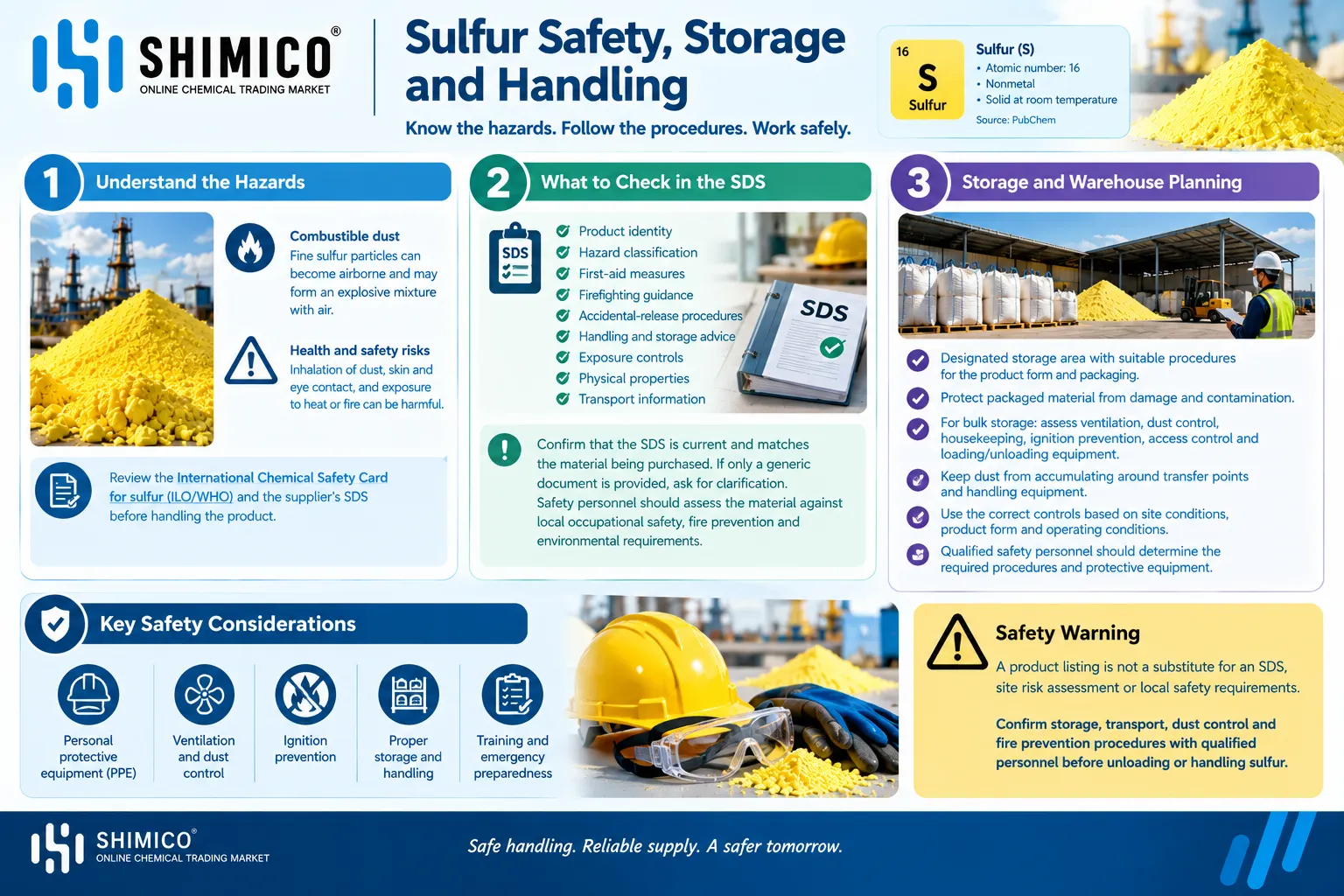
Solid sulfur can present a combustible-dust hazard when fine particles become airborne and mix with air. The International Chemical Safety Cards published through the International Labour Organization and World Health Organization describe the hazards associated with sulfur dust and combustion. Review the International Chemical Safety Card for sulfur and the supplier’s SDS before handling the product.
What to Check in the Sulfur SDS
Review the product identity, hazard classification, first-aid measures, firefighting guidance, accidental-release procedures, handling and storage advice, exposure controls, physical properties and transport information. Confirm that the SDS is current and corresponds to the material being purchased.
If the supplier provides only a generic document, ask for clarification before accepting the shipment. The facility’s safety personnel should assess the material against local occupational safety, fire prevention and environmental requirements.
Sulfur Storage and Warehouse Planning
Store sulfur in a designated area with procedures suited to its physical form and packaging. Protect packaged material from damage and contamination. For bulk storage, assess ventilation, dust control, housekeeping, ignition prevention, access control and the equipment used for loading and unloading.
Do not allow dust to accumulate around transfer points or handling equipment. The correct controls depend on the site, product form and operating conditions. Qualified safety personnel should determine the required procedures and protective equipment.
Safety warning
A product listing is not a substitute for an SDS, site risk assessment or local safety requirements. Confirm storage, transport, dust control and fire prevention procedures with qualified personnel before unloading or handling sulfur.
Sulfur Export from Iran: Documents and Trade Checks
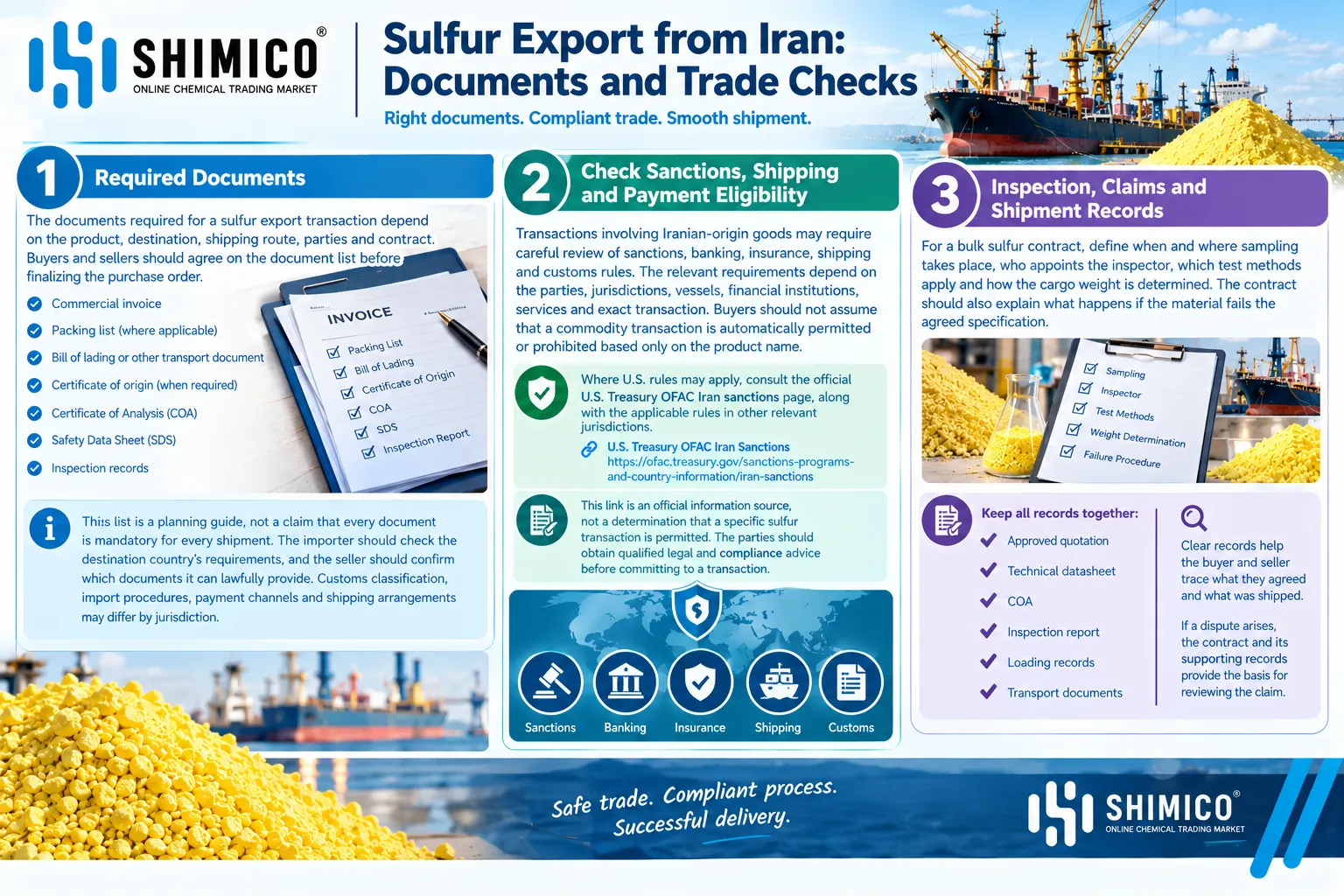
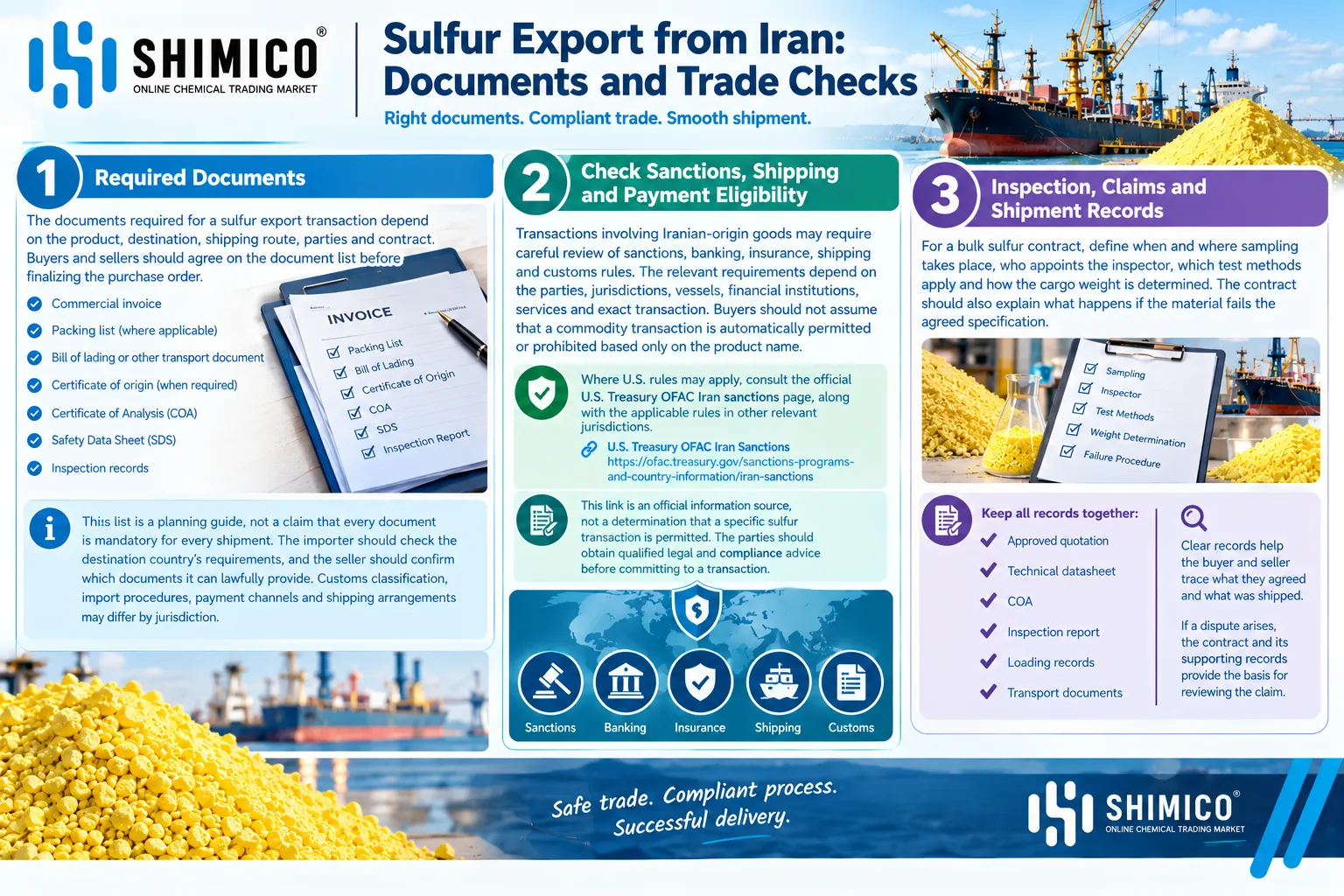
The documents required for a sulfur export transaction depend on the product, destination, shipping route, parties and contract. Buyers and sellers should agree on the document list before finalizing the purchase order. Commercial records may include an invoice, packing list where applicable, bill of lading or other transport document, certificate of origin when required, COA, SDS and inspection records.
This list is a planning guide, not a claim that every document is mandatory for every shipment. The importer should check the destination country’s requirements, and the seller should confirm which documents it can lawfully provide. Customs classification, import procedures, payment channels and shipping arrangements may differ by jurisdiction.
Check Sanctions, Shipping and Payment Eligibility
Transactions involving Iranian-origin goods may require careful review of sanctions, banking, insurance, shipping and customs rules. The relevant requirements depend on the parties, jurisdictions, vessels, financial institutions, services and exact transaction. Buyers should not assume that a commodity transaction is automatically permitted or prohibited based only on the product name.
Where U.S. rules may apply, consult the official U.S. Treasury OFAC Iran sanctions page, along with the applicable rules in other relevant jurisdictions. This link is an official information source, not a determination that a specific sulfur transaction is permitted. The parties should obtain qualified legal and compliance advice before committing to a transaction.
Inspection, Claims and Shipment Records
For a bulk sulfur contract, define when and where sampling takes place, who appoints the inspector, which test methods apply and how the cargo weight is determined. The contract should also explain what happens if the material fails the agreed specification.
Keep the approved quotation, technical datasheet, COA, inspection report, loading records and transport documents together. Clear records help the buyer and seller trace what they agreed and what was shipped. If a dispute arises, the contract and its supporting records provide the basis for reviewing the claim.
How to Request a Sulfur FOB Iran Quotation
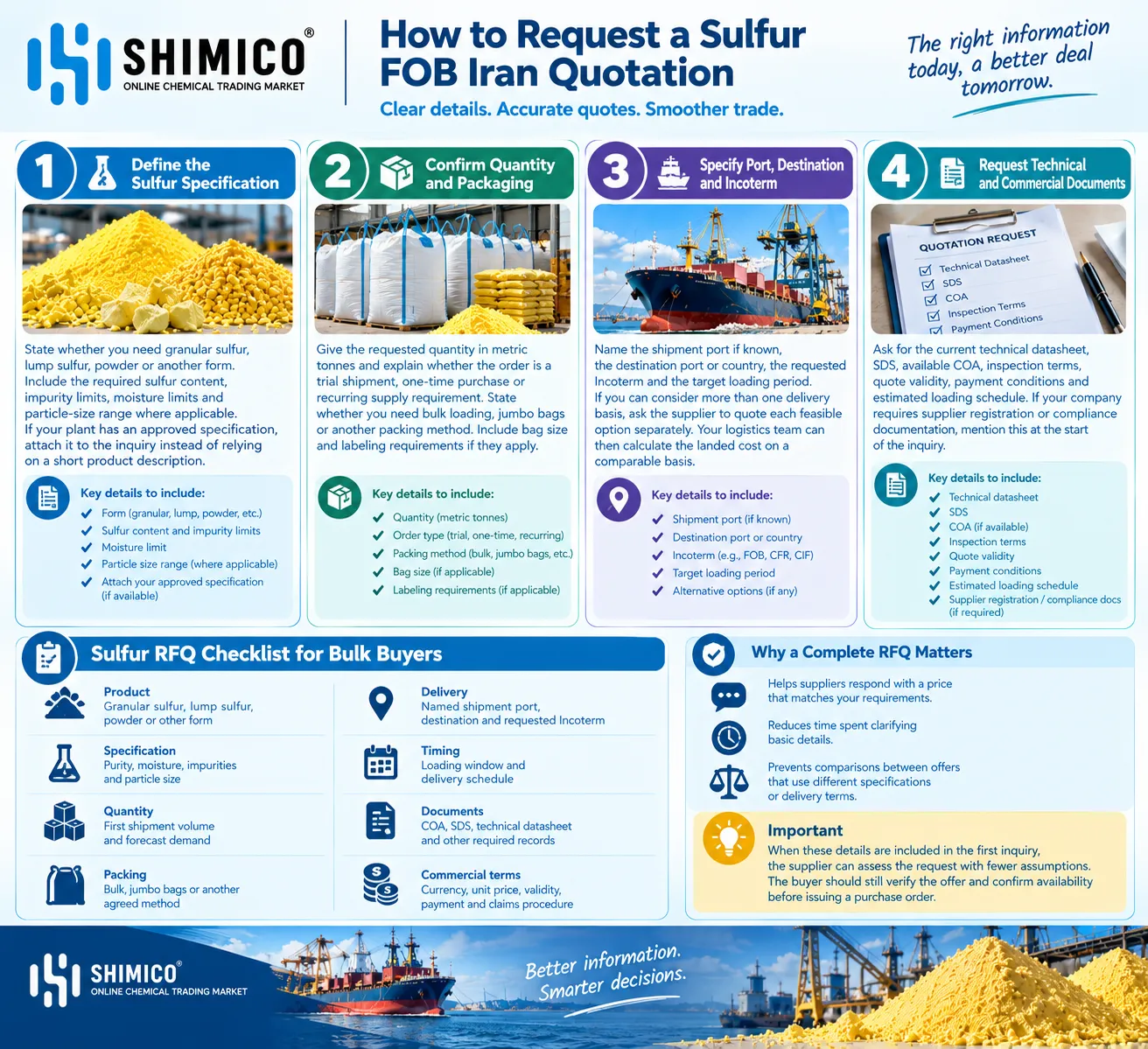
A complete request for quotation (RFQ) helps suppliers respond with a price that matches the buyer’s requirements. It also reduces the time spent clarifying basic details and prevents comparisons between offers that use different specifications or delivery terms.
Step 1: Define the Sulfur Specification
State whether you need granular sulfur, lump sulfur, powder or another form. Include the required sulfur content, impurity limits, moisture limits and particle-size range where applicable. If your plant has an approved specification, attach it to the inquiry instead of relying on a short product description.
Step 2: Confirm Quantity and Packaging
Give the requested quantity in metric tonnes and explain whether the order is a trial shipment, one-time purchase or recurring supply requirement. State whether you need bulk loading, jumbo bags or another packing method. Include bag size and labeling requirements if they apply.
Step 3: Specify Port, Destination and Incoterm
Name the shipment port if known, the destination port or country, the requested Incoterm and the target loading period. If you can consider more than one delivery basis, ask the supplier to quote each feasible option separately. Your logistics team can then calculate the landed cost on a comparable basis.
Step 4: Request Technical and Commercial Documents
Ask for the current technical datasheet, SDS, available COA, inspection terms, quote validity, payment conditions and estimated loading schedule. If your company requires supplier registration or compliance documentation, mention this at the start of the inquiry.
Sulfur RFQ Checklist for Bulk Buyers
- Product: granular sulfur, lump sulfur, powder or other form
- Specification: purity, moisture, impurities and particle size
- Quantity: first shipment volume and forecast demand
- Packing: bulk, jumbo bags or another agreed method
- Delivery: named shipment port, destination and requested Incoterm
- Timing: loading window and delivery schedule
- Documents: COA, SDS, technical datasheet and other required records
- Commercial terms: currency, unit price, validity, payment and claims procedure
When these details are included in the first inquiry, the supplier can assess the request with fewer assumptions. The buyer should still verify the offer and confirm availability before issuing a purchase order.
How to Compare Sulfur Suppliers in Iran
Supplier comparison should include technical, commercial and compliance checks. A product listing can help a buyer discover potential sellers, but it does not prove current stock, production capacity, export capability or eligibility for a specific transaction. Those details must be confirmed directly with the supplier and relevant service providers.
Supplier Evaluation Criteria for Bulk Sulfur
- Technical documentation: Can the supplier provide a specification, SDS and relevant COA?
- Product traceability: Can the supplier identify the offered product and shipment batch where applicable?
- Commercial clarity: Does the quotation state the price unit, currency, quantity, Incoterm, port and validity?
- Loading arrangements: Are packing, handling, inspection and loading dates clearly described?
- Contract terms: Are payment conditions, acceptance criteria and claims procedures written into the contract?
- Compliance review: Have the parties assessed applicable customs, sanctions, banking, insurance and shipping requirements?
- Communication: Does the supplier answer technical questions and provide the documents needed for evaluation?
For a first transaction, a buyer may consider a sample, inspection or qualification shipment where appropriate and feasible. The suitability of these steps depends on the product, route, handling requirements and contract. For recurring purchases, record performance against the agreed specification and shipment schedule rather than relying only on the first quotation.
Market Benchmark vs. Supplier Offer
A market assessment and a supplier quotation serve different purposes. A benchmark follows a defined methodology for a stated product, location and delivery basis. A supplier quotation is a commercial proposal for a particular quantity, specification, shipment period and set of contract terms.
Argus publishes a Middle East FOB sulfur assessment that covers bulk granular sulfur in selected producing countries and excludes Iran from that particular assessment. Argus also lists a separate FOB Iran assessment for lump and granular sulfur in its sulfur methodology and product information. Buyers should therefore check the exact assessment name, scope and date before using a benchmark in a procurement model.
Review the Argus Middle East sulfur FOB assessment description and the Argus sulfur methodology and specifications guide. These references explain the scope of the relevant assessments; they do not replace a current supplier quote.
Sulfur Export Price FOB Iran Today: How to Read a Price List
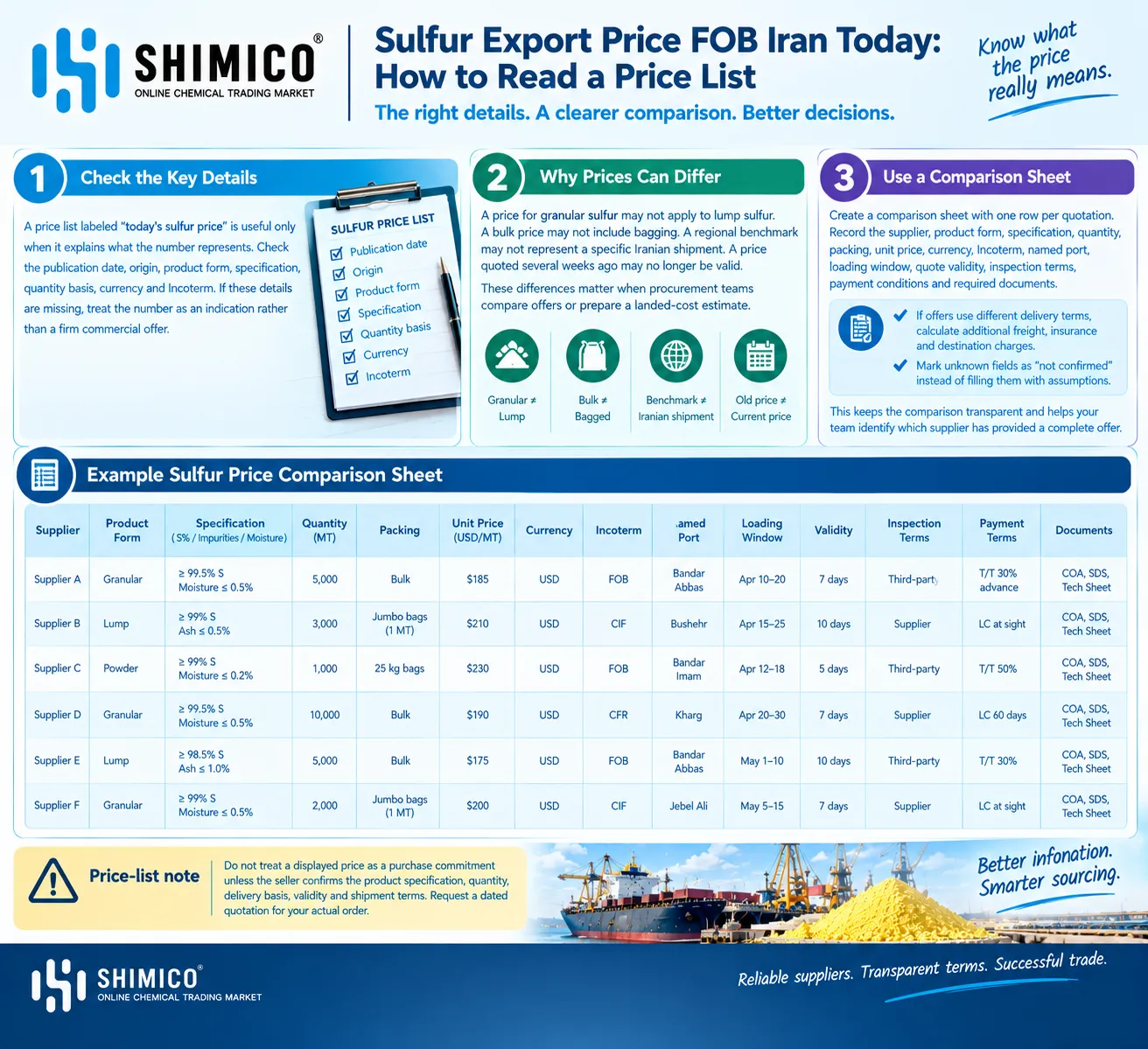
A price list labeled “today’s sulfur price” is useful only when it explains what the number represents. Check the publication date, origin, product form, specification, quantity basis, currency and Incoterm. If these details are missing, treat the number as an indication rather than a firm commercial offer.
A price for granular sulfur may not apply to lump sulfur. A bulk price may not include bagging. A regional benchmark may not represent a specific Iranian shipment. A price quoted several weeks ago may no longer be valid. These differences matter when procurement teams compare offers or prepare a landed-cost estimate.
A Practical Sulfur Price Comparison Method
Create a comparison sheet with one row per quotation. Record the supplier, product form, specification, quantity, packing, unit price, currency, Incoterm, named port, loading window, quote validity, inspection terms, payment conditions and required documents.
If the offers use different delivery terms, calculate the additional freight, insurance and destination charges that apply to each one. Mark any unknown fields as “not confirmed” instead of filling them with assumptions. This keeps the comparison transparent and helps your team identify which supplier has provided a complete offer.
Price-list note
Do not treat a displayed price as a purchase commitment unless the seller confirms the product specification, quantity, delivery basis, validity and shipment terms. Request a dated quotation for your actual order.
Buy Sulfur from Iran Through Shimico
Shimico helps business buyers discover chemical product listings and connect with sellers. Buyers looking for sulfur can use the platform as a starting point for supplier discovery and inquiries. Review the available product information, then confirm the specification, availability and commercial terms directly with the seller before placing an order.
For a more useful inquiry, include the required sulfur form, specification, tonnage, destination and preferred Incoterm in your first message. Attach the plant specification if one is available. This gives the seller a clearer basis for responding and helps your purchasing team assess whether the offer fits its requirements.
Buyers searching for other industrial products can also browse the chemical product listings on Shimico and the wider Shimico products directory. Companies purchasing fertilizer inputs can visit the fertilizer category and urea listings.
Request a Sulfur Export Quotation
Prepare your sulfur specification, required tonnage, packing preference, destination and delivery terms. Review relevant listings on Shimico and contact sellers to request a commercial quotation. Confirm the final price, technical documents, shipment arrangements and applicable trade requirements before signing a contract.
Browse Chemical Listings
View All Products
Product availability, specifications and final commercial terms must be confirmed directly with the relevant seller.
Frequently Asked Questions About Sulfur Export Price FOB Iran
What is the sulfur export price FOB Iran?
It is a seller’s quotation for a defined sulfur product delivered on board a vessel at the named shipment port under the agreed FOB rule. There is no single price for every grade, quantity and shipment. Request a current quote that states the product form, specification, quantity, port, currency, validity and loading period.
How can I get the current Iran sulfur price per ton?
Send a request to a relevant seller with the sulfur form, technical specification, quantity in metric tonnes, packing, destination and requested Incoterm. Ask for a dated offer with a stated validity period. Market reports can provide context, but a supplier must confirm the actual price for your shipment.
Does an FOB sulfur price include ocean freight?
Under FOB, the seller delivers the goods on board the vessel at the named shipment port. The buyer generally arranges and pays for the main sea freight after that point. Compare FOB with CFR or CIF only after accounting for freight, insurance where applicable and other costs under each delivery term.
What is the difference between granular sulfur and lump sulfur?
Granular sulfur is supplied as formed particles, while lump sulfur consists of larger pieces. The forms can differ in handling, particle size, loading requirements and suitability for a particular process. Confirm the physical form and technical specification before comparing prices.
Which documents should I request when buying sulfur in bulk?
Request the technical datasheet, SDS and a COA relevant to the offered product or shipment where available. Depending on the route and contract, you may also need a commercial invoice, packing list, transport document, certificate of origin and inspection records. Confirm the final document list with the seller and destination-side customs adviser.
Is a Middle East sulfur benchmark the same as an Iranian FOB offer?
No. A benchmark covers a defined product, location and assessment method. Argus states that its Middle East FOB sulfur assessment excludes Iran, while its methodology also lists a separate FOB Iran assessment for lump and granular sulfur. Check the exact assessment before using it as a reference for procurement.
Can I buy sulfur by vessel or through a monthly supply contract?
That depends on the seller’s confirmed availability, loading capability, route and contract terms. State the first shipment quantity and forecast monthly or quarterly demand in your inquiry. Ask the seller to confirm volumes and dates in writing before relying on a recurring supply plan.
What should I check before buying sulfur from Iran?
Confirm the specification, COA and SDS, quantity, packing, named port, Incoterm, quote validity, inspection method, payment terms and claims procedure. The parties should also assess applicable customs, sanctions, banking, insurance and shipping rules for the specific transaction before committing to the purchase.
Sources for Sulfur Pricing, Specifications and Export Terms
The following sources support the technical and trade information referenced in this guide. Each source should be read within its stated scope. None of these references confirms a supplier’s current inventory, a live offer for a particular shipment or the legal status of a specific transaction.
- International Chamber of Commerce, “Incoterms® Rules”. Official overview of trade terms and the allocation of responsibilities, costs and risks. Read the ICC Incoterms overview.
- International Chamber of Commerce, “Incoterms® Rules: FOB, CFR and CIF”. Official explanation of delivery obligations and risk transfer. Read the ICC rules.
- Argus Media, “Argus Middle East Sulphur FOB”. Describes the scope of the Middle East FOB sulfur assessment, which excludes Iran. Read the assessment description.
- Argus Media, “Argus Methodology and Specifications Guide: Sulphur”. Describes sulfur price assessments, including FOB Iran and other regional assessments. Read the sulfur methodology guide.
- PubChem, “Sulfur”. Scientific reference information about the element and its properties. Read the PubChem sulfur record.
- International Chemical Safety Cards, “Sulfur”. Safety information covering physical hazards and handling concerns. Read the sulfur safety card.
- U.S. Department of the Treasury, Office of Foreign Assets Control, “Iran Sanctions”. Official information for parties assessing whether U.S. sanctions rules apply to a transaction. Read the OFAC Iran sanctions page.
Source record: International Chamber of Commerce, “Incoterms® Rules,” URL; International Chamber of Commerce, “Incoterms® Rules,” URL; Argus Media, “Argus Middle East Sulphur FOB,” URL; Argus Media, “Argus Methodology and Specifications Guide: Sulphur,” URL; PubChem, “Sulfur,” URL; International Chemical Safety Cards, “Sulfur,” URL; U.S. Treasury OFAC, “Iran Sanctions,” URL. Online sources may be updated after publication. Check the latest version before relying on them for a live transaction.
Last Seen


Users Comment
Sulfur Fungicide: How It Works, Uses and Safety Precautions
Types of Sulfur Fertilizers: Powder, Granular, Liquid & Sulfate Forms
Sulfur for Soil: Benefits, Uses and How to Apply It
Sulphur 80 WDG: Technical Specifications, Uses & Bulk Supply
Sulfur WDG: Water Dispersible Granules, Uses & Bulk Supply
Sulphur WDG Pakistan: Bulk Supply, Prices & Import Guide
Sulfuric Acid Supply to Turkey: Price, Transport and Import Guide
Sodium Bicarbonate for Dairy Cows: Rumen Buffer, Dosage, Milk Fat
Why Sulfuric Acid Is King and Benzene Is Called Queen
Buy Basic Chromium Sulfate in Pakistan: BCS Price, Wholesale Supply
How Urea Can Hydrate and Exfoliate Your Skin
Sodium carbonate| Soda ash; features and applications