


Methanol Prices After the Iran War: Supply, Freight and Buyer Risks
Direct answer: Methanol prices rose sharply after the Iran war disrupted Gulf production and shipping through the Strait of Hormuz. The acute price spike has eased in parts of Asia, but supply has not returned to normal. Buyers still face vessel delays, war-risk insurance, higher freight, uncertain Iranian exports and competition for non-Gulf cargoes.
A lower spot assessment does not prove that delivered methanol has become cheaper. Procurement teams must compare the product price, freight, insurance, tank availability, port costs and arrival reliability on the same basis.
Methanol prices after the Iran war moved through three stages. The first was panic. Gulf exports slowed, several regional producers faced operating or shipment restrictions, and buyers in India and Southeast Asia chased prompt cargoes.
The second stage brought inventory releases, alternative supply from Russia and the Americas, and weaker demand from buyers unable to absorb the new replacement cost. The third stage is now developing: prices differ sharply by destination because physical delivery matters more than one global headline.
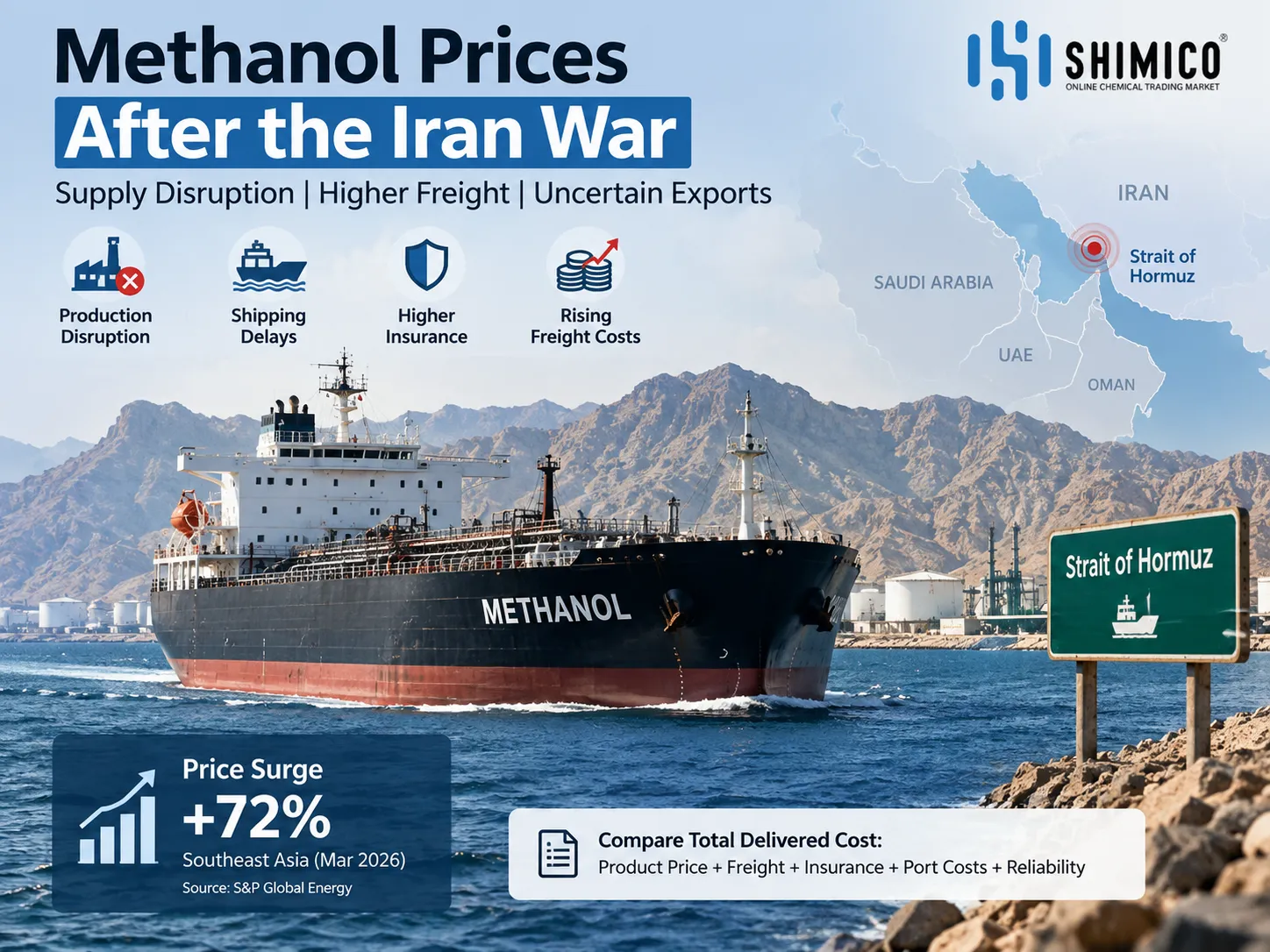
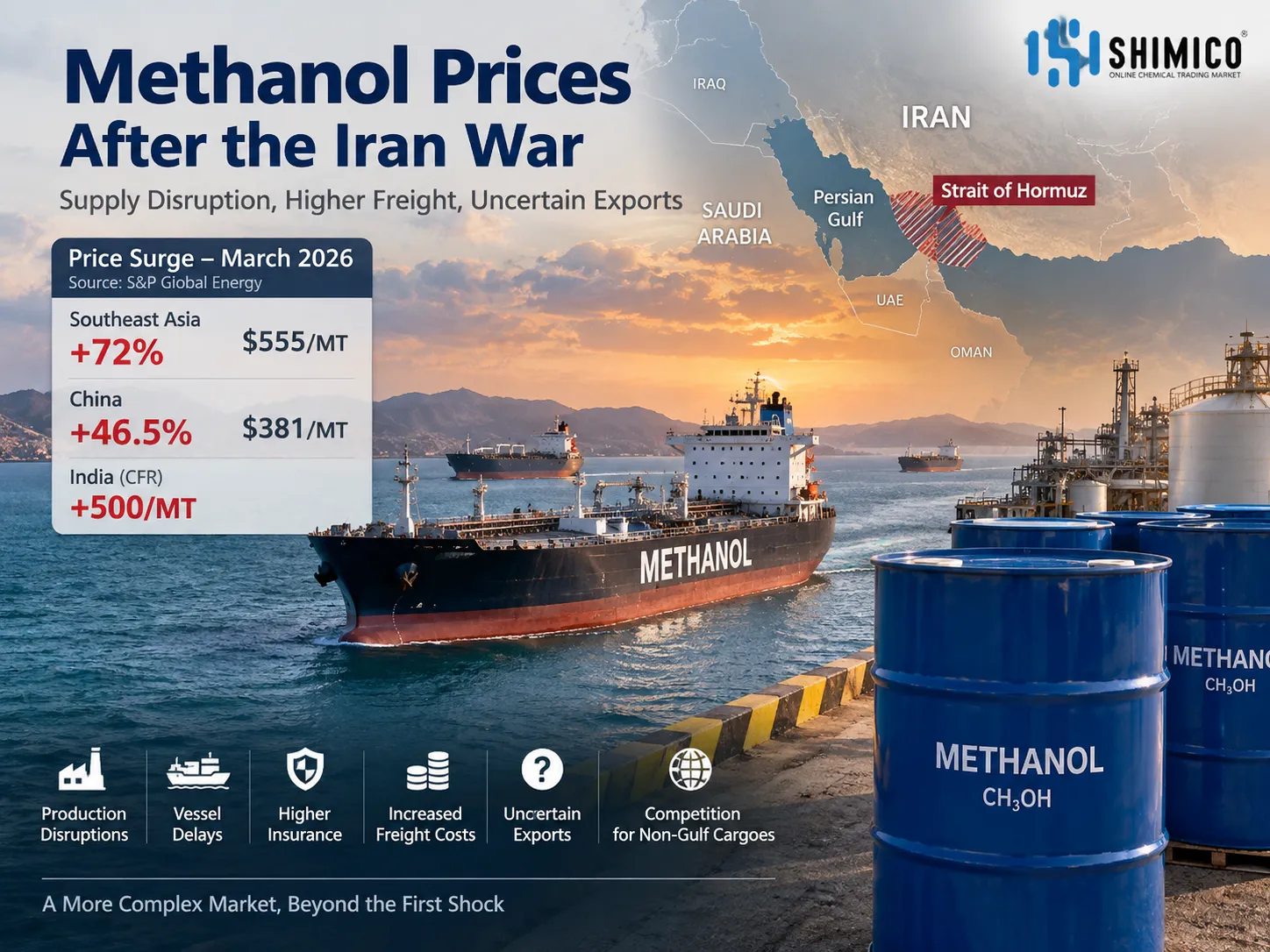
The scale of the first shock was measurable. On 20 March 2026, S&P Global Energy reported that Southeast Asian methanol had risen 72% to $555 per metric ton, China had climbed 46.5% to $381 per metric ton, and CFR India had reached $500 per metric ton. S&P estimated that 18% of global methanol capacity was affected by the conflict and the effective blockage of Hormuz.
Those March values should not be read as September offers. They describe the first shock. Current contract references show a different but still elevated structure. Methanex posted September 2026 prices of $525 per metric ton for China and $550 per metric ton for Asia Pacific.
Its European contract price for the third quarter was €915 per metric ton. Contract postings and spot assessments serve different purposes, so a buyer should never place them in the same comparison column without a clear label.
The methanol shortage has changed shape rather than disappeared. The market moved from a visible loss of Gulf cargoes to a less visible contest between inventories, alternative origins, freight capacity and demand destruction.
Methanol Prices Iran War Update: What Changed After the First Shock?
The first rise in methanol prices did not come from one plant outage. The war affected natural gas supply, production sites, export terminals, vessel traffic, marine insurance and payment execution at the same time.
Methanol is normally a liquid and globally traded commodity, but its supply chain depends on dedicated tanks, suitable chemical tankers and compatible port infrastructure. A replacement origin cannot enter the chain as quickly as a dry bulk product that can use a wider range of terminals.
Iran is a large methanol producer and a major supplier to China. Other Gulf producers also serve Asia and India. When Hormuz traffic slowed, buyers lost access not only to Iranian tonnes but also to cargoes from Qatar, Saudi Arabia and Bahrain.
S&P reported that Saudi and Qatari exports to Asia were restricted, while Qatar-related force majeure and uncertainty around other Gulf arrivals helped lift Indian prices to a four-year high.
Methanol Price Correction After the March 2026 Peak
A correction can begin while the physical supply chain remains weak. Buyers draw inventory, reduce plant rates or postpone spot purchases. Traders release expensive stock before its value falls.
Alternative supply begins to move from Russia, South America or Atlantic Basin producers. Each action reduces immediate buying pressure, but none proves that Gulf production and shipping have fully recovered.
Energy Aspects estimated global methanol demand at 114.5 million metric tons in 2026, with growth of 1.2% rather than its earlier 2.5% estimate. The lower growth forecast reflects weaker affordability and feedstock scarcity outside China.
At the same time, the firm expected Middle East supply constraints to continue through the third quarter and possibly longer. The result is a market where weak demand can pull prices down even while supply remains exposed.
Methanol Buyer Signal: Price Decline Versus Supply Recovery
A genuine recovery should show regular Gulf vessel departures, shorter loading delays, stable insurance cover, higher destination inventories and fewer emergency spot purchases.
A price decline caused only by low MTO or derivative operating rates carries a different message. It means consumers cannot support the replacement cost. If downstream margins recover, postponed demand may return before export reliability improves.
Buyer warning:
Do not treat a lower domestic China price as proof that an imported cargo will arrive on time. Domestic coal-based supply, coastal import stocks and international vessel availability are separate parts of the market.
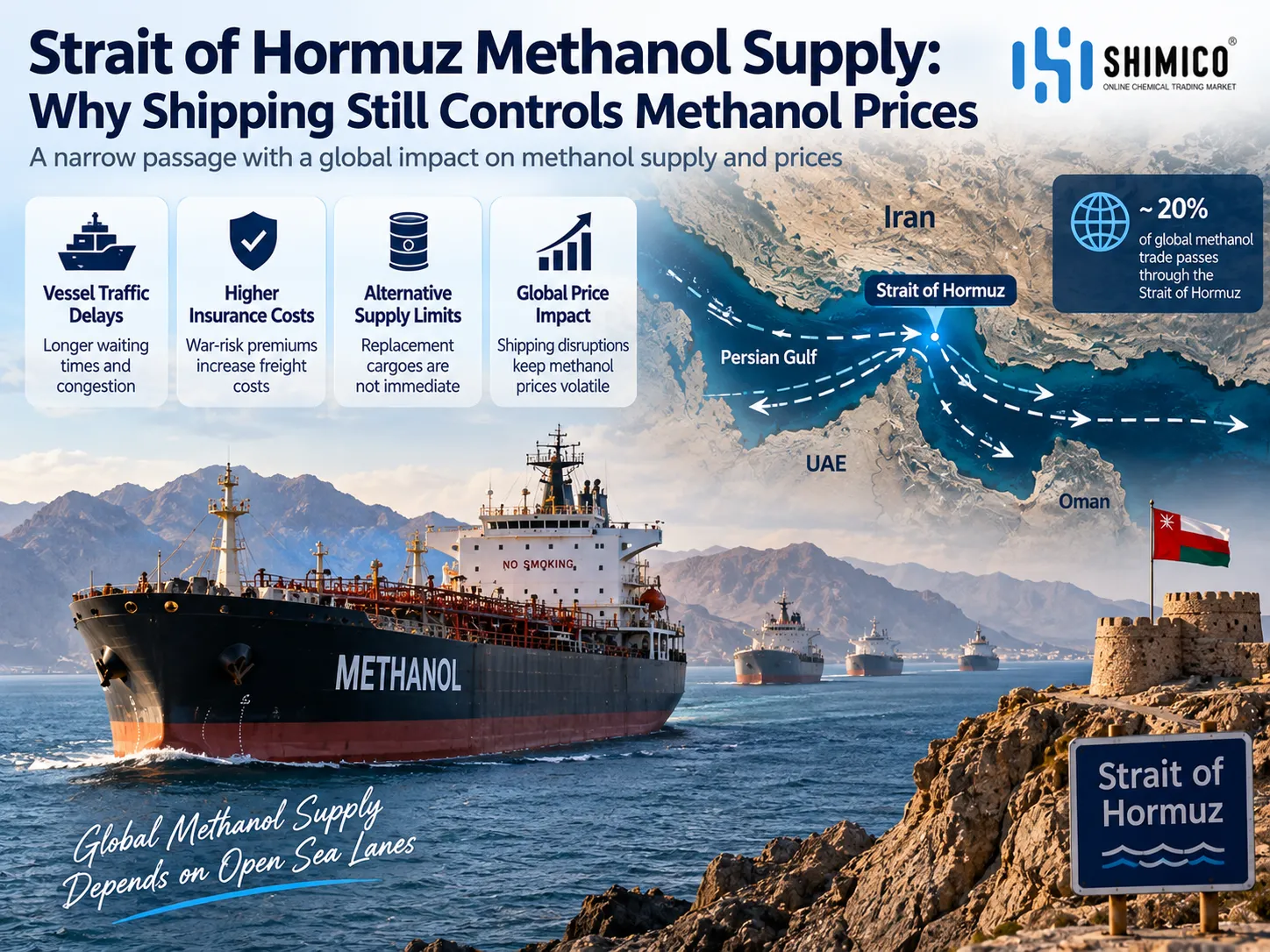
Strait of Hormuz Methanol Supply: Why Shipping Still Controls Methanol Prices
The Strait of Hormuz remains central to methanol trade because a large group of Gulf production sites loads export cargoes from ports inside the strait. A producer may continue making methanol while storage tanks fill, yet overseas availability falls if vessels cannot enter, load or depart. Production, export allocation and delivered availability must be checked separately.
Chemical tankers also require product-compatible tanks, cleaning records, terminal approval and a workable laycan. A generic claim that vessels are available says little. Buyers need a named or nominated ship, an agreed loading window, the last acceptable arrival date and a clear allocation of delay costs.
Hormuz Methanol Shipping Risk and War-Risk Insurance
War-risk insurance can change after the product price has been agreed. Under an FOB contract, the buyer may secure attractive methanol value but remain unable to charter an acceptable tanker.
Under CFR or CIF, the seller may include a large logistics premium or reserve a right to pass through new insurance charges. The contract must state whether freight and war-risk adjustments are fixed, indexed or open for later revision.
S&P reported in March that Medium Range tanker freight from the Americas to Asia was heard at roughly twice pre-war levels. That increase narrowed the arbitrage even when Atlantic Basin product was available. Distance alone did not decide the trade. Bunker cost, vessel availability, insurance and the value of keeping a ship away from higher-paying routes changed the delivered economics.
Oman Methanol Supply Outside the Strait of Hormuz
Oman offers a geographic advantage because major ports face the Arabian Sea outside Hormuz. During the first shock, Indian buyers looked for spot cargoes from Oman and other available origins. This advantage reduces direct strait exposure, but it does not remove regional freight pressure. More buyers competing for the same Omani tank availability can raise the premium quickly.
Oman should therefore be treated as a lower-route-risk origin, not a guaranteed low-price origin. The buyer still needs confirmation of produced stock, export allocation, loading terminal, vessel nomination and inspection arrangements.
Methanol Price Today by Region: China, India, Southeast Asia, Europe and North America
There is no single methanol price today. Spot and contract values differ, while location, delivery month, tax status, tank terms, parcel size and credit conditions can change the final number. The dated references below show how the war moved regional markets and how later contract postings compare. They are market references, not live SHIMICO quotations.
In March, Southeast Asia carried the highest immediate scarcity premium at $555 per metric ton. CFR India reached $500 per metric ton, while China was lower at $381 because local stocks and domestic production offered a buffer. By September, Methanex posted $525 per metric ton for China and $550 for Asia Pacific. Those September postings are contract references, not a continuation of the March spot series.
Source note: March spot values come from S&P Global Energy. September contract postings come from Methanex. A procurement comparison should use the latest assessment for the same region, delivery period and commercial basis.
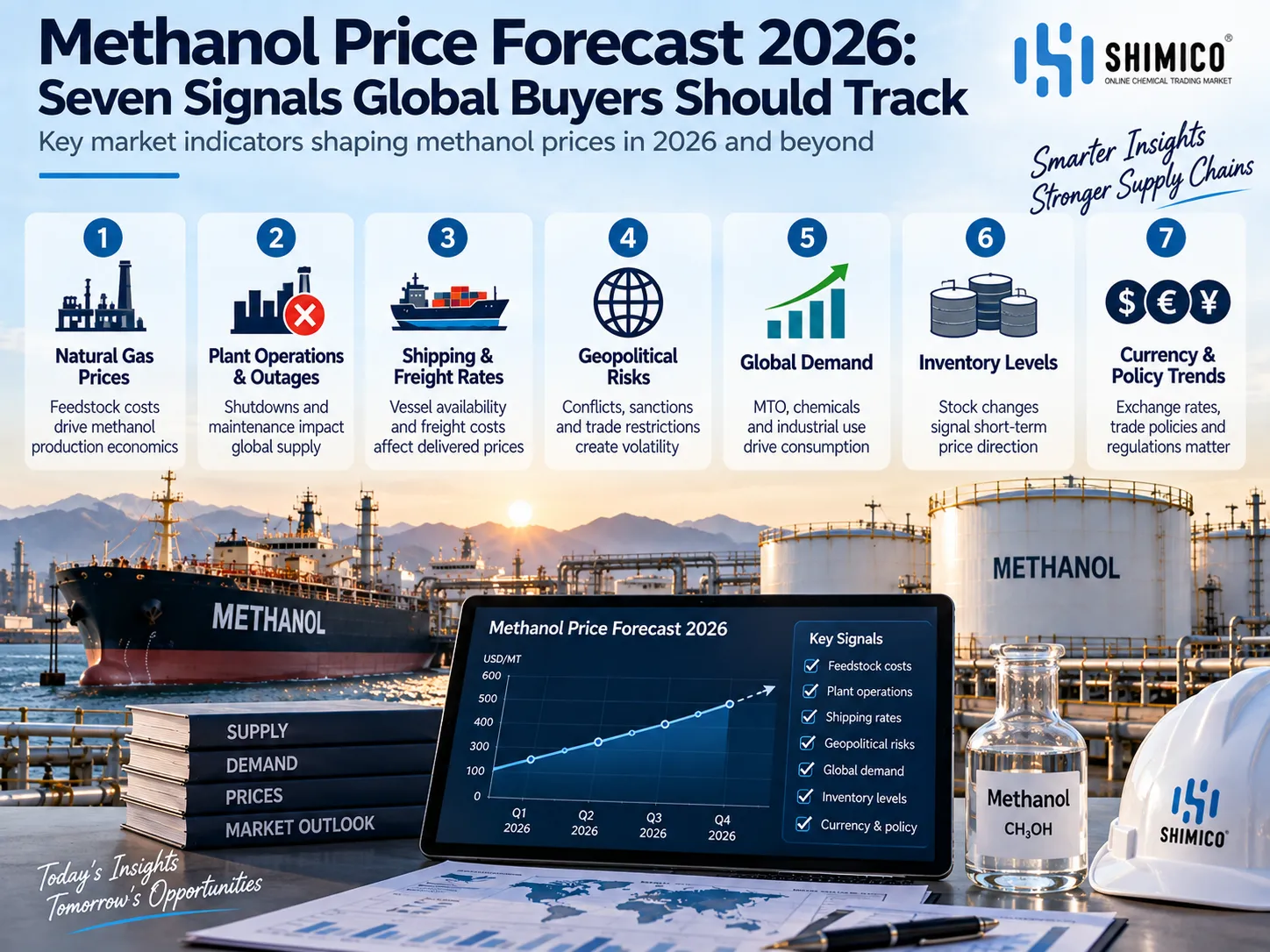
Methanol Price Forecast 2026: Seven Signals Global Buyers Should Track
A sound methanol price forecast starts with signals that can be checked. One target price cannot describe a market split between domestic Chinese production, seaborne imports, Gulf export risk and Atlantic replacement cargoes. Buyers should watch several indicators together and change purchasing coverage when the signals confirm each other.
Methanol Price Signal 1: Gulf Plant and Port Availability
Confirm whether a producer is operating, whether export tanks have space, and whether cargoes are completing loading. Production news alone can mislead when ports or vessels remain restricted.
Methanol Price Signal 2: China Coastal Inventories
China entered the first shock with stocks that traders believed could cover at least eight weeks of demand. Falling coastal inventory combined with higher MTO operating rates would support new import demand. Rebuilding stocks with weak MTO margins would point in the opposite direction.
Methanol Price Signal 3: China MTO and CTO Operating Rates
China is the largest methanol demand center. Energy Aspects estimates that MTO and CTO represent about 45% of Chinese domestic demand. Non-integrated MTO plants buy methanol and are sensitive to the spread between methanol and olefin values. Integrated CTO plants use coal-derived methanol and can follow different economics.
Methanol Price Signal 4: Iranian Cargo Departures
Track completed vessel movements rather than export announcements. A vessel listed for loading may be delayed, reassigned or unable to obtain suitable cover. Delivered tonnes matter more than planned tonnes.
Methanol Price Signal 5: Russia and South America Supply
Energy Aspects reported that increased Chinese domestic production and imports from Russia and South America helped cover demand during the first half of 2026. Buyers should check whether alternative tonnes remain available after freight and whether sellers obtain a better netback in Europe or the Americas.
Methanol Price Signal 6: Freight and Insurance
A stable FOB value can coexist with a rising CFR value. Request separate product, freight and insurance lines when possible. This shows whether the market changed because methanol became more expensive or because delivery became harder.
Methanol Price Signal 7: Posted Contract Prices and Spot Discounts
Methanex postings offer a transparent regional reference, but the paid price may include negotiated discounts, credit terms and logistics. Compare the posting with executed spot business and local tank prices. A high posting with weak spot demand can produce a wide gap.
Procurement note:
When vessel departures, inventories, MTO rates and freight point in different directions, staged purchasing can reduce timing risk. Cover the plant’s minimum operating need first, then leave later volume open for verified improvement.
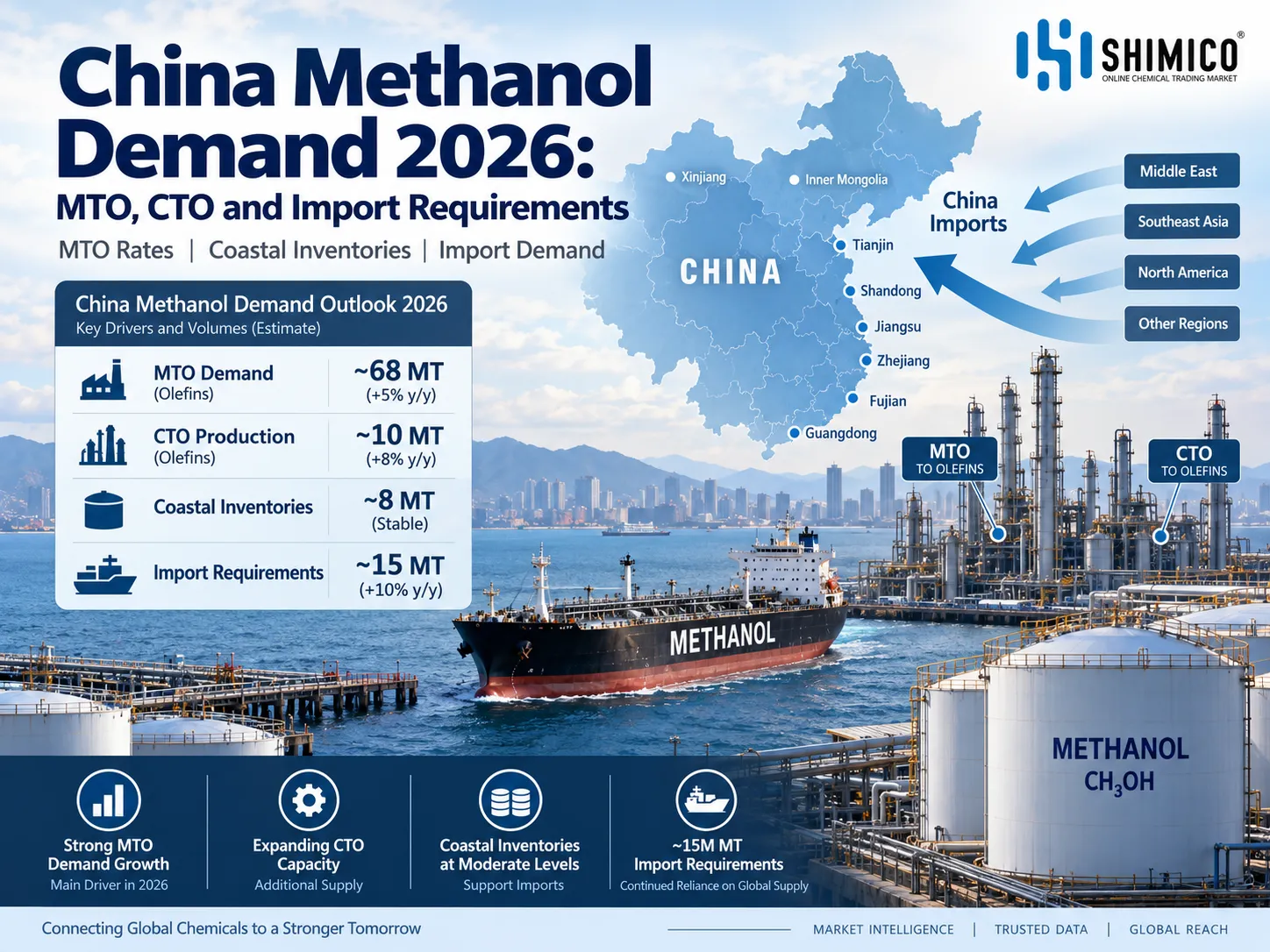
China Methanol Demand 2026: MTO, CTO and Import Requirements
China determines the direction of global methanol trade because it combines large domestic coal-based production with a major import requirement. Energy Aspects estimates Chinese imports near 15 million metric tons and describes MTO as the largest swing factor for trade. A small change in MTO rates can alter import demand by more than the annual consumption of smaller national markets.
The Global Methanol Alliance states that more than 30 MTO plants operate in China and that one metric ton of olefins can require about 2.9 to 3.2 metric tons of methanol. A 600,000-tonne olefin plant may consume 1.7 to 1.9 million tonnes of methanol per year. This conversion ratio explains why MTO economics can change methanol demand quickly.
China Methanol Price Versus Olefin Margin
Non-integrated MTO plants purchase methanol. When methanol rises faster than polyethylene and polypropylene values, their feedstock margin contracts and operating rates can fall. That reduces import demand and may cap CFR China prices. Integrated CTO units have access to coal-derived feedstock, so their operating response may differ.
China Methanol Inventory and Cargo Timing
Inventory should be read in days of demand, not only total tonnes. A large stock figure can provide a short buffer if MTO plants raise rates. Location also matters. Coastal imports cannot always replace inland coal-based supply without storage, transport and price differences.
Methanol Delivered Cost: How Buyers Should Compare FOB, CFR and CIF Offers
A methanol quotation becomes comparable only after every offer is converted to the same destination, shipment month, parcel size and payment basis. FOB covers the seller’s obligations to load under the agreed Incoterm.
CFR includes ocean freight to the named port. CIF adds insurance under the stated cover. None of these terms automatically includes destination storage, discharge delay, bank charges, import tax or inland transport.
The landed-cost calculation should include product value, ocean freight, war-risk premium, marine insurance, inspection, finance cost, discharge, tank rental, terminal losses, customs charges and inland delivery. A cargo that looks $20 per tonne cheaper at FOB can become more expensive after a delayed vessel and ten days of tank or demurrage cost.
Methanol FOB Price Versus Methanol CFR Price
FOB can work well for buyers with chartering access and established marine insurance. It can be risky during conflict because the buyer carries more shipping responsibility. CFR can provide a clearer arrival basis, but the buyer must verify that the seller has a workable vessel plan and has not used an unrealistically low freight assumption.
Methanol Landed Cost Worksheet
The calculation below should be completed for every shortlisted offer. The values must come from the quotation, charter estimate, bank and destination terminal. The table structure also prevents a fixed product price from hiding an open insurance exposure.
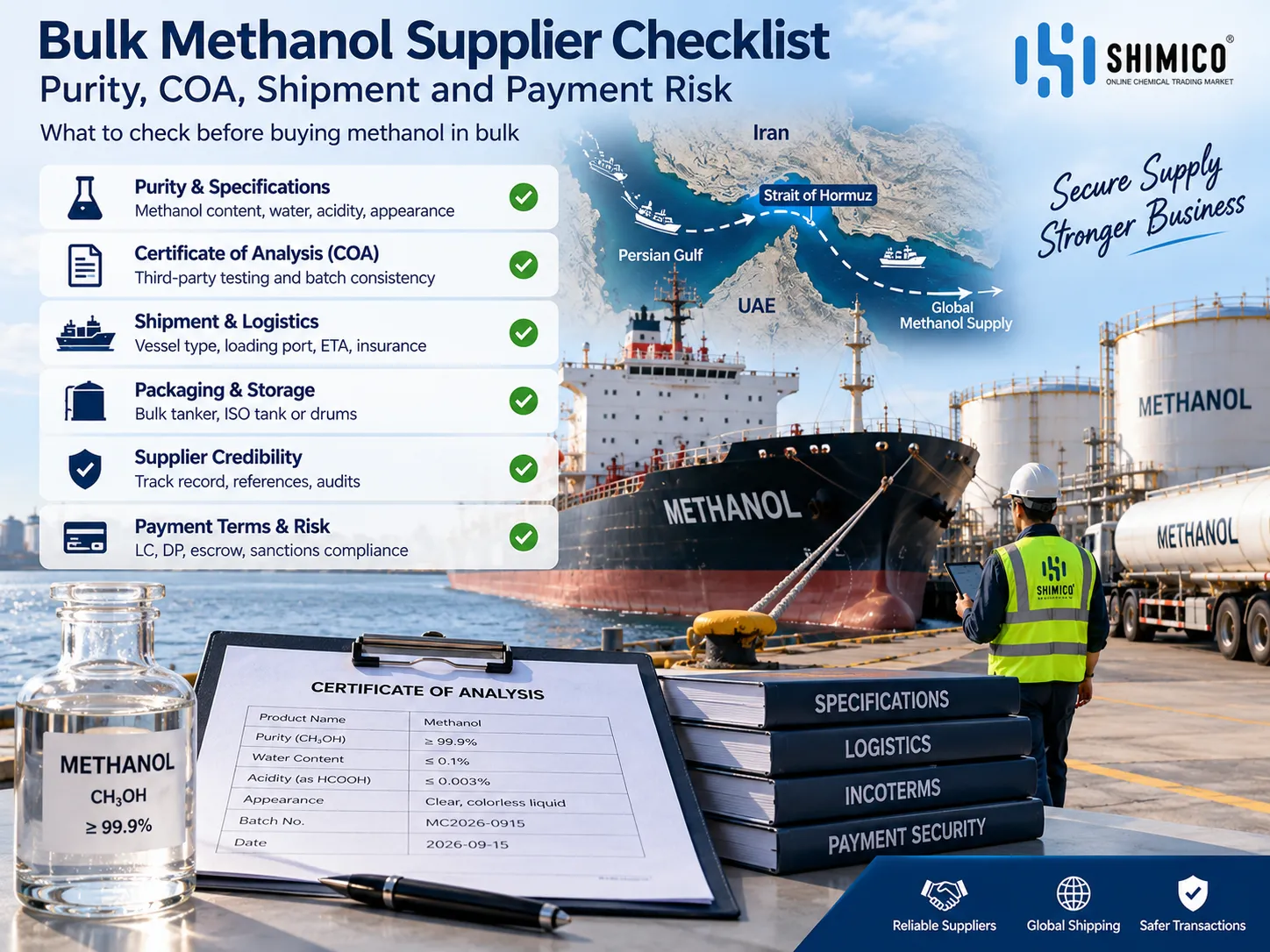
Bulk Methanol Supplier Checklist: Purity, COA, Shipment and Payment Risk
A credible bulk methanol offer must identify the product, physical control of the cargo and a workable delivery plan. A generic product sheet proves only that the company knows a common specification. It does not prove that the offered batch exists, has been allocated or can be loaded within the stated period.
Industrial buyers commonly request methanol near 99.85% purity, but acceptance limits depend on the application. Water, ethanol, acetone, color, acidity, density and distillation range can affect downstream use. Request a recent batch COA and agree on the inspection method before payment.
Bulk Methanol RFQ Information
The buyer should place technical and commercial requirements in one RFQ. This reduces offers that look comparable but cover different purity, shipment size or payment risk.
- Grade and specification: purity, water, acidity, color, density and restricted impurities.
- Quantity: total tonnes, shipment lots and acceptable tolerance.
- Origin: producing plant and export terminal, not only trader location.
- Stock status: produced, stored, allocated, planned or already loaded.
- Shipment: parcel size, laycan, vessel status and expected arrival.
- Commercial basis: FOB, CFR or CIF, currency, validity and payment.
- Documents: COA, SDS, origin certificate, inspection and shipping papers.
- Delay terms: demurrage, route change, insurance adjustment and cancellation rights.
Methanol Supplier Verification Before Payment
Confirm the legal seller, bank account, authority of the representative and relationship to the producer or cargo owner. Request recent shipping evidence with sensitive commercial data removed. Match the loading terminal, vessel type and cargo size with the current offer. Old bills of lading and unrelated certificates do not prove allocation.
Use independent inspection when the contract value or process risk justifies it. The inspection clause should name the point of sampling, test methods, quantity measurement and procedure for off-spec material. Payment milestones should follow verification milestones.
Fraud and performance warning:
An offer far below the relevant regional benchmark requires stronger verification, not faster payment. Confirm cargo control, inspection rights, vessel plan and document sequence before transferring funds.
Methanol Storage and Transport Safety for Bulk Buyers
Price and delivery are not the only purchase criteria. Methanol is toxic and flammable. The Global Methanol Alliance reports a flash point of 11°C and a flammable range in air of 6.7% to 36.5%. Its flame can be pale blue and difficult to see in daylight. Storage and unloading procedures must account for vapor detection, ignition control and emergency response.
Methanol is classified as a Class 3 flammable liquid for international maritime transport. Carbon steel is widely used for suitable tanks, while seals and other materials must be checked for compatibility. Larger installations may use nitrogen blanketing, pressure relief, flame arrestors, vapor detection and secondary containment.
Methanol Delivery Readiness at the Destination Terminal
Before nominating a vessel, confirm available tank capacity, product compatibility, transfer rate, hose or loading-arm requirements, sampling procedure and emergency shutdown tests. A delayed discharge can create demurrage even when the seller loaded on time.
Methanol Buying Strategy 2026: Three Supply and Price Scenarios
The purchasing plan should protect minimum production needs without turning the entire annual requirement into a bet on one forecast. Storage, working capital, voyage time and shutdown cost determine the right coverage. Buyers with low inventory need more prompt protection. Buyers with adequate stock can wait for confirmed route improvement.
Methanol Buying Scenario 1: Hormuz Shipping Improves
Regular departures and lower insurance premiums would reduce the delivery premium. Buyers can shorten quote validity, compare Gulf FOB plus freight with CFR alternatives and avoid paying for emergency coverage after the route has normalized. Stored Gulf methanol may still need time to clear earlier contracts.
Methanol Buying Scenario 2: Supply Improves but Demand Returns
Better shipping can coincide with higher Chinese MTO rates and inventory rebuilding. In this case, prices may stay firm despite more cargoes. Buyers should compare inventory days, MTO economics and import arrivals rather than relying on vessel counts alone.
Methanol Buying Scenario 3: Gulf Production and Shipping Tighten Again
Renewed outages combined with restricted passage would create the strongest upward risk. Sellers may shorten validity and prioritize buyers with workable payment and terminal readiness. In this case, a verified higher-priced cargo can carry less total risk than a low offer without a vessel.
For wider market context, review SHIMICO’s analysis of Strait of Hormuz chemical price risk, the broader report on Iran war effects on fertilizer and chemical markets, and the related sulfur price outlook after the Iran war.
Compare Bulk Methanol Suppliers on SHIMICO
Review methanol listings or publish a free chemical advertisement. Include purity, quantity, origin, destination, Incoterm and delivery window to receive more comparable responses.
Methanol Prices Iran War FAQ for Global Buyers
Why did methanol prices rise after the Iran war?
The war restricted Gulf production and shipping through Hormuz while freight and insurance costs increased. Buyers in India and Southeast Asia competed for fewer prompt cargoes. S&P estimated that 18% of global methanol capacity was affected during the first shock.
Is the global methanol shortage over?
No. Alternative supply, inventories and weaker demand reduced the first price spike, but Middle East exports and supporting infrastructure remain exposed. Availability still differs by destination and delivery month.
Will methanol prices fall in late 2026?
Prices may weaken if Hormuz departures normalize, China maintains comfortable inventory and non-integrated MTO rates stay low. Renewed Gulf outages, stock rebuilding or lower freight availability could reverse the decline.
What is the current methanol price per metric ton?
There is no universal price. Methanex posted $525 per metric ton for China and $550 per metric ton for Asia Pacific for September 2026. These are contract postings, not live spot offers. Request a current quote for the required origin, Incoterm and delivery window.
How does China MTO demand affect methanol prices?
MTO plants consume large volumes of methanol to make ethylene and propylene. When olefin margins support higher operating rates, import demand can rise. When methanol becomes too expensive relative to olefins, non-integrated MTO plants may reduce rates.
What should buyers check before ordering bulk methanol?
Check purity, water and impurity limits, batch COA, origin, stock status, parcel size, vessel status, loading window, Incoterm, payment sequence, inspection rights, SDS and destination tank readiness.
Methanol Prices Iran War Sources and Publication Record
- Global Methanol Prices Soar in Response to Middle East War, S&P Global Energy, 20 March 2026.
- Current Posted Methanol Prices, Methanex, September 2026 postings.
- Methanol and Derivatives Long-Term Supply and Demand: Q3 2026 Update, Energy Aspects, 16 July 2026.
- Methanol-to-Olefins, Global Methanol Alliance, accessed 20 September 2026.
- Methanol Safe Handling, Storage and Transport, Global Methanol Alliance, accessed 20 September 2026.
Last Seen

Users Comment
Sulfur Prices After the Iran War: Is the Shortage Easing or Just Shift
Urea Prices During the Iran War: Is the Shortage Over or Just Shifting
Strait of Hormuz Disruption: Which Chemical Prices Could Rise First?
Aramco loan $2 billion to Petro Rabigh to cover cash shortfall
Moldova exports gas to Ukraine for storage injections