




Sulfur Prices After the Iran War: Is the Shortage Easing or Just Shift
Direct answer: The acute sulfur shortage has eased in some destinations, but the global market has not returned to normal. Middle East export constraints, vessels waiting near the Strait of Hormuz, low inventories and high delivery premiums still expose buyers to sudden price changes.
Weak phosphate demand and returning Russian or Kazakh supply could pull prices lower. The result is a divided market in which physical availability, delivery certainty and destination matter more than one global headline price.
Sulfur prices after the Iran war moved through two conflicting phases. The first phase brought lost Gulf exports, blocked vessels and a sharp increase in sulfur and sulfuric acid costs.
The second brought demand destruction, new trade routes and cautious buying. Prices stopped rising everywhere at once, but they did not become predictable.
For a procurement team, this distinction matters. A lower assessment in one region does not guarantee a lower landed cost at your port. Freight, insurance, vessel availability, stock status and shipment timing can erase the apparent saving.
Buyers now need to separate three questions: Is sulfur physically produced? Can it be loaded? Can the vessel leave and arrive inside the agreed window?
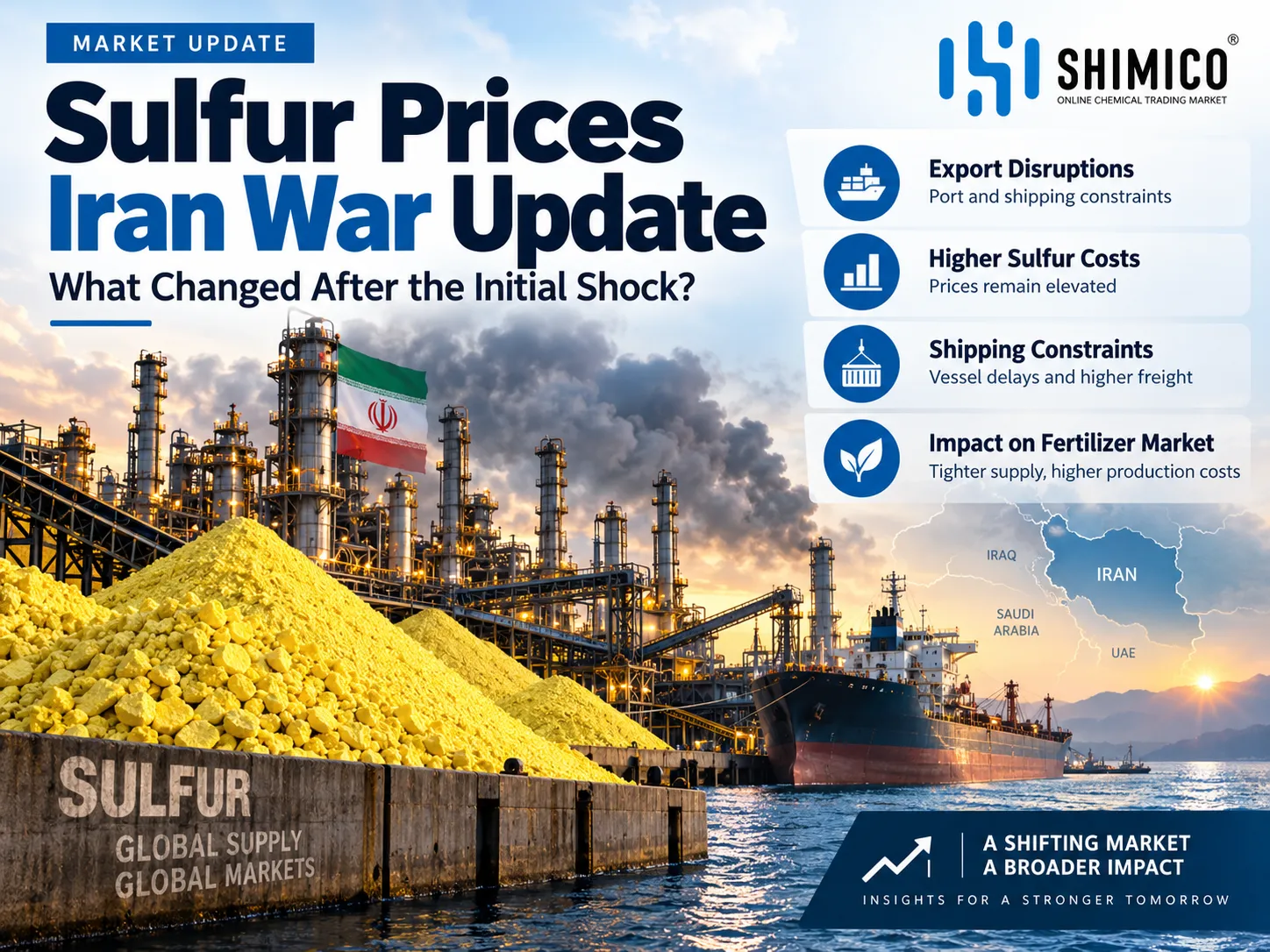
Sulfur Prices Iran War Update: What Changed After the Initial Shock?
The early price shock did not come from one damaged sulfur plant. The conflict affected crude production, refining, gas processing, ports, vessel traffic and insurance at the same time.
This matters because most commercial sulfur is recovered as a by-product of oil refining and natural gas processing. Producers cannot simply open a dedicated sulfur mine and replace lost Gulf cargoes within weeks.
The World Bank reported in May that sulfur prices had doubled from January as the Strait of Hormuz disruption tightened fertilizer feedstock supply. Qatar also suspended sulfur production after damage to energy facilities.
The shock moved into phosphate fertilizers because sulfur is converted into sulfuric acid, which producers use to manufacture phosphoric acid and products such as DAP and MAP.
By September, the market showed signs of partial adjustment. BC Insight reported Middle East values around $865–900 per tonne FOB in late August, while some import markets paid far more for cargoes with dependable delivery.
The same report described weak demand in Brazil and India, lower Chinese port prices and possible returning supply from Kazakhstan and Russia. These forces capped buying appetite even while shipping remained constrained.
The 2026 sulfur market is not a simple shortage story. It is a contest between restricted physical supply and demand that cannot afford the replacement cost. This interpretation follows the latest regional evidence published by BC Insight on 18 September 2026.
Sulfur Price Correction After the 2026 Peak
A price correction can occur before supply fully recovers. Buyers postpone purchases, fertilizer plants lower operating rates and traders avoid taking expensive inventory.
China’s sulfur imports rebounded in July from a record-low June, but remained far below the prior year. Chinese port stocks improved from their summer low, while high costs weakened downstream demand.
This creates an uncomfortable buyer signal. Falling spot prices may reflect better supply, but they may also reflect factories cutting production because sulfur is too expensive.
Procurement teams should check phosphate operating rates, tender participation and completed cargoes before treating a price decline as proof that the supply problem has ended.
Buyer warning:
Do not compare an FOB Gulf indication with a CFR offer delivered to India, China, Morocco or Indonesia. The two prices cover different costs. Confirm Incoterm, loading month, freight, war-risk premium, discharge costs and payment conditions.
Strait of Hormuz Sulfur Supply: Why the Shipping Route Still Matters
The Strait of Hormuz remains central to sulfur trade because Gulf refiners and gas processors recover large volumes of elemental sulfur.
The route carries a major share of internationally traded sulfur toward China, India, Morocco and other consumers. When vessel traffic slows, sulfur can accumulate at producing sites while buyers face shortages at destination ports.
This is the difference between production and export availability. A producer may report normal recovery rates, but the cargo is not commercially useful to an overseas buyer until storage, berth access, vessel nomination and safe passage are confirmed.
In September, industry reporting still referred to hundreds of thousands of tonnes loaded on vessels waiting to transit the strait.
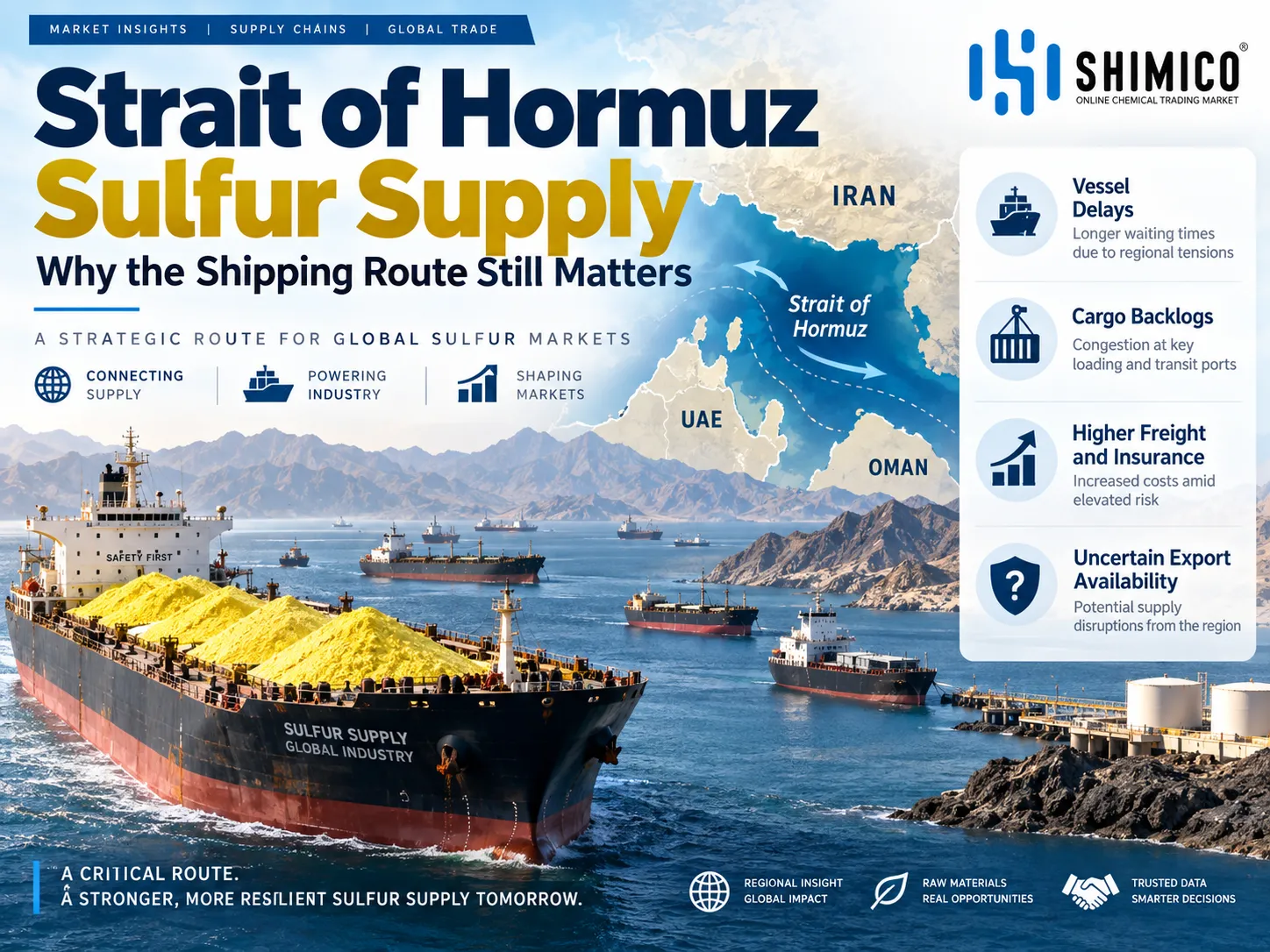
Hormuz Sulfur Shipping Disruption and Vessel Backlogs
A vessel backlog affects more than the delayed cargo. Ships remain occupied, replacement tonnage becomes scarce and owners demand higher compensation for risk and waiting time.
A seller may have sulfur in storage but no suitable vessel within the buyer’s required laycan. Demurrage exposure can also rise when port queues or security checks delay loading.
Ask suppliers whether the offer covers produced stock, future production or material already loaded. Request the named loading port, shipment range, vessel status and latest acceptable arrival date. Broad claims that a port is open provide less protection than a documented loading plan.
Oman Sulfur Supply Outside the Strait of Hormuz
Oman has a geographic advantage because its principal export ports sit outside the Strait of Hormuz. That reduces direct transit exposure. It does not remove regional risk.
Vessel availability, insurance, port congestion and competition from buyers seeking non-Hormuz origins can still raise the delivered cost of Omani sulfur.
Sulfur Price Today by Region: Middle East FOB and Major CFR Markets
There is no single sulfur price today. Physical sulfur trades through regional assessments, producer contract prices and private spot negotiations. Product form, purity, origin, parcel size and delivery month all change the result. The figures below are dated market references, not live offers from SHIMICO.
Late-August and early-September assessments showed Middle East FOB prices below several delivered benchmarks. Indonesia and North America paid premiums for dependable cargoes.
China’s domestic price declined from its June record as weak downstream demand and improved port inventory reduced buying pressure.
Source and date: These indicative references come from the 18 September 2026 BC Insight sulfur price review. Replace every price with a fresh dated assessment before publication or later updates.
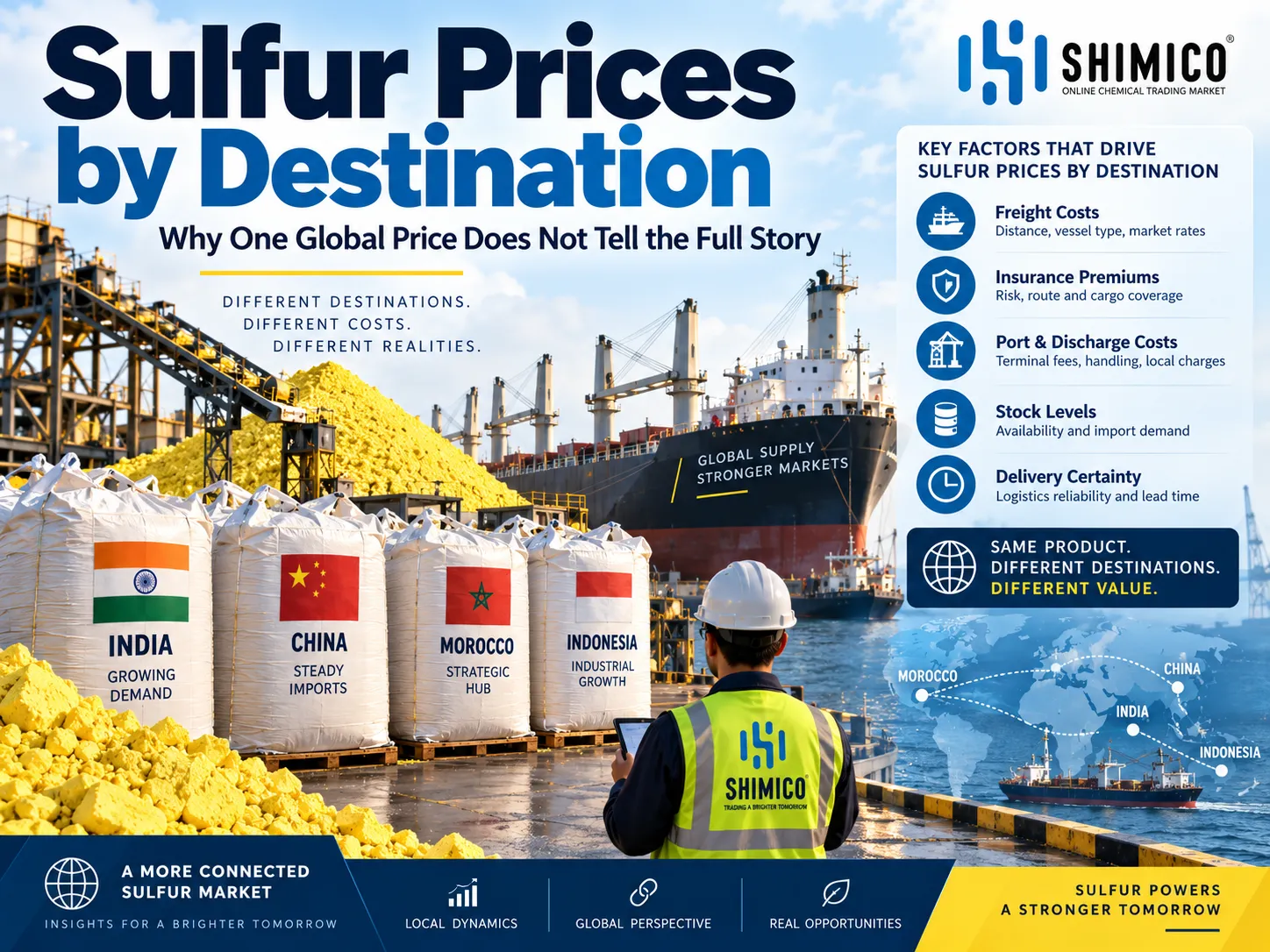
Sulfur Price Forecast 2026: Seven Signals Global Buyers Should Watch
A defensible sulfur price forecast does not begin with a single target. It begins with observable signals. When vessel movement, inventories, producer prices and downstream operating rates point in the same direction, buyers gain a stronger basis for timing purchases. When the signals conflict, staged purchasing may reduce exposure.

Sulfur Price Signal 1: Middle East Vessel Traffic
Track ships entering and leaving sulfur terminals, not total vessel counts across the Gulf. Confirm whether loaded sulfur vessels complete transit. A falling backlog and regular loading schedule would support better prompt availability.
Sulfur Price Signal 2: Producer OSP and Contract Prices
Monthly prices from large Gulf producers provide an early indication of seller confidence. Compare the official price with completed spot business. A high posted price means less when few cargoes trade or buyers cannot secure vessels.
Sulfur Price Signal 3: China Port Inventories and Import Demand
China is a major sulfur importer and phosphate producer. Low port inventories can support prices, but weak fertilizer economics may delay buying. Review inventory direction together with port prices, import volumes and phosphate plant operating rates.
Sulfur Price Signal 4: Morocco and Phosphate Fertilizer Output
Morocco imports sulfur to support large phosphate fertilizer operations. Lower purchases may signal maintenance, weak margins or delayed demand. A return to active spot buying can tighten Atlantic and Gulf cargo availability quickly.
Sulfur Price Signal 5: Russia and Kazakhstan Export Availability
Returning supply from Russia or Kazakhstan can pressure prices, but route and grade matter. Cargoes committed under earlier contracts may not reach the spot market immediately. Buyers should track confirmed loadings and destinations rather than policy headlines alone.
Sulfur Price Signal 6: Refinery and Gas Processing Rates
Sulfur output follows hydrocarbon processing. Refinery outages can reduce recovered sulfur, while new sour-gas projects may add supply. Oil prices alone do not predict sulfur availability. Physical processing rates and sulfur-recovery units matter more.
Sulfur Price Signal 7: Freight, Insurance and Delivery Premiums
A stable FOB price can coexist with a rising CFR price. Request separate product, freight and insurance components when possible. This exposes which part of the landed cost changed and makes competing origins easier to compare.
High Sulfur Prices and Fertilizer Costs: DAP, MAP and Phosphoric Acid
Sulfur matters to agriculture even though elemental sulfur is not the largest component of every fertilizer. Phosphate producers burn sulfur to make sulfuric acid.
The acid reacts with phosphate rock during phosphoric acid and fertilizer production. When sulfur becomes scarce or expensive, the cost moves through this chain.
The World Bank linked higher DAP prices in 2026 partly to sulfur costs and reported that sulfur had doubled from January by April. High feedstock costs later compressed producer margins.
Some fertilizer groups reduced production because selling prices could not fully cover the new sulfur replacement cost.
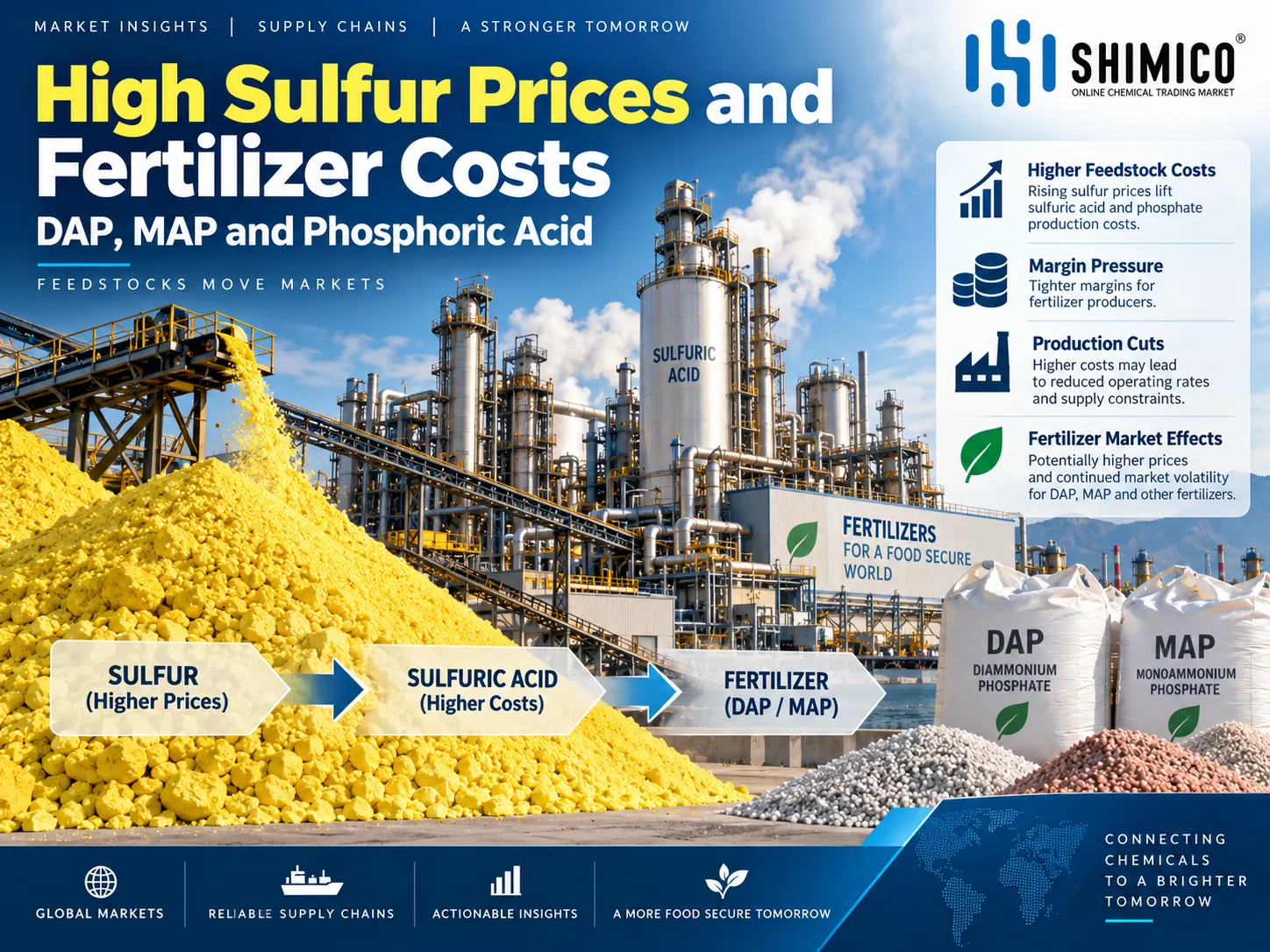
Sulfur Shortage and Phosphate Fertilizer Production Cuts
Production cuts can reduce sulfur demand and stop a price rise, but they carry another risk. Lower DAP and MAP output can tighten fertilizer supply closer to planting seasons. A sulfur price decline caused by closed fertilizer lines does not necessarily mean cheaper phosphate fertilizer for farmers.
This is why buyers should review both markets. Sulfur procurement teams need phosphate operating rates. Fertilizer buyers need sulfur and sulfuric acid availability. The relationship works in both directions.
Sulfuric Acid Prices After the Iran War
Sulfuric acid prices do not always move in lockstep with elemental sulfur. Smelters can produce acid as a by-product, and regional freight conditions differ.
By late August, some sulfuric acid benchmarks had softened even while elemental sulfur remained historically expensive. Buyers must compare local acid availability with the cost of importing sulfur and producing acid on site.
Global Sulfur Shortage 2026: Which Import Markets Face More Risk?
Exposure depends on import reliance, inventory, supplier diversity, port capacity and the economics of the consuming industry. A large buyer may secure cargoes through scale. A smaller buyer may face fewer offers even when global supply appears adequate.
China Sulfur Price and Port Inventory Risk
China’s 2026 imports fell sharply during the disruption. Domestic inventories later improved, but remained low by historical standards. Weak downstream affordability pushed port prices lower from their June record. A restart in phosphate demand could return China to the international market and tighten available cargoes.
Morocco Sulfur Imports and Phosphate Production Risk
Morocco needs large sulfur volumes for its phosphate industry. Its first-half imports declined in 2026, including lower supply from Kazakhstan and the UAE. Diversification toward Saudi Arabia, Turkmenistan, Kuwait and the United States reduced dependence on one route, but longer voyages can increase freight exposure.
India Sulfur CFR Price and Fertilizer Affordability
India remains sensitive to both sulfur import parity and fertilizer subsidy decisions. Buyers may delay cargoes when domestic pricing does not support the import cost. This can create a quiet market without solving the underlying supply restriction.
Indonesia Sulfur Demand for Nickel Processing
Indonesia uses sulfur and sulfuric acid in expanding nickel-processing operations. Cargoes with firm delivery schedules can earn a premium because a missed shipment can affect plant throughput. Industrial buyers may compete with fertilizer producers for reliable parcels.
Granular Sulfur Price vs Lump and Powder Sulfur Price
Price comparisons fail when the product forms or specifications differ. Granular sulfur flows well and suits large bulk handling systems. Lump sulfur may be competitive where crushing or melting equipment is available. Powder sulfur serves applications that need smaller particles but raises dust-control and handling requirements.
Purity, ash, moisture, acidity, particle size and contaminant limits can affect use. A buyer should request a current batch COA rather than relying on a generic product sheet. Confirm whether the quoted weight refers to net product, bagged material or bulk cargo.
Bulk Sulfur Buying Strategy During the Iran War
A useful strategy covers the buyer’s minimum operating requirement before speculating on the next price move. Plants with limited stock should secure near-term tonnes and keep later volume flexible. Buyers with comfortable inventory can compare more origins, but must still test whether low offers have executable shipping plans.
Sulfur Buying Scenario 1: Hormuz Traffic Improves
Regular vessel departures, falling backlogs and more Gulf offers would pressure delivery premiums. Buyers can request shorter price validity and compare FOB plus freight against CFR offers. Do not assume stored sulfur reaches the export market immediately. Producers may need time to clear contracted cargoes.
Sulfur Buying Scenario 2: Supply Improves but Freight Stays High
Product values may weaken while delivered prices remain firm. Separate freight and insurance from the sulfur value. Staged purchases can cover immediate consumption while leaving later tonnes open to better shipping conditions.
Sulfur Buying Scenario 3: Production and Shipping Tighten Again
Renewed outages combined with shipping restrictions would create the strongest upward risk. Sellers may shorten validity and prioritize buyers with workable payment and logistics. Confirm stock, allocation, port and vessel before treating the quotation as supply.
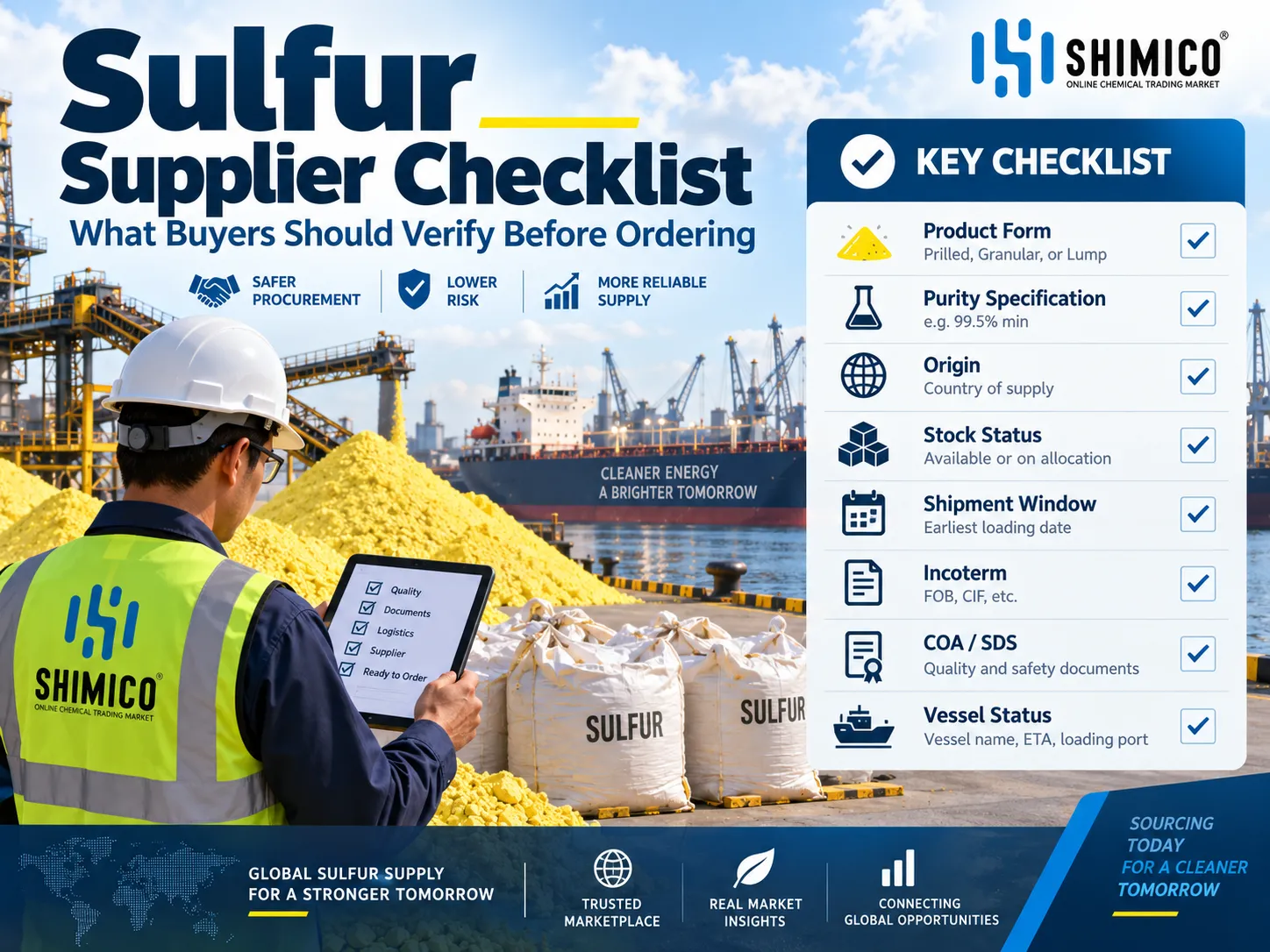
Sulfur Supplier Checklist for Price and Shipment Risk
A complete request for quotation makes supplier offers comparable. State the application because fertilizer, sulfuric acid, mining and rubber users may require different forms or limits. Then request the following commercial and technical information in writing.
- Product form: granular, lump, powder, molten or another agreed form.
- Specification: sulfur purity, moisture, ash, acidity, particle distribution and contaminants.
- Quantity: total tonnes, shipment lots and acceptable tolerance.
- Packaging: bulk, 25 kg, 50 kg or jumbo bags with markings.
- Origin: producing refinery or gas-processing source, not only trader location.
- Stock status: produced, allocated, stored, loaded or planned production.
- Shipment: loading port, laycan, vessel nomination and expected arrival.
- Commercial basis: FOB, CFR or CIF; currency; payment; validity and taxes.
- Documents: COA, TDS, SDS, origin certificate, inspection and shipping papers.
- Delay allocation: demurrage, war-risk premium, route changes and cancellation rights.
For wider context, read SHIMICO’s reports on Strait of Hormuz chemical price risks, Iran war effects on fertilizer and chemical markets, and urea prices after the Iran war supply shock.
Compare Bulk Sulfur Suppliers on SHIMICO
Review sulfur listings or publish a free chemical advertisement. Include grade, purity, form, quantity, origin, destination and delivery window to receive more comparable responses.
Sulfur Delivered Cost During the Iran War: How Buyers Should Compare Offers
A sulfur quotation becomes useful only after the buyer converts it into a comparable delivered cost. An FOB offer covers the material and loading obligations defined by the contract, but the buyer still faces ocean freight, insurance, financing, inspection, discharge, inland transport and possible delay costs.
A CFR offer includes freight to the named port but usually leaves insurance and several destination charges outside the price. CIF adds marine insurance under the agreed terms, yet the policy may not cover every war-related event or loss.
Start with the same shipment month, parcel size and destination. A 5,000-tonne bagged shipment cannot be compared directly with a 30,000-tonne bulk cargo.
Smaller parcels may carry higher unit freight, while a large vessel may need deeper draft, different discharge equipment or longer storage. Confirm whether the terminal accepts the nominated ship and whether the quoted discharge rate matches the port’s actual capability.
Sulfur FOB Price vs Sulfur CFR Price
FOB can provide transparency when the buyer has reliable shipping access. It can also transfer considerable risk during a regional conflict.
If the buyer cannot secure a vessel or insurance, a low FOB price remains theoretical. CFR may provide a clearer delivered benchmark, but the buyer must verify that the seller has included a realistic freight rate and can nominate a vessel.
Request a landed-cost worksheet with separate lines for product, freight, war-risk insurance, inspection, bank charges, port costs and inland delivery.
Add a contingency for demurrage when queues are long. This calculation reveals why a higher-priced non-Gulf cargo can cost less at destination when it offers a shorter voyage or dependable arrival.
Sulfur Price Validity and War-Risk Surcharges
Short validity is common when freight and insurance change quickly. The contract should state whether the seller may pass through a new war-risk surcharge after confirmation.
If the clause permits adjustment, define the evidence, calculation method and maximum exposure. Without a written limit, the buyer may accept a fixed product price but remain exposed to an open logistics cost.
Sulfur Market Outlook for Mining, Metals and Industrial Acid Buyers
Fertilizer demand receives much of the attention, but sulfur also supports copper, nickel, cobalt and other mineral-processing chains. Hydrometallurgical plants use sulfuric acid to leach metals from ore or intermediate products. A plant that lacks acid or sulfur may reduce throughput even when ore, labor and power remain available.
This industrial demand changes the competition for cargoes. Fertilizer plants may cut production when margins turn negative, while a mining operation may keep buying because the lost value of metal output exceeds the sulfur premium.
Indonesia’s nickel-processing projects illustrate this pattern. Buyers there paid more for cargoes with dependable delivery, not simply because broad sulfur demand increased.
Sulfur Demand for Nickel and Copper Processing
Mining buyers should calculate sulfur cost per tonne of finished metal rather than judging the input price alone. The purchasing team also needs to compare imported elemental sulfur with purchased sulfuric acid.
Local acid production requires a sulfur burner, utilities, storage and environmental controls. Imported acid avoids sulfur conversion but can create its own vessel, tank and corrosion-handling constraints.
The correct route depends on plant design and regional supply. A coastal operation with dedicated acid storage may access imported acid efficiently.
An inland plant with an existing sulfur burner may prefer solid sulfur despite higher freight. During disruption, maintaining two approved supply paths can protect production, but each path needs technical qualification before an emergency.
Sulfur Inventory Policy for Continuous Industrial Operations
Inventory targets should reflect voyage time, port reliability, consumption and the cost of a shutdown. A fixed number of storage days can become inadequate when a route that once took three weeks needs six. Recalculate safety stock using the longest credible replenishment period, not the historic average.
Storage also has limits. Solid sulfur requires fire prevention, dust control, drainage and segregation from incompatible materials. Holding more inventory without suitable storage can exchange procurement risk for safety and quality risk. Coordinate purchasing, operations and HSE before increasing the stock target.
Sulfur Spot Price vs Contract Price: Which Purchase Structure Fits 2026?
Spot purchases expose the buyer to the current market but provide flexibility when prices fall or consumption changes. Term contracts can support regular supply and clearer planning, yet formulas, freight adjustments and force-majeure language determine how much price and delivery protection they provide. A contract does not guarantee physical supply if it lacks allocation and shipment detail.
Large consumers often combine structures. A base volume under term agreement covers minimum operating demand. Spot cargoes cover seasonal peaks or take advantage of attractive offers.
The balance depends on storage, forecast accuracy and the cost of missing material. Buyers should avoid committing the entire requirement to one origin while Hormuz and Red Sea routes remain exposed.
Sulfur Contract Formula and Benchmark Selection
A formula should reference a benchmark that matches the origin, form and destination. Define the publication, assessment, averaging window, currency and adjustment.
State what happens when the benchmark is unavailable or no representative trades occur. A vague reference to the market price invites disagreement during volatile periods.
Freight formulas require the same care. A quarterly product price with spot freight can leave most volatility with the buyer. A fixed CFR price may shift more risk to the seller, which can appear as a higher premium. Compare the total expected cost under several freight cases before selecting the contract form.
Sulfur Supplier Verification Before Payment
Price stress attracts offers that cannot be executed. Verify the legal seller, bank account, company registration and authority of the representative.
Request recent shipping evidence with sensitive commercial data removed, then confirm the loading port and producing source. An unrelated certificate or an old bill of lading does not prove ownership of the offered cargo.
Match the COA to the product and batch. Use independent inspection when contract value or application risk justifies it. Payment terms should correspond with verification progress. Buyers should not treat a copied document, warehouse photograph or unusually low quotation as proof of physical allocation.
Fraud and performance warning:
A sulfur offer priced far below the relevant regional benchmark needs stronger verification, not faster payment. Confirm seller identity, product control, inspection rights, vessel plan and document sequence before transferring funds.
Sulfur Prices Iran War FAQ for Global Buyers
Why did sulfur prices rise during the Iran war?
Prices rose because Gulf production and exports faced simultaneous disruption. The Strait of Hormuz restricted cargo movement, while outages affected sulfur recovery. Buyers also paid higher freight and insurance costs. Phosphate fertilizer and industrial acid demand competed for fewer dependable cargoes.
Is the global sulfur shortage over?
No. Supply pressure eased in some markets as demand weakened and alternative origins returned, but Gulf logistics remain constrained. Regional availability and delivery certainty still vary sharply.
Will sulfur prices fall in late 2026?
They may fall if Hormuz traffic improves, Russian and Kazakh exports return and phosphate producers keep operating rates low. Renewed outages, vessel restrictions or stronger Chinese and Moroccan buying could reverse that pressure.
What is the current sulfur price per tonne?
There is no universal price. In late August, BC Insight assessed the Middle East at $865–900/t FOB, while selected delivered and alternative-origin markets traded at higher levels. Buyers need a current quote for the required form, origin, Incoterm and delivery window.
How do sulfur prices affect DAP and MAP fertilizer?
Phosphate producers convert sulfur into sulfuric acid and use it to process phosphate rock. Higher sulfur costs can raise production costs, compress margins and cause output cuts, which may tighten DAP and MAP availability.
What should buyers check before ordering bulk sulfur?
Check form, purity, moisture, ash, acidity, particle size, origin, stock status, packaging, shipment window, vessel status, Incoterm, payment terms, COA, SDS and inspection requirements.
Sulfur Prices Iran War Sources and Publication Record
- Fertilizer Prices Surge as Strait of Hormuz Disruptions Tighten Supplies, World Bank, 14 May 2026.
- Mineral Commodity Summaries 2026: Sulfur, U.S. Geological Survey, 2026.
- Medium-Term Fertilizer Outlook 2026–2030, International Fertilizer Association, 6 May 2026.
- Price Trends: Sulphur, BC Insight / CRU, 18 September 2026.
- High Sulfur Prices Squeeze Fertilizer Margins, S&P Global, 29 May 2026.
- Fertiliser Groups Cut Production as Iran War Squeezes Sulphur Supplies, Financial Times, 2026.
Last Seen


Users Comment
Methanol Prices After the Iran War: Supply, Freight and Buyer Risks
Urea Prices During the Iran War: Is the Shortage Over or Just Shifting
Strait of Hormuz Disruption: Which Chemical Prices Could Rise First?
Iran War Impact on Chemical and Fertilizer Markets: Prices, Supply
Sulfur Concrete for Chemical Industries: Definition, Benefits & Uses
Sulfur for Infrastructure: Asphalt, Coatings & Concrete
The Top 10 Industrial Chemicals Shaping the World in 2026
How Urea Can Hydrate and Exfoliate Your Skin
Sodium carbonate| Soda ash; features and applications
Copper Sulfate; Features and applications
Sulfur; Features and applications
Zinc sulfate; Features and applications