





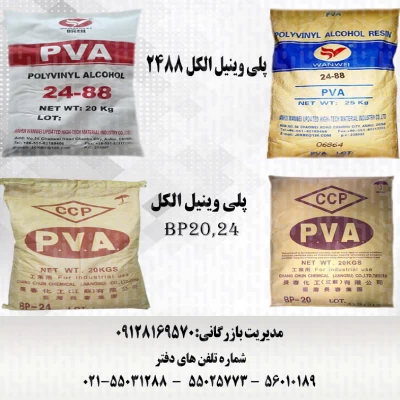
Buy Polyvinyl Alcohol; PVA 2088 and 2488 Price and Wholesale Sales of Industrial Polyvinyl Alcohol
To inquire about the price of polyvinyl alcohol, select the appropriate grade, review the COA, receive a sample, and make tonnage purchases, specify two indicators before the brand name: degree of hydrolysis and solution viscosity.
High-demand grades: 2088, 2488, 1788 and 1799Supply form: white to cream powder or granulesCommon packaging: 20 and 25 kg bagsOrder documents: COA, SDS and TDSSales type: wholesale, tonnage and export
The price of PVA depends on grade code, hydrolysis percentage, viscosity, brand, country of manufacture, packaging, order quantity, market inventory, and delivery location.
What Is Polyvinyl Alcohol? Structure, the Names PVA and PVOH, and the Difference from PVAc
Polyvinyl alcohol, or PVA, which is also written as PVOH in industrial sources, is a synthetic water-soluble, film-forming polymer. Its repeating structure is represented by the unit CH2-CH(OH).
The industry does not produce PVA by direct polymerization of vinyl alcohol because this monomer is unstable. Polyvinyl acetate, or PVAc, is first produced, and then the acetate groups are converted into hydroxyl groups through hydrolysis or alcoholysis.
The degree of conversion of acetate groups determines the degree of hydrolysis. Partially hydrolyzed grades dissolve more easily, while fully hydrolyzed grades provide greater water resistance after drying.

The two main factors determining PVOH performance are molecular weight and degree of hydrolysis.Source: SEKISUI Selvol
Physical and Chemical Properties of Industrial Polyvinyl Alcohol PVA
PVA is not a single material with one fixed specification. It is a family of grades with different molecular weights, degrees of hydrolysis, viscosities, and impurity levels. Most grades are white to cream in appearance and do not have a strong odor.
The abundant hydroxyl groups create strong hydrogen bonding. This structure explains film strength, adhesion to paper and fibers, tensile strength, and the ability to stabilize particles.
Solubility depends on hydrolysis, molecular weight, particle size, and temperature. Partially hydrolyzed grades dissolve at lower temperatures, while fully hydrolyzed grades often require 85 to 95°C.
Technical Specifications Table for Polyvinyl Alcohol 2088, 2488, 1788 and 1799
Grades 2088, 2488, 1788 and 1799 are highly searched in the Iranian market. Their main differences are viscosity class and degree of hydrolysis. The interpretation of each brand's code must be checked against its official data sheet.
This table is for initial screening. A sample of each option should be dissolved using a consistent method, and its viscosity, clarity, insoluble matter, and final performance should be measured.

Difference Between Polyvinyl Alcohol 2088 and 2488
At the same concentration, 2488 produces a more viscous solution. This can increase film strength, but it makes transfer and dissolution more difficult. 2088 is easier to control on lines with limited equipment.
Difference Between Polyvinyl Alcohol 1788 and 1799
1799 is more fully hydrolyzed and provides greater water resistance. 1788 dissolves faster and is selected for adhesion and easier processing.
Technical COA Analysis of Polyvinyl Alcohol; Quality-Control Parameters Before Buying PVA
The COA must relate to the actual product batch. A document without a batch number, test date, manufacturer name, or acceptance range is not sufficient for a tonnage contract.
Degree of hydrolysis, standard solution viscosity, volatile matter, ash, sodium acetate, pH, and particle size are the most important items. Each value must be accompanied by a test method.
Degree of hydrolysis changes solubility and water resistance. Viscosity is a practical indicator of molecular weight. Sodium acetate and ash can also affect color, conductivity, and precipitation in sensitive formulations.

Technical COA Analysis Table for Polyvinyl Alcohol
Each COA parameter should be stated together with its test method and acceptance range. Comparing two sheets without identical conditions can be misleading.
Hardness, pH, temperature, and salts in factory water can change dissolution behavior and viscosity.
Types of Industrial Polyvinyl Alcohol; Comparison of 2088, 2488, 088, 098 and 099 Grades
Classifying PVA only by country name or brand is not sufficient. The main selection criteria are degree of hydrolysis and viscosity class.
Partially hydrolyzed grades typically have about 87 to 89 percent hydrolysis and are widely used in adhesives, textiles, paper, and emulsions. Fully hydrolyzed grades are usually above 98 percent and provide greater water resistance.
Low-viscosity grades are more suitable for high-solids solutions and limited pump capacity. High-viscosity grades produce stronger films, but are more difficult to dissolve and transfer.

Complete Comparison of Polyvinyl Alcohol 088 and 098 Grades for Industrial PVA Purchasing
Professional buyers do not look only at the numbers 2088 or 2488. They first identify the hydrolysis family. Grades in the 088 group are usually partially hydrolyzed and offer easier solubility, better surface behavior, and better compatibility with many adhesives and emulsions. Grades in the 098 or 099 group are closer to fully hydrolyzed and form films with different water resistance and strength. On a production line, this difference can change everything from dissolution time to final product quality.
Polyvinyl Alcohol 088 for Adhesives, Textiles, and Emulsions
In water-based adhesives, textile sizing, and emulsion polymerization, 088 grades are widely used because of their balance between solubility and film formation. The presence of some residual acetate groups reduces interchain bonding and makes it easier for the polymer to open up in water. This advantage allows the factory to prepare a solution with ordinary equipment and at a lower temperature. In contrast, the final film's water resistance may be lower than that of fully hydrolyzed grades.
PVA 088-05 and 088-08 for Low-Viscosity Solutions
Low-viscosity grades are suitable for thin coatings, sprays, emulsions, and systems where pumpability and penetration are more important than creating high body. If your line has a narrow nozzle or high coating speed, a low-viscosity grade can prevent pressure increases and clogging. Selecting only by price may lead the factory toward a high-viscosity grade and increase water consumption or curing time.
PVA 088-20 and 088-50 for Higher Body and Stronger Film
As viscosity increases, film strength and solution body increase. This is beneficial in high-solids adhesives, paper coatings, and some mortars. However, the tank, mixer, pump, and filter must be capable of moving the viscous solution. Grade 088-50 cannot replace 088-20 without redesigning the solids percentage.
Polyvinyl Alcohol 098 and 099 for Water Resistance and Specialty Film
Fully hydrolyzed grades are considered for applications where film water resistance, adhesion to polar surfaces, or barrier properties are more important. These products usually require more heat and time to dissolve. Using them in a factory with a small tank or poor temperature control can lead to gel particles, reduced clarity, and batch instability.
PVA 098-05 and 098-20 in Coatings and Film
Low-viscosity 098 grades are more suitable for thin coatings and controlled films, while 098-20 can provide greater strength and body. In both cases, dissolution temperature, cooling rate, and ambient humidity affect the properties of the dried film. Final testing should be carried out under actual use conditions.
This table is only a selection map. A manufacturer may specify different ranges for the same code. The buyer should compare the TDS of that specific brand with the factory's criteria and test the substitute grade in solution, pilot production, and the final product.
Polyvinyl Alcohol Production Method; From Vinyl Acetate and PVAc to Powdered PVA
Production begins with vinyl acetate monomer. The monomer is polymerized to produce PVAc. PVAc is then hydrolyzed or alcoholyzed in an alcoholic medium with a catalyst.
Time, temperature, and material ratios create the target degree of hydrolysis. The polymer is washed, dried, milled or granulated, and packaged.
Viscosity, hydrolysis, sodium acetate, ash, volatile matter, particle size, and color are checked during batch control. Consistency between batches is very important for industrial users.

Polyvinyl Alcohol Manufacturers and Suppliers in Iran
The Iranian market supplies a large share of its PVA demand through imports. Manufacturer, importer, distributor, and seller have different roles and should not be described interchangeably.
Persian packaging or a domestic brand does not mean the polymer was produced in Iran. The actual manufacturer's name on the COA, country of origin, batch number, and consistency of the documents with the bag must be checked.
Wanwei, Shuangxin, CCP, Kuraray Poval, Sekisui Selvol, Mowiol, and Elvanol are well-known names in the global market or on sales pages. Their availability in Iran is not constant.
Comparison of Polyvinyl Alcohol Brands; Wanwei, Shuangxin, CCP, Kuraray, and Selvol
Brand comparison is valid only between grades at the same technical level. First align hydrolysis, viscosity, moisture, ash, and sodium acetate. Then compare batch consistency, dissolution, packaging, documentation, and delivered price.

This list does not mean stock or representation in Iran is confirmed. Authenticity, batch number, and documents must be checked at the time of ordering.
In a market where a large share of the product is imported, Persian packaging or a domestic trade brand does not mean the polymer was produced in Iran.
Industrial Applications of Polyvinyl Alcohol in Adhesives, Textiles, Paper, Construction, Film, and Medicine
PVA forms viscous solutions, forms films, adheres to polar surfaces, and stabilizes particles or droplets. These properties have made its application range broad.
In paper and carton adhesives, PVA acts as a binder and film-strengthening agent. In textiles, PVA sizing increases yarn abrasion resistance. In paper, it is used for surface sizing, coating, and oil resistance.
In mortar, plaster, and putty, it changes adhesion and cohesion. In water-soluble films and detergent pods, a specialty grade must balance dry strength with controlled solubility.
In medicine and pharmaceuticals, only approved grades with regulatory documentation are permitted. General industrial grades should not be recommended for these applications.
PVA is used in paper, textiles, and printing, and some grades are also found in ophthalmic solutions.Source: PubChem
Polyvinyl Alcohol Formulation in Adhesives
In an adhesive formulation, PVA is not merely a thickener. The polymer affects surface wetting, open time, drying rate, bond strength, film flexibility, and water resistance. A high-viscosity grade may increase dry bond strength, but if it limits adhesive penetration into paper or wood, the final result can be worse. Selection should begin with the substrate and application method.

Polyvinyl Alcohol in Paper and Carton Adhesives
Paper is a porous, cellulosic surface. The hydroxyl groups of PVA bond with the fibers and form a continuous film. For high-speed machines, viscosity must be low enough for the adhesive to pass through a nozzle or roll and spread across the surface. Grade 2088 is often a suitable starting point, but solids percentage and starch content are decisive.
Combining PVA with Starch in Paper Adhesives
Starch reduces cost and provides initial tack. PVA increases film strength and stability. The ratio between the two must be coordinated with viscosity, starch gelatinization temperature, and dryer speed. Adding PVA to cooked starch without temperature control can create lumps or local gel formation.
Polyvinyl Alcohol in Wood and Lamination Adhesives
In wood adhesives, PVA can act as a co-binder or rheology modifier, but it should not be confused with PVAc emulsion. The water resistance of wood adhesive depends on the complete resin system, crosslinking, filler, and pressing conditions. Using a 99 percent grade alone does not make the adhesive waterproof.
Borax and Polyvinyl Alcohol Crosslinking
Borax forms a temporary network with PVA hydroxyl groups and can suddenly increase viscosity. This reaction is useful in gels and some adhesives, but excessive dosage can make the solution unpumpable. Addition sequence and pH should be determined in a small-scale test.
Antifoam, Preservative, and Plasticizer in PVA Formulations
Intense mixing and surface-active materials generate foam. The antifoam must be compatible with adhesion and printability. Aqueous PVA solution can become contaminated during long storage, so the preservative must be selected according to the regulations of the final product. Glycerol or a similar plasticizer softens the film, but it also increases moisture absorption.
Application of Polyvinyl Alcohol in Textiles; Yarn Sizing, Desizing, and PVA Grade Selection
In textiles, the purpose of sizing is to reduce yarn abrasion and breakage as it passes rapidly through the weaving machine. PVA forms a continuous film on the yarn, controls fuzz, and increases abrasion resistance. However, this same film must be removed from the fabric during the desizing stage after weaving. Grade selection must consider both stages at the same time.

PVA 1788 and 2088 in Yarn Sizing
Partially hydrolyzed grades are common in sizing formulations because of their solubility and washability. Medium viscosity allows the solution to spread over the yarn without making the sizing bath excessively thick. Blending with starch, acrylate, or lubricant affects the final film.
PVA 2488 for Yarns Requiring a Stronger Film
For yarns exposed to greater tension and abrasion, a high-viscosity grade may form a stronger film. In return, solution penetration and desizing become more difficult. The factory should evaluate yarn breakage, dryer energy use, sizing add-on, and washing cost together.
Control of PVA Sizing-Bath Temperature
Low temperature can raise viscosity and make size distribution uneven. Excessive temperature increases water evaporation, changes solids percentage, and promotes skin formation on the surface. Temperature, viscosity, and solids percentage should be recorded during each shift.
Removing PVA Size from Fabric
Partially hydrolyzed grades wash out more easily with hot water. Fully hydrolyzed or crosslinked films require more time, heat, and detergent. Selecting a grade only for the weaving stage can increase finishing costs.
Application of Polyvinyl Alcohol in Paper and Board; Surface Coating and Oil Resistance
PVA is used in paper as a coating binder, surface-sizing agent, and strength enhancer. Its film covers surface pores and increases the bond between fibers and pigment. In packaging for fatty foods, oil and grease resistance can improve. Water-vapor resistance remains limited, and a combined coating is needed for a multi-barrier system.

PVA in Paper Surface Sizing
In a size press, PVA solution is applied to the paper surface. Viscosity must match machine speed, roll pressure, and solution temperature. A grade that is too viscous can reduce penetration and increase consumption. A grade that is too fluid may fail to form enough film.
PVA in Pigmented Paper Coatings
PVA binds pigments to the surface and increases dry strength and surface-pick resistance. The ratio of PVA to latex and starch affects rheology and cost. Ash or undissolved particles can create spots and streaks on the coating.
Oil Resistance of PVA Film on Paper
PVA film provides a good barrier against oil and many organic materials. High humidity can reduce this performance. Testing should be carried out at humidity and temperature close to the actual packaging-use conditions.
Application of Polyvinyl Alcohol in Dry Mortar, Plaster, Putty, and Tile Adhesive
In construction formulations, PVA can alter adhesion to the substrate, powder cohesion, and water retention. It works in one system with cellulose ether, starch ether, cement, gypsum, and polymer powders. The dosage is low, and uncontrolled increases can adversely change water demand, surface adhesion, or drying time.

PVA in Cement Mortar and Plaster
In cement mortar, the alkaline environment, salts, and mineral particles affect PVA dissolution. Grade and particle size must match the dry-mixing process and contact time with water. In plaster, setting time and flow are more sensitive, and a compatibility test is required.
Difference Between PVA and RDP in Construction Products
RDP redisperses after contact with water and forms a hydrophobic or flexible polymer film during drying. PVA is a water-soluble polymer, and its role is more related to adhesion, rheology, and binding. The two are not direct substitutes and may be present together in a formulation.
Pilot Tests for PVA in Mortar
Measure working time, flow, tensile adhesion, flexural strength, water absorption, cracking, and drying time. The result of one formulation with one factory's cement may not repeat with another cement because alkalinity and specific surface area differ.
If a cheaper grade requires a higher dosage to reach the target strength or increases mixing time, its real cost is higher. Compare cost per ton of final product together with test results.
Water-Soluble Polyvinyl Alcohol Film; Resin Selection for Detergent Pods and Packaging
A water-soluble film is not made from only one resin and one extruder. Degree of hydrolysis, molecular weight, plasticizer, moisture, thickness, process temperature, and the composition of the packaged material all affect dissolution behavior. A detergent-pod film must remain strong in storage, not fail quickly when touched with damp hands, and dissolve at the right time during the wash cycle.

Selecting PVA for Cold-Water-Soluble Film
Grades with lower hydrolysis generally dissolve more easily in cold water. This advantage must be balanced against mechanical strength, edge adhesion, and humidity stability. A highly soluble film may soften or stick together in a humid warehouse.
Selecting PVA for Hot-Water-Soluble Film
Higher-hydrolysis grades are suitable for packages that must remain stable in cold water and open at higher temperatures. Thickness and plasticizer also change dissolution temperature. Do not select the resin without testing it with the packaged material.
Effect of Glycerol on PVA Film
Glycerol increases film flexibility and reduces brittleness. Excessive amounts increase moisture absorption, surface tack, and loss of strength. The plasticizer ratio must be adjusted to film thickness and warehouse humidity.
Compatibility of PVA Film with Detergents and Chemicals
Salt, surfactant, solvent, enzyme, and pH can weaken the film during storage. Stability testing should be performed on the final package under elevated temperature, humidity, and transport-cycle conditions. Evaluation with pure water alone is not sufficient.
Polyvinyl Alcohol in Medicine, Pharmaceuticals, and Cosmetic Products
PVA is used in some eye drops, coatings, hydrogels, dressings, and cosmetic products. These applications require pharmaceutical- or cosmetic-grade material with impurity control, biocompatibility, and regulatory documentation. Industrial adhesive or textile grades must not be used in medical applications merely because they have the same chemical name.

Polyvinyl Alcohol in Eye Drops and Artificial Tears
PVA can increase viscosity and the residence time of the moist layer on the eye surface. Concentration, molecular weight, sterility, and compatibility with preservatives are controlled in pharmaceutical products. Raw-material purchasing must be aligned with the pharmacopoeia or the manufacturer's dossier.
Polyvinyl Alcohol in Hydrogels and Dressings
PVA chains can form hydrogel networks through freeze-thaw cycles or chemical crosslinking. Water content, strength, transparency, and permeability can be adjusted. Residual reactants and the sterilization method must be evaluated.
PVA in Peel-Off Masks and Cosmetic Products
Rapid film formation has led to the use of PVA in peel-off masks and hair products. Excessive amounts can create a dry, tight film. Cosmetic grade must be documented for impurities, odor, color, and skin compatibility.
How to Use and Dissolve Polyvinyl Alcohol; Preventing Lumps, Foam, and PVA Gelation
Lumps are most often caused by an incorrect dissolution method. Rapidly adding powder to hot water gels the particle surface while leaving a dry core.
The powder is slowly dispersed in cold or lukewarm water under agitation. The temperature is then gradually raised to the range recommended by the manufacturer. After the solution becomes clear, it is cooled with gentle stirring and filtered if necessary.
The stock-solution concentration must be compatible with the mixer and pump capacity. Increasing concentration can raise viscosity nonlinearly and disrupt transfer.

Troubleshooting Polyvinyl Alcohol Solution; Lumps, Foam, Gel, and Viscosity Loss
Lumps result from uneven wetting of particles. Foam is caused by air entrainment, excessive mixer speed, or surface-active materials. Gel can result from high concentration, cooling, borate, ionic contamination, or unintended crosslinking. Viscosity loss may also result from measurement temperature, dilution, thermal degradation, contamination, or batch differences.
Cause of Cloudiness in PVA Solution
Cloudiness can be related to incomplete dissolution, hard water, insoluble matter, insufficient temperature, or additive incompatibility. First, prepare a pure PVA solution using specified water. Then add each additive step by step to identify the point at which cloudiness develops.
Foam Control in PVA Solution
Before adding antifoam, correct the impeller type, immersion depth, speed, return path, and air entrainment. An unsuitable antifoam can cause film-surface defects, fisheyes, or loss of adhesion. Antifoam selection must be tested in the final formulation.
Storage of Prepared PVA Solution
An aqueous solution is a suitable environment for microbial contamination. A closed tank, cleaning, storage temperature, residence time, and an appropriate preservative must be defined. A solution with odor, gas formation, color change, or viscosity loss should not be used without investigation.
Polyvinyl Alcohol Safety and SDS Requirements in the Warehouse and Production Line
Many PVA grades have low acute toxicity, but dust can irritate the eyes and respiratory system. Hot solution can cause burns, and wet floors create a slip hazard.
For manual charging, use goggles, a dust mask, and gloves. Local exhaust ventilation, controlled dry cleaning, and access to the SDS for the same grade are required.
The terms food-grade or medical-grade should be used only with valid approval and documentation. The use of PVA in some pharmaceutical applications does not mean that every industrial grade is permitted.

Packaging and Storage Method for Powdered Polyvinyl Alcohol PVA
PVA is commonly supplied in 20 or 25 kg multilayer bags with a moisture-resistant inner layer. Product name, grade code, net weight, batch number, production date, and manufacturer should appear on the package.
The warehouse should be dry, cool, covered, and ventilated. Bags should be placed on pallets and kept away from damp floors or walls.
The truck floor should be clean and dry. At delivery, check bag count, weight, package integrity, batch number, labels, and documents.
Export and Import of Polyvinyl Alcohol; Documents, Loading, and PVA Shipment Control
Imported purchases require review of the manufacturer, country of origin, COA, SDS, packing list, certificate of origin, and transport conditions.
For re-export, packaging must resist moisture. Pallets, shrink wrap, a dry container, English labels, and consistent documents are important.
Take samples from several bags and several points in the load. A seller's pre-shipment sample does not necessarily represent the final shipment.
Incoming Inspection and Identification of Genuine Polyvinyl Alcohol Before Bulk Purchase
A white appearance, brand name, and clean bag printing are not sufficient to confirm quality. Incoming inspection must begin with proper sampling. If the shipment contains several batch numbers, each batch should be sampled separately. A sample from one bag among hundreds does not represent the entire shipment. Primary samples should be taken from the top, middle, and bottom of pallets and, after mixing, divided into test, retention, and dispute samples.

Appearance and Particle-Distribution Test for Polyvinyl Alcohol
The powder should be uniform and free from dark spots, foreign fibers, abnormal odor, or hard lumps. Differences in particle size can change wetting speed. Very fine powder produces more dust and foam. Coarse particles dissolve more slowly. Recording photographs and sample weight helps trace batch differences.
PVA Solution Viscosity Test
To compare against the COA, concentration, water type, dissolution temperature, cooking time, measurement temperature, and viscometer type must be kept constant. A small temperature change can shift the viscosity reading. The laboratory should have a written internal method and test an approved reference sample alongside the new shipment.
Effect of Solution Concentration on PVA Viscosity
Viscosity does not increase in a simple linear way as solids percentage rises. Closer polymer chains, entanglement, and hydrogen bonding can produce a much steeper increase. A grade that is fluid at four percent may become too viscous for the factory pump at ten percent.
Effect of Temperature on Polyvinyl Alcohol Solution Viscosity
A warm solution appears thinner and becomes more viscous as it cools. If the operator measures viscosity immediately after cooking, the result is not comparable with a product cooled overnight. The standard test temperature must be recorded on the form.
Measurement of Degree of Hydrolysis, Moisture, and Ash
Degree of hydrolysis is used to confirm the grade family. Moisture is measured by controlled drying and shows how much of the bag weight is not active material. Ash is measured by controlled incineration and shows the remaining inorganic fraction. For sensitive products, sodium acetate and residual methanol are also defined in the contract.
PVA Solubility and Filterability Test
An approved solution should be clear or uniform after the specified cooking program and should not leave significant gel on the screen. Record the weight of remaining particles, filter-passage time, and pressure drop. This test often reveals differences not shown on a general COA.
Touching, tasting, burning, or dissolving the powder without PPE is neither safe nor proof of purity. Testing must be performed using a written method and a reference sample.
Industrial Polyvinyl Alcohol Purchasing Guide; Grade Selection, Sample Testing, and Tonnage Contract
The purchasing process is carried out in four stages: defining specifications, receiving sample and documents, testing and pilot evaluation, and contracting with acceptance limits.
In sample testing, record dispersion time, dissolution temperature, clarity, insoluble matter, viscosity, and final performance. Do not approve the result by visual inspection alone.
In the contract, specify the test method, reference sample, complaint period, transport responsibility, and the method for replacing nonconforming product.
Common Mistakes in Buying Polyvinyl Alcohol and How to Prevent Production Loss
Losses in PVA purchasing usually do not come from one major mistake. Several small decisions combine to create problems: ordering by a generic name, ignoring the test method, accepting a nonrepresentative sample, comparing prices without freight, and changing brands without a pilot. Each can cause a failed batch, line shutdown, or product return.
Buying PVA Based Only on Price per Kilogram
Price per kilogram is incomplete without dosage, dissolution time, and line efficiency. If a cheaper product requires fifteen percent more dosage or two additional hours of cooking, its final cost is higher. Cost should be calculated per unit of acceptable product.
Replacing a PVA Brand Without Technical Approval
The number 2088 on two bags does not guarantee identical behavior. Molecular-weight distribution, particle size, sodium acetate, and moisture may differ. A laboratory sample and one pilot batch should be tested before completely changing suppliers.
Storing PVA Solution for a Long Time
Aqueous solution in an open tank can become contaminated, foamy, or gelled. Stock-solution production should be aligned with daily consumption. The tank, piping, and filter should have a cleaning schedule. Do not add a preservative without checking the regulations for the final product.
Recording Data for Every PVA Batch
For each batch, record bag number, COA, dissolution method, cooking time, viscosity, amount of gel on the filter, and final-product result. During negotiation with the supplier, these data are more useful than any verbal claim.
Real Cost and Wholesale Sales Contract for Polyvinyl Alcohol PVA
Price per kilogram is only the first line of cost. Heating energy, mixer time, water consumption, production loss, filtration, waste, actual dosage, warehousing, and transport also cost money. A higher-priced grade may dissolve faster or achieve the result at a lower dosage. A cheaper grade may contain more insoluble matter and stop the filter.
Formula for Comparing the Real Cost of PVA
For each option, record material purchase cost, freight, dissolution energy, equipment time, dosage per ton of product, waste, and downtime. Then calculate cost per unit of acceptable product. This figure provides a better basis for purchasing negotiations.
One offer may include tax, pallets, and freight, while another shows only the seller's ex-warehouse price. Delivery basis, price validity, payment terms, and net weight should be standardized in the comparison table.
Checklist for a Wholesale Polyvinyl Alcohol Sales Contract
A wholesale contract should record the exact product name, manufacturer, grade code, country of origin, net weight, packaging, batch number, technical limits, test method, documents, delivery schedule, payment terms, and how nonconformity will be handled. The phrase “first-grade PVA” is not a contractual criterion.
Technical Acceptance Limits in the PVA Contract
Minimum and maximum hydrolysis, viscosity, moisture, ash, and sodium acetate should be stated. The test method or reference to the manufacturer's standard should also be recorded. If only a target value is written, normal test variation can create a dispute.
Control of Batch Changes and Manufacturer Changes
The seller should not replace the brand, plant, or equivalent grade without informing the buyer. For sensitive applications, a major batch change should also preferably be preceded by sending the COA and a sample.
Today's Polyvinyl Alcohol Price; Factors Affecting PVA 2088 and 2488 Prices
The current PVA price is affected by the exchange rate, vinyl acetate, energy, freight, origin, brand, grade, inventory, and order volume.
The prices of 2088 and 2488 should not be compared only by bag weight. Dosage, dry matter, dissolution time, energy, and process stability affect the real cost.
A price list without a date, brand, grade, weight, and delivery terms is not sufficient for decision-making. Validity period and freight, tax, pallet, and unloading costs must be clear.
Why Buy Polyvinyl Alcohol Through SHIMICO?
SHIMICO is a B2B platform that connects buyers and sellers of chemicals. Buyers can register their technical requirements and compare offers from multiple suppliers in terms of grade, price, documents, and delivery time.
- Register a Purchase Request with Grade Code and Quantity
- Receive Offers from Multiple Suppliers
- Request COA, SDS, and Sample
- Compare Price and Delivery Terms
- Post a Free Buying or Selling Listing
Inquiry for Industrial Polyvinyl Alcohol Purchase and Price
Enter the grade code, quantity, application, packaging, delivery city, and required documents.
View ChemicalsPost a Free ListingFrequently Asked Questions About Buying, Pricing, and Using Polyvinyl Alcohol PVA
What Is Polyvinyl Alcohol?
PVA or PVOH is a synthetic, water-soluble, film-forming polymer produced by hydrolysis of polyvinyl acetate.
What Is the Difference Between Polyvinyl Acetate and Polyvinyl Alcohol?
PVAc is the emulsion polymer used in white glue, while PVA is a water-soluble polymer with abundant hydroxyl groups.
What Is Polyvinyl Alcohol 2088?
2088 is usually a partially hydrolyzed grade with medium viscosity. The exact value should be checked in the TDS and COA.
What Is Polyvinyl Alcohol 2488?
2488 is usually a partially hydrolyzed grade with higher viscosity than 2088.
Is PVA 2088 Better Than 2488?
2088 offers easier processing, while 2488 produces a more viscous solution and stronger film. Selection should be based on testing.
How Does PVA Dissolve in Water?
Solubility depends on hydrolysis, molecular weight, particle size, and temperature.
How Can PVA Be Dissolved Without Lumps?
Disperse the powder slowly in cold or lukewarm water and then gradually raise the temperature.
What Items Are Important in a Polyvinyl Alcohol COA?
Check hydrolysis, viscosity, moisture, ash, sodium acetate, pH, and batch number.
What Is Liquid Polyvinyl Alcohol?
It is usually a ready-made aqueous PVA solution. The pure product is more commonly supplied as powder or granules.
Is PVA Toxic?
Many grades have low acute toxicity, but dust and hot solution require safety controls.
Is Every PVA Suitable for Medical Use?
No. Medical use requires an approved grade and regulatory documentation.
What Are the Storage Conditions for PVA?
Store it in a dry, cool warehouse, on pallets, and away from moisture.
How Is the Price of PVA Determined?
Grade, brand, origin, hydrolysis, viscosity, quantity, packaging, currency, and freight affect the price.
What Test Should Be Performed Before Bulk Purchase?
Evaluate dissolution, clarity, insoluble matter, viscosity, and final performance in a pilot test.
Where Can Polyvinyl Alcohol Be Purchased?
From an importer, distributor, or B2B marketplace after checking the COA and an actual shipment sample.