






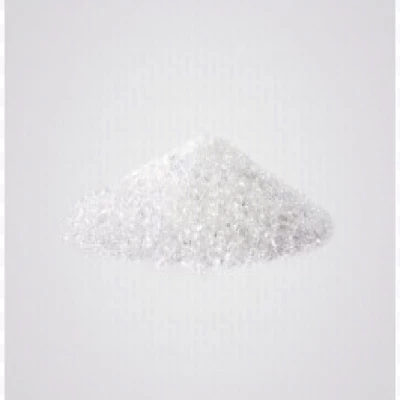
Buy Sodium Sulfate | Price and Wholesale Sales of Industrial Sodium Sulfate
This landing page is written for purchasing managers at detergent, glass, textile, and paper factories, sodium sulfide producers, trading units, and export buyers.
In bulk sodium sulfate purchases, the price per ton is only one of the variables. Na2SO4 purity, iron, chloride, moisture, insoluble matter, particle size, packaging, loading location, and batch consistency determine how the shipment performs in the actual process.
Buying Sodium Sulfate for Large Industries; Selecting the Sodium Sulfate Grade Based on Application
In buying sodium sulfate for industrial use, a correct request starts with defining the application. A detergent-powder factory pays more attention to purity, moisture, flowability, and product behavior in the spray dryer.
A glass factory, in addition to purity, is sensitive to iron and the fines fraction. A dyeing unit looks at solubility and impurity consistency. A paper factory also values composition consistency and continuous supply.
Buying a few bags for testing is not the same as a monthly or tonnage contract. In a large order, a small change in iron, chloride, moisture, or particle size can change the process. The buyer should write the Spec before requesting a quotation, approve the sample on the production line, and record the same limits in the purchase contract.
In an inquiry, the phrase 99% sodium sulfate alone is not enough. State the application, minimum purity, maximum iron and chloride, moisture, insoluble matter, particle size, packaging type, order quantity, and delivery destination.
Buying 99% and 99.5% Sodium Sulfate for Industrial Orders
In the industrial market, the figures 99, 99.5, and 99.6 percent usually refer to the weight percentage of Na2SO4. A half-percent difference may look small on paper, but when that difference consists of chloride, moisture, alkalinity, or insoluble matter, it can be important for some industries. Comparison should be based on the complete analysis, not only the purity number.
Buying Detergent-Grade Sodium Sulfate for Laundry Powder
In powdered detergents, sodium sulfate acts as a filler and processing aid. The powder should flow freely and should not cake rapidly during storage. High moisture or unsuitable particle-size distribution can affect bulk density, flow, and product uniformity.
Buying Low-Iron Sodium Sulfate for Glassmaking
In glass, iron is an important impurity because it affects product color and quality. Iran Salts Mining Company states iron below 2 ppm and control of fines below 50 microns for its glass grade. These limits should be viewed as a market example, and the buyer should align its own Spec with the glass formulation and production-line requirements.
Buying Textile- and Paper-Grade Sodium Sulfate for Continuous Consumption
Textile and paper factories usually need stable supply. In such purchasing, supplier capacity, loading schedule, batch consistency, warehouse conditions, and the method of sampling each shipment are as important as price. A contract that specifies only price and tonnage leaves a significant part of the quality risk open.
What Is Sodium Sulfate and What Is the Difference Between Anhydrous Sodium Sulfate and Glauber's Salt?
Sodium sulfate is an inorganic salt with the formula Na2SO4. Its anhydrous form is identified by CAS number 7757-82-6 and a molar mass of about 142.04 grams per mole. English-language sources use the names Sodium Sulfate, Sodium Sulphate, Disodium Sulfate, and Sodium Sulfate Anhydrous. The decahydrate form, Na2SO4·10H2O, is known as Glauber's Salt.
Mineral names are also seen in the market. Thenardite refers to the natural anhydrous form, while mirabilite is the mineral decahydrate form. Glauberite is also a double sodium-calcium sulfate mineral that can serve as processing feedstock. These names must be used precisely in purchasing, because raw mineral form is not the same as a 99.5% industrial product.

PubChem lists sodium sulfate with the formula Na2SO4, molar mass 142.04, and CAS 7757-82-6, and also includes Disodium sulfate and Sodium sulfate anhydrous among its synonyms.
Sodium Sulfate, PubChem
How Does Industrial Anhydrous Sodium Sulfate Differ from Sodium Sulfate Decahydrate?
The anhydrous form is more common for dry industrial applications, detergents, glass, paper, and many processes. The decahydrate form contains water of crystallization and shows different mass and thermal behavior. Purchasing based on gross weight without considering water of crystallization can change the active-material calculation.
What Do Thenardite and Mirabilite Mean in the Sodium Sulfate Market?
Thenardite is the anhydrous Na2SO4 mineral. Mirabilite is Na2SO4·10H2O. In evaporite deposits, changes in temperature and humidity can create a relationship between these forms. After extraction and concentration, mineral feedstock must be converted into a product with contractual purity and particle size.
What Is the Difference Between Soda Sulfate and Salt Cake in Sodium Sulfate Purchasing?
The term Salt Cake has historically and industrially been used for some forms of sodium sulfate. In modern trade, it is better to use the chemical name, CAS, purity, and production method so that ambiguity from trade or historical names is removed.
Physical and Chemical Properties of Sodium Sulfate for Industrial Purchasing
Anhydrous sodium sulfate is a white, odorless solid. The ILO/WHO safety card describes it as a white, hygroscopic solid and reports a melting point of about 884°C and a relative density of about 2.7. It is highly soluble in water and dissociates into sodium and sulfate ions in water.
For the purchasing department, these data are not merely textbook information. Hygroscopicity relates to packaging and storage. Solubility relates to textiles, detergent formulations, and solution processes. Thermal stability matters for glass and drying. Particle shape affects pneumatic conveying, dust, and dosing.

Color and Appearance of Industrial Sodium Sulfate
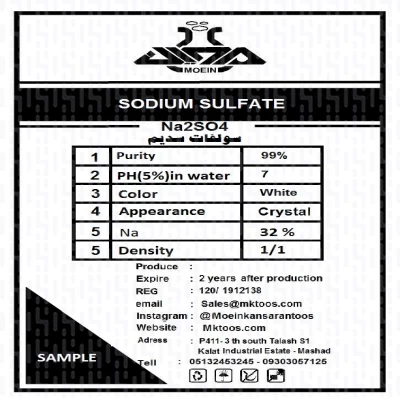
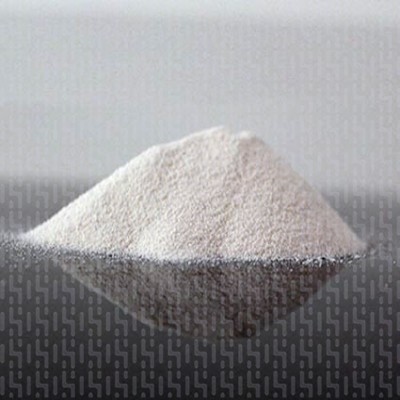
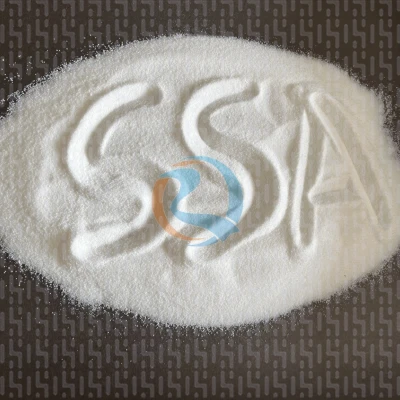
A suitable industrial product is usually a white powder or crystal. Yellowing, dark spots, foreign particles, and major differences in particle size can indicate contamination or process differences. Appearance alone does not prove purity, but incoming inspection should record it.
Solubility of Sodium Sulfate in Water and the Effect of Temperature
Sodium sulfate solubility depends on temperature and hydrate form. In processes where rapid solution preparation is required, particle size, agitation, water temperature, and impurities affect dissolution time. Two suppliers should be compared using a consistent dissolution method.
Bulk Density of Sodium Sulfate and Its Effect on Transport
Bulk density changes with particle size and crystal shape. This parameter affects bag volume, silo capacity, and volumetric-feeder performance. In jumbo-bag purchasing, bulk density relates to the actual bag volume and the possibility of safe filling.
Moisture and Caking of Sodium Sulfate in Storage
Sodium sulfate is hygroscopic. Moisture ingress, day-night temperature differences, and contact with a damp floor or wall can cause caking. Caking is not merely a visual problem; it affects unloading, conveying, weighing, and uniform mixing.
The table below summarizes several physical and chemical properties for quick reading. The same information has already been explained in the text above so that the page does not depend on the table.
| Sodium Sulfate Property | Typical Value or Condition | Effect on Industrial Purchasing | Source or Control |
|---|---|---|---|
| Formula | Na2SO4 | Material Identity Verification | PubChem and COA |
| CAS | 7757-82-6 | SDS and Document Verification | PubChem and ECHA |
| Molar Mass | 142.04 g/mol | Process Calculations | PubChem |
| Appearance | White Solid, Powder or Crystal | Incoming Inspection | ICSC and Sample |
| Melting Point | About 884°C | Thermal Behavior | ICSC |
| Relative Density | About 2.7 | Storage and Volumetric-Mass Calculation | ICSC |
| Solubility in Water | High | Solution Preparation and Textiles | ICSC and Internal Testing |
| Moisture Behavior | Hygroscopic | Packaging and Caking | ICSC and Warehouse |
Technical Specifications Table for 99% and 99.5% Sodium Sulfate for Purchase Contracts
A sodium sulfate purchasing Spec should be derived from the end use. For detergents, purity, moisture, chloride, and powder flow are relevant. For glass, iron and particle size become more important. For export, batch consistency and packaging should be specified in addition to the analysis.
Nornickel publishes an example 99.6% product with sample values for alkalinity, Ca and Mg, iron, zinc, chloride, loss on ignition, insoluble matter, and moisture. This table should not be copied directly as the Spec for every supplier, but it is very useful for building a purchasing checklist.

Na2SO4 Purity in Sodium Sulfate Technical Specifications
Purity should be reported with a specified test method. The figure 99.5 without a measurement method and tolerance is not contractually reliable. For monthly orders, it is better to define minimum purity rather than only a typical value.
Iron and Chloride in Sodium Sulfate Technical Specifications
Iron is important for low-color glass, and chloride should be limited in some processes. If the product is used in corrosion-sensitive equipment or a special formulation, the chloride limit should be defined according to the buyer's actual requirements.
Insoluble Matter and Moisture in Sodium Sulfate Specifications
Insoluble matter can create problems in solution preparation, filters, and product surfaces. High moisture reduces the weight of effective material and increases caking. Both parameters should be controllable in the incoming sample.
The figures in the table below are purchasing guidance. The “contract recommendation” column does not mean a mandatory standard and must be approved for your production line.
| Sodium Sulfate Parameter | Market Example or Typical Limit | Industrial Importance | Contract Recommendation |
|---|---|---|---|
| Na2SO4 | 99 to 99.6% in High-Purity Grades | Main Material | Specify Minimum Purity |
| Iron Fe | From Low ppm to the Contractual Limit | Glass Color and Impurity | Define a Strict Limit for Glass |
| Chloride | Depends on Source and Process | Corrosion and Formulation | Specify the Maximum Allowable Limit |
| Ca + Mg | Low Level in Refined Grade | Precipitation and Purity | Control in Sensitive Applications |
| Moisture | Low in Anhydrous Grade | Caking and Effective Material | Specify Maximum Moisture |
| Insoluble Matter | Low | Filter and Sediment | Specify the Maximum Allowable Limit |
| pH of 5% Solution | 5 to 8 Reported for the Iranian Standard Example | Process Control | Use a Consistent Test Method |
| Particle Size | Based on Application | Flow, Fines, and Glass | Define Sieve and Passing Percentage |
The best Spec is not the shortest Spec. Include only the parameters that actually affect your product, but for those parameters specify the value, test method, and tolerance.
Technical COA Analysis of Sodium Sulfate; Purity, Iron, Chloride, and Moisture
The COA must relate to the same batch that is delivered. A general product data sheet or TDS is useful for understanding the grade, but it does not replace the batch COA. The batch number on the bag, jumbo bag, or bill of lading must match the number on the test document.
For industrial purchasing, purity is not the only parameter. On its official product page, Nornickel reports Na2SO4, alkalinity as Na2CO3 equivalent, Ca and Mg, Fe, Zn, chloride, Loss on Ignition, insoluble matter, and moisture.
The Garmsar laboratory of Iran Salts Mining Company also includes purity, acidity or alkalinity, chloride, and pH in its test form.

Nornickel publishes a typical purity of 99.6% for its sodium sulfate, together with chloride, iron, moisture, insoluble matter, and loss-on-ignition parameters.
Sodium sulfate, Nornickel
Interpreting Purity in a Sodium Sulfate COA
If the COA only states “Purity 99.5%” but the composition of the remainder is not specified, the technical department has an incomplete picture. It is better for the main impurity parameters to be reported separately. A change in the impurity pattern can alter process behavior even when purity remains constant.
Interpreting Iron in a Glass-Grade Sodium Sulfate COA
For glass, lower iron is more valuable. In purchasing, the unit of measurement, ppm or percent, the test method, and the detection limit should be specified. Reporting “Trace” without a number is not sufficient for a contract.
Interpreting Moisture in an Anhydrous Sodium Sulfate COA
The term “anhydrous” does not mean absolutely zero moisture in the shipment. An industrial sample may contain surface or absorbed moisture. The moisture limit should be aligned with the packaging and warehouse conditions.
Sampling Sodium Sulfate to Verify the COA
One bag among hundreds does not represent the entire shipment. Primary samples should be taken from several pallet locations or several jumbo bags, then combined into a composite sample and divided into test, retention, and dispute samples. If multiple batch numbers are present, each batch should be checked separately.
Types of Sodium Sulfate; Anhydrous, Decahydrate, Heavy, and Light Sodium Sulfate
Sodium sulfate classification is not based only on purity. Hydrated or anhydrous form, natural or synthetic source, bulk density, particle size, and application type are also important. The market terms “heavy” and “light” usually refer to differences in structure and bulk density and should be confirmed by actual numerical values.

Anhydrous Sodium Sulfate for Detergents and Glass
The anhydrous form is preferred in many industrial applications because it provides more active material per kilogram and better dry behavior. High-purity, low-moisture grades are widely used in glass and detergents.
Sodium Sulfate Decahydrate or Glauber's Salt
Glauber's Salt contains ten molecules of water of crystallization. This form is seen in certain laboratory, thermal, or historical applications. For industrial purchasing, the weight of crystallization water and conversion to anhydrous Na2SO4 must be included in calculations.
Natural Sodium Sulfate from Thenardite, Mirabilite, and Glauberite
Natural sources are converted into industrial product after extraction, dissolution, purification, crystallization, and drying. Iran Salts Mining Company names the Garmsar and Miqan deposits and presents final product purity above 99.5%.
Synthetic Sodium Sulfate and By-Product from Chemical Processes
Sodium sulfate can be a by-product of certain chemical or metallurgical processes. Nornickel describes it as a by-product of electrolytic nickel and cobalt production. The production source affects the impurity profile, so the buyer should review the COA rather than make assumptions based on the production method.
Sodium Sulfate Production Method; Mineral Extraction, Crystallization, and Industrial Sodium Sulfate Production
Natural production starts with evaporite deposits. The extracted mineral material usually does not have sufficient purity for direct sale to sensitive industries. Therefore, dissolution, impurity separation, concentration, crystallization, centrifugation or filtration, drying, and sizing are carried out.
In the synthetic or by-product route, sodium-sulfate-containing solutions are obtained from another process and converted to dry salt after purification and crystallization. The common point between both methods is control of impurities and moisture in the final stage.

Extraction of Sodium Sulfate from the Garmsar and Miqan Mines
Iran Salts Mining Company extracts and processes mineral salts at its Garmsar and Arak complexes. The company's English page refers to feedstock from the Garmab and Miqan mines and concentration to purity above 99.5%.
Dissolution and Purification in Sodium Sulfate Production
The purpose of dissolution is to transfer Na2SO4 into the solution phase and separate insoluble matter. Control of Ca, Mg, chloride, and iron during purification determines whether the final product is suitable for glass or detergents.
Sodium Sulfate Crystallization and Particle-Size Control
Cooling or evaporation rate, supersaturation, seeding, and hydrodynamics affect crystal size. Very fine particles increase dust and fines. Very coarse particles dissolve or mix more slowly. Glass grade requires a controlled particle-size distribution.
Drying and Packaging of Anhydrous Sodium Sulfate
After crystal separation, the product is dried until moisture reaches the contractual range. Contact with humid air after the dryer can remove part of this advantage. Enclosed transfer, silo handling, and bag sealing should be designed to prevent moisture from re-entering the product.
Sodium Sulfate Producers in Iran and Units with a Production Track Record
This section includes only names that state on their official websites that they produce sodium sulfate. Sufficient data were not found to introduce ten independent producers with official documentation, so the list is limited to verifiable names. This approach prevents the page from becoming an advertising list or including unsupported claims.
Iran Salts Mining Company, with its Garmsar and Arak complexes, states sodium sulfate production in its official sources, and Sadr Tamin describes it as the largest sodium sulfate producer in Iran.
Noavaran Shimi Saveh also has a sodium sulfate line and states capacity of nearly 13,000 tons per year on its English page. Shahab Shimi Saveh also lists sodium sulfate among its products and explains the group's daily production capacity, but it does not separately state dedicated sodium sulfate capacity.

Sodium Sulfate Production by Iran Salts Mining Company in Garmsar and Arak
On the company's official page, the Garmsar plant reports current capacity of about 59,000 tons per year for that unit. Industrial grade with a minimum purity of 99.5% is introduced for detergents and glass. The company has two sodium sulfate production complexes in Garmsar and Arak, and parent-company information also reports a higher practical production capacity for the group.
Sodium Sulfate Production by Noavaran Shimi Saveh
Noavaran Shimi Saveh presents its sodium sulfate production line alongside calcium chloride and hydrochloric acid. The company's English page states a sodium sulfate production rate of nearly 13,000 tons per year. The buyer should confirm the current grade, production method, purity, and packaging when requesting a quotation.
Sodium Sulfate Supply by Shahab Shimi Saveh
Shahab Shimi Saveh displays sodium sulfate in its product portfolio and provides information about the group's daily production capability. Because dedicated sodium sulfate capacity is not separated on the public page, the actual capacity for the same grade and delivery schedule should be confirmed in the contract.
The table below is written based on traceable data. The term “producer” is used for each row only on the basis of the official claim by the company itself or its parent holding company.
| Company or Unit Name | Location | Verifiable Information | Purchasing Consideration |
|---|---|---|---|
| Iran Salts Mining Company - Garmsar | Semnan | Minimum purity 99.5%, detergent and glass grades, unit capacity about 59,000 tons | Check the COA and particle size of the same shipment |
| Iran Salts Mining Company - Arak | Markazi Province | Sodium sulfate powder production complex and Miqan mine | Request current capacity and grade |
| Noavaran Shimi Saveh | Saveh | Sodium sulfate line and stated capacity close to 13,000 tons per year | Confirm purity, production method, and packaging |
| Shahab Shimi Saveh | Saveh | Sodium sulfate in the official product portfolio | Confirm dedicated product capacity separately |
A store or trading company name has not been listed as a producer. Factory ownership, operating license, current capacity, and ability to sell directly should be verified before contracting.
Application of Sodium Sulfate in Laundry Powder and Buying Detergent Grade
Sodium sulfate is used in many powdered detergents as a filler and processing aid. In its detergent-ingredient assessment, HERA reports that the concentration of sodium sulfate in household powder products can span a wide range. This variation shows that there is no single general dosage and each product formulation should be the basis.
For a detergent producer, sodium sulfate is not merely “an inexpensive material for increasing weight.” Particle size and moisture affect powder flow, component segregation, bulk density, and storage behavior. In a spray tower, thermal behavior and formulation composition also matter.

HERA assesses sodium sulfate as one of the materials used in household detergents and reports a wide use range in laundry powders and tablets.
Sodium sulfate Human and Environmental Risk Assessment, HERA
Purity of Detergent-Grade Sodium Sulfate
Detergent grade usually requires high purity and controlled impurities. Chloride and iron may not be as restrictive as in glass, but changes in them can indicate a change in source or process. Consistency between batches is important for a fixed formulation.
Moisture of Detergent-Grade Sodium Sulfate and Powder Flow
High moisture increases caking and stickiness. If the factory has automatic feeding, caking can cause bridging in the hopper. In a hot and humid warehouse, multilayer packaging and FIFO rotation become more important.
Particle Size of Sodium Sulfate for a Spray Dryer
Excess fines increase dust and segregation. Very coarse particles can also make uniform mixing more difficult. Particle-size distribution should be aligned with the detergent-powder production method.
Application of Sodium Sulfate in Glassmaking; Buying Low-Iron, Coarse-Particle Sodium Sulfate
In glassmaking, sodium sulfate can act as a melt-finishing agent and help bubbles escape. Its reactions at furnace temperature depend on batch composition, oxidation conditions, and carbonaceous materials. Excessive or unsuitable use can create other problems, so dosage should be adjusted based on the glass formulation.
Glass grade usually requires low iron and controlled particle size. Iran Salts Mining Company states iron below 2 ppm and a minimum control of fines below 50 microns for its glass grade. This figure is an example from one producer and should not be used as a general limit without approval against the factory formulation.

Iron in Sodium Sulfate for Float Glass
Iron is a color-forming impurity. For clear glass, controlling iron at the ppm level is highly important. The sampling and analytical method must be capable of detection at low levels.
Particle Size of Glass-Grade Sodium Sulfate and Fines Control
Excess fines create dust during transport and batch mixing and alter particle segregation. A size distribution close to the other batch materials can make mixing more stable. The sieve used and passing percentage should be written in the Spec.
Sodium Sulfate and Bubble Removal from Molten Glass
The purpose of fining is to help bubbles grow and escape from the melt. Exact behavior depends on temperature and the oxidation environment. Furnace formulation control should be carried out by the glass technologist, and the raw-material supplier should not provide one general dosage for every factory.
Application of Sodium Sulfate in Textiles and Dyeing; Buying Dyeing-Grade Sodium Sulfate
In dyeing, sodium sulfate can be used to increase bath ionic strength and drive dye toward the fibers. In reactive dyeing of cotton, the dye type, liquor ratio, alkali, temperature, and salt-addition program determine how much is required. There is no fixed recipe for all shades.
The textile buyer should pay attention to solubility, purity, and insoluble matter. Insoluble particles can cause problems in nozzles, pumps, or on the fabric surface. Iron and interfering ions can also affect the shade of certain dyes.

Sodium Sulfate in Reactive Dyeing of Cotton
Salt helps absorption by reducing electrostatic repulsion between anionic dye and the fiber surface. Controlled addition is important for uniformity. Rapid addition of a large amount of salt can increase the risk of unevenness.
Glauber's Salt in Dyeing and Its Difference from Anhydrous Sodium Sulfate
If decahydrate Glauber's Salt is used, the amount of active Na2SO4 per kilogram is lower than in the anhydrous form. Mass conversion must be included in the formulation. One-to-one replacement by weight can change the ionic strength of the bath.
Water Quality and Sodium Sulfate in the Dye Bath
Water hardness, metals, and pH, together with the salt, affect dyeing. When the color result changes, do not blame only the sodium sulfate. Water, dye, alkali, and the timing of addition should be reviewed simultaneously.
Application of Sodium Sulfate in Papermaking and the Kraft Process
In the kraft process, sodium sulfate is known as one of the makeup chemicals used to compensate for sodium and sulfur in the chemical cycle. In the recovery furnace, sulfate compounds are converted to sulfide under reducing conditions and support part of the white-liquor cycle.
Actual consumption depends on the plant's sodium and sulfur balance. In a 2024 article, TAPPI reviewed different makeup options, including sodium sulfate, in a kraft mill. This shows that material selection is not based only on purchase price; sulfur balance, cost, and recovery-unit conditions must also be considered.

In its review of sulfur makeup for a kraft mill, TAPPI Journal compares sodium sulfate alongside several other sources as an option for supplying sodium and sulfur.
Sulfur makeup in an unbleached kraft pulp mill, TAPPI Journal, 2024
Sodium Sulfate in the Kraft Paper Recovery Cycle
The material enters the chemical cycle, and its performance is related to sulfidity and ion balance. The process unit should determine quality and quantity based on the mass balance.
Buying Sodium Sulfate for a Pulp Mill
For continuous supply, consistency of analysis and the transport schedule are important. If the factory has a silo, particle size and powder flow should also be compatible with the conveying system. A supply interruption can be more costly than a small price difference.
Application of Sodium Sulfate in Sodium Sulfide Production and Buying Na2SO4 Feedstock
One industrial route for producing sodium sulfide is the high-temperature reduction of sodium sulfate with carbon. In this process, feedstock purity, ash, moisture, and mineral impurities affect the product and energy consumption. In its history, Tehran Sulfur Chemical Industries refers to the use of a combination of sodium sulfate and coal in the old method of sodium sulfide production.
For this application, buying sodium sulfate based only on whiteness or detergent grade is not logical. The buyer should review impurities that remain in the furnace or transfer into the sulfide product.

Purity of Sodium Sulfate for Sodium Sulfide Production
Higher purity increases the main material, but economic suitability depends on price, energy, and final-product quality. Insoluble matter and ash can increase slag or waste.
Moisture of Sodium Sulfate for the Reduction Furnace
Moisture must be evaporated before the reaction and creates a thermal load. In tonnage purchases for a furnace, moisture directly affects energy consumption in addition to the effective material.
Sodium Sulfate Safety and SDS Notes for Handling and Use
According to the international ICSC card, sodium sulfate is not flammable. However, dust can reach irritating concentrations in air. Ventilation, prevention of dust generation, goggles, and gloves are recommended during handling. In a surrounding fire, the material can decompose under severe heat and produce sulfur and sodium oxides.
Sodium sulfate is not a highly hazardous material like acids or strong oxidizers, but this does not permit carelessness. Actual industrial risks include dust, slipping from spilled powder, manual bag handling, and eye contact.

ICSC 0952 identifies sodium sulfate as nonflammable and recommends ventilation, gloves, and safety goggles to control exposure to particles.
Sodium Sulfate ICSC 0952, ILO/WHO
Sodium Sulfate Dust and Respiratory Protection
Slow bag emptying, local exhaust ventilation, and industrial housekeeping prevent dust dispersion. For high exposure, a particulate respirator appropriate to the workplace risk assessment should be selected. Compressed air is not suitable for cleaning clothing or floors.
Eye and Skin Contact with Sodium Sulfate
Safety goggles reduce the chance of powder entering the eyes. In case of eye contact, rinse with water and follow the SDS instructions for the same product. Gloves are useful for preventing prolonged contact and skin dryness.
Fire and Sodium Sulfate
Sodium sulfate itself does not burn, but polymer packaging and wooden pallets can burn. The fire-extinguishing system should be designed for the surrounding materials. In a major fire, smoke from thermal decomposition should also be considered.
Do not apply one supplier's SDS to another supplier's shipment. Anti-caking additives, impurities, or packaging type can change handling and storage recommendations.
Sodium Sulfate Packaging; 25 kg and 50 kg Bags and Jumbo Bags
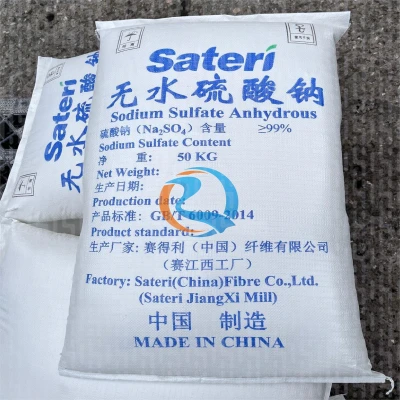
Industrial sodium sulfate is supplied in 25 or 50 kg bags and, for large orders, in jumbo bags. Nornickel states big bags of up to 1,300 kg for its product. Iran Salts Mining Company also offers a 50 kg product. Packaging type should be compatible with the unloading system, warehouse, and transport route.
A good bag is not merely clean in appearance. The inner liner, stitching, moisture resistance, label, and batch number should be acceptable. A jumbo bag also requires a suitable SWL, loop type, liner, and discharge arrangement.

25 kg Sodium Sulfate Bags for Industrial Consumption
A 25 kg bag is easier to handle manually, but it increases the number of packages and unloading time. For a production line with low daily feed consumption, this option makes inventory control easier.
50 kg Sodium Sulfate Bags for Wholesale Orders
A 50 kg bag reduces the number of packages, but manual-handling ergonomics are more difficult. Using pallets and a forklift is safer. The integrity of the inner liner is important for preventing moisture ingress.
Sodium Sulfate Jumbo Bags for Tonnage Purchasing
Jumbo bags improve the speed of loading and unloading high tonnage. The buyer should specify actual capacity, SWL, liner, discharge outlet, and the ability to connect to the hopper.
The table below compares common packaging forms, and the same information has already been explained in the text above.
| Sodium Sulfate Packaging | Typical Weight Range | Application | Delivery Control |
|---|---|---|---|
| Small Bag | 25 kg | Industrial Use with Manual Unloading | Weight, Stitching, Liner, Batch |
| Industrial Bag | 50 kg | Detergent, Glass, and Bulk Consumption | Pallet, Moisture, and Bag Integrity |
| Jumbo Bag | About 1,000 to 1,300 kg Depending on Supplier | Tonnage Purchasing and Silos | SWL, Loops, Liner, and Outlet |
| Shrink-Wrapped Pallet | Several Dozen Bags per Pallet | Export and Organized Transport | Count, Straps, Hood, and Pallet |
How to Store Sodium Sulfate in a Warehouse and Prevent Caking
A sodium sulfate warehouse should be dry, covered, and properly ventilated. Bags should not be placed directly on the floor. Clearance from damp walls and the use of pallets reduce the likelihood of moisture absorption. Opened product should be resealed.
Caking is usually not the result of one factor alone. Air humidity, warehouse temperature, pressure from excessive stacking, residence time, and temperature fluctuations act together. If caking repeats in every shipment, do not blame only the bag. Also review the warehouse, transport, and incoming product moisture.

Moisture Control in a Sodium Sulfate Warehouse
High relative humidity accelerates water absorption. In humid climates or sea containers, a resistant hood and condensation management are important. Container desiccant bags can reduce part of the risk but do not replace suitable packaging.
Stacking Sodium Sulfate Bags on Pallets
The pallet should be sound and dry. Stacking height should be determined based on bag strength and warehouse safety. Excessive pressure can deform lower bags and intensify caking.
FIFO and Sodium Sulfate Batch Traceability
First in, first out controls storage time. Each pallet should have a clear batch number and receipt date. This enables rapid traceability in the event of a quality complaint.
Comparison of Global Sodium Sulfate Producers and Foreign Grades
The global sodium sulfate market combines natural production and by-product material. For an Iranian buyer, a foreign brand name has value when the grade, production location, COA, packaging, and import availability are clear. A 99.6% product from Russia does not necessarily have the same impurity profile as a natural product from Turkey or China.
Nornickel is a clear example of published specifications and presents a 99.6% product in big bags up to 1,300 kg. Natural sodium sulfate production also exists in the Turkish market. When comparing foreign brands, the focus should be on the Spec and shipment consistency, not on brand reputation.

Nornickel Sodium Sulfate from Russia
Nornickel's official page publishes chemical composition, packaging, and applications. This level of transparency is useful for initial comparison, but a COA for the same batch is still required.
Natural Sodium Sulfate from Turkey and China
Turkey and China participate in the global sodium sulfate supply chain. Mineral source and refining process affect density, particle size, and impurities. The buyer should review the sample and documents rather than make assumptions based on country of origin.
Comparison of Iranian and Foreign Sodium Sulfate
Advantages of Iranian product can include shorter transport time, easier sampling, and reduced currency risk. Foreign product may offer a special grade or packaging. The decision should be based on delivered cost, quality, supply time, and supply risk.
Sodium Sulfate Export and Import; HS Code, COA, and Delivery Terms
For Disodium sulphate, the common six-digit HS code is 283311. However, in one classification decision, the WCO showed that some natural products processed by a specific method may fall under a different Heading. Therefore, the final code should be confirmed with a customs broker based on the product's nature and production method.
For exports, a commercial invoice, Packing List, COA, SDS, certificate of origin, and packaging specifications are required. For glass orders, iron and particle size should be written into the export contract. For detergents, moisture and flowability become important during long-distance transport.

Under HS 2022, the WCO lists subheading 2833.11 for Disodium sulphate. Final product classification should be confirmed based on the actual shipment specifications.
WCO Harmonized System 2022, 2833.11
Sodium Sulfate HS Code and Code 283311
Code 283311 is widely used for disodium sulfate, but every declaration should be matched to the destination country's rules and the precise product description. Raw natural form and processed chemical product may have different classifications.
FOB, CFR, and CIF Prices for Export Sodium Sulfate
FOB price covers costs up to the port delivery point. CFR also adds ocean freight, and CIF includes insurance as well. Pallet cost, inspection, THC, demurrage, and documentation should be clarified separately.
Exporting Sodium Sulfate to Iraq, Turkey, Azerbaijan, and Pakistan
Each market has different packaging, transport-route, and standard requirements. For land destinations, bag and pallet resistance during truck loading is important. For sea containers, condensation and transit time become more important. Trade statistics should be reviewed for a specific period and country, not treated as a fixed number on the page.
Industrial Sodium Sulfate Purchasing Guide and Wholesale Order Checklist
The purchasing guide consists of three stages: defining the Spec, approving the supplier, and controlling delivery. The technical department should write the specifications. Purchasing should compare offers on the same basis. The warehouse and laboratory should also inspect the incoming shipment according to the contract.
The phrase “similar to the sample” is not sufficient for a multi-month order. The sample must be converted into numerical criteria. Purity, iron, chloride, moisture, insoluble matter, pH, and particle size should be specified when relevant. A retention sample should be kept for later disputes.
Defining the Sodium Sulfate Purchasing Spec
State the application, minimum Na2SO4, maximum Fe, chloride, moisture, insoluble matter, particle size, and packaging. Link each parameter to a test method. If a parameter is not important for your production line, adding an unnecessary number only makes purchasing harder.
Approving a Sodium Sulfate Sample Before a Tonnage Contract
Test the sample in the actual process. In detergents, record mixing behavior and powder flow. In glass, evaluate batch performance and defects. In textiles, assess dissolution speed and effect on shade.
Sodium Sulfate Delivery Control at Destination
Check the seal, weight, number of bags, batch number, pallet integrity, and visible moisture. Retain a sample from each batch. If the load is bulk or in jumbo bags, sample from several points.
The checklist table below is designed for the purchasing department. All items have already been explained in the preceding paragraphs.
| Sodium Sulfate Purchasing Stage | Required Information | Document | Risk of Omission |
|---|---|---|---|
| Define the Application | Detergent, Glass, Textile, Paper, or Chemical | Purchase Request Form | Selecting the Wrong Grade |
| Define Quality | Purity, Fe, Cl, Moisture, Insolubles, Particle Size | Purchasing Spec | Quality Dispute |
| Approve the Sample | Production-Line Test | Trial Report and Retention Sample | Waste After Purchase |
| Approve the Supplier | Identity, Factory, Capacity, Warehouse | Documents and Site Visit | Failure to Deliver |
| Commercial Agreement | Price, Tax, Freight, Payment | Pro Forma Invoice and Contract | Hidden Cost |
| Destination Control | Weight, Batch, COA, Seal, Sample | Receipt and QC Report | Acceptance of Nonconforming Load |
Today's Sodium Sulfate Price and Factors Affecting the Price per Ton of Sodium Sulfate
The price of sodium sulfate depends on purity, production source, iron and chloride, particle size, moisture, packaging, order volume, loading location, freight, and payment terms. The current rate should not be recorded as a fixed figure in landing-page text without a date and delivery terms because market prices change.
In tonnage orders, the difference in freight can sometimes be more important than the difference in ex-works price. The buyer should compare the delivered price at destination. A jumbo bag may reduce packaging cost per ton, but if the factory does not have suitable unloading capability, the advantage disappears.
Effect of Purity on the Price of 99.5% Sodium Sulfate
More refining to reduce iron, chloride, and insoluble matter costs more. Low-iron glass grade is usually not priced the same as general grade. The purity number should be considered together with other impurities.
Effect of Packaging on Sodium Sulfate Price
A 25 kg bag involves more packaging and handling cost than a jumbo bag. Export pallets, hoods, labels, and straps also have separate costs. The price should specify whether packaging is included in the rate or calculated separately.
Effect of Freight on the Price of Tonnage Sodium Sulfate
High weight and relatively low material value mean that freight can account for a large share of the delivered price. Distance from the mine or plant to the consumer, truck type, return-load availability, and loading cost affect the rate.
Effect of Exchange Rate on the Price of Imported Sodium Sulfate
For imported product, exchange rate, international freight, tariff, port costs, and working capital affect the price. Domestic product has less of this risk, but energy and domestic transport costs are still important.
Compare the price per ton only after aligning purity, particle size, packaging, delivery location, and payment terms. A low price for a grade whose iron or moisture is outside the Spec is not an economical purchase.
| Sodium Sulfate Price Factor | Typical Effect | Comparison Method |
|---|---|---|
| Purity and Impurities | High-purity or low-iron grades cost more | Compare COAs at the same level |
| Particle Size | Glass grade or custom grade may differ | Use the same sieve method |
| Packaging | 25 kg, 50 kg, or Jumbo Bag | Separate the net material price from packaging |
| Tonnage | Higher volume can change the rate | Use the same MOQ and delivery schedule |
| Freight | Distance to destination has a large effect | Compare delivered price |
| Payment | Cash, Credit, or Foreign Currency | Include financing cost |
Why Is Buying Sodium Sulfate Through SHIMICO Suitable for Comparing Suppliers?
SHIMICO is a B2B platform for posting purchase requirements and sales listings for chemicals. A sodium sulfate buyer can specify the grade, purity, application, packaging, quantity, and destination in the request and compare offers on a more consistent basis.
SHIMICO does not replace the laboratory or the contract. The platform's role is to create a communication and comparison channel. Producer verification, sample approval, COA, transport conditions, and quality commitments must be reviewed in the transaction.
Submit a Sodium Sulfate Purchase Inquiry on SHIMICO
In an inquiry, the phrase “99.5% sodium sulfate, detergent grade, 50 kg bags, 100 tons, delivery to Tehran” is much more precise than “sodium sulfate price.” For glass, add iron and particle size as well.
Post a Sodium Sulfate Sales Listing on SHIMICO
The seller should state the producer name, purity, COA, packaging type, loading location, inventory, and minimum order. A technical listing shortens negotiations and reduces irrelevant inquiries.
Request Wholesale Sodium Sulfate Buying and Selling Quotes on SHIMICO
Enter purity, application, order quantity, packaging, and delivery city, and compare supplier offers based on the same specifications.
View Chemical ProductsPost a Free Chemical ListingReviews from Sodium Sulfate Buyers on SHIMICO
Purity, moisture, packaging, and delivery terms were recorded in the inquiry, and the offers were compared against the same specifications.
Publication Evidence: Invoice and Approved OrderIron, fines, and particle size were specified before ordering, and the sample was matched to the COA for the same batch.
Publication Evidence: QC Report and Permission to PublishBag type, loading location, number of pallets, and delivery schedule were specified before the contract.
Publication Evidence: Delivery Receipt and Batch NumberCOA, SDS, certificate of origin, pallet, and export label were written into the pro forma invoice.
Publication Evidence: Export Documents and Buyer PermissionFrequently Asked Questions About Buying Sodium Sulfate
What Is Sodium Sulfate and What Is It Used For?
What Is the Difference Between “Sulfate Sodium” and “Sodium Sulfate”?
What Is the Difference Between Anhydrous and Decahydrate Sodium Sulfate?
What Is Glauber's Salt?
What Is Thenardite?
What Is Mirabilite?
Which Industries Is 99.5% Sodium Sulfate Suitable For?
What Is the Best Sodium Sulfate for Glass?
What Is the Best Sodium Sulfate for Detergents?
Which Parameters Are Included in a Sodium Sulfate COA?
Why Does Sodium Sulfate Cake?
How Should Sodium Sulfate Be Stored?
Is Sodium Sulfate Flammable?
Does Sodium Sulfate Dissolve in Water?
Is Sodium Sulfate Acidic or Basic?
What Is the Difference Between Sodium Sulfate and Sodium Sulfite?
What Is the Difference Between Sodium Sulfate and Sodium Metabisulfite?
What Factors Affect the Price of Sodium Sulfate?
What Is the HS Code for Sodium Sulfate?
What Is the Minimum Order for Sodium Sulfate?
How Can Genuine Sodium Sulfate Be Identified?
Is Iranian or Chinese Sodium Sulfate Better?
Which Parameters Are Important When Buying Sodium Sulfate for Glass?
Which Parameters Are Important When Buying Sodium Sulfate for Detergents?
How Can Sodium Sulfate Be Purchased Through SHIMICO?
Scientific and Industrial Sources for Sodium Sulfate
| Title | Publisher | Date | Link |
|---|---|---|---|
| Sodium Sulfate | PubChem / U.S. National Library of Medicine | Page Updated in 2026 | View Source |
| Substance Information: Sodium sulphate | ECHA | Current Page | View Source |
| Sodium Sulfate ICSC 0952 | ILO / WHO | October 2005 | View Source |
| Human and Environmental Risk Assessment on Sodium sulfate | HERA / Cefic | January 2006 | View Source |
| Sodium sulfate product specification | Nornickel | Current Page | View Source |
| HS 2833.11 Disodium sulphate | World Customs Organization | HS 2022 | View Source |
| Sodium Sulphate | Iran Salts Mining Company | Current Page | View Source |
| Production units | Iran Salts Mining Company | Current Page | View Source |
| Sodium Sulphate production | Noavaran Shimi Saveh | Current Page | View Source |
| Sulfur makeup in an unbleached kraft pulp mill | TAPPI Journal | August 2024 | View Source |